
Li Qiu: Why the First Day of Autumn Makes the Chinese Reach for Pears
When Autumn Begins in the Middle of Summer
Before we get to the pears, let’s clear something up. The 24 Solar Terms aren't folklore. They are a brilliant agricultural and wellness calendar based on astronomy. Ancient Chinese astronomers divided the sun's 360-degree path into 24 equal 15-degree segments. Each time the sun enters a new segment, a new “solar term” begins. This system was vital for farmers. It told them when to plant, when to transplant, and when to harvest, all based on predictable changes in daylight, solar radiation, and the corresponding effects on the natural world. It’s so accurate that it was named a UNESCO Intangible Cultural Heritage of Humanity. So, Li Qiu doesn’t mean you should break out your sweaters. It means the peak of Yang energy, the explosive, expansive force of summer, has passed. From this day forward, Yin energy—which is cooling, contracting, and storing—will slowly begin to rise. You can feel it if you pay close attention. The light in the late afternoon has a slightly different, more golden quality. The mornings might have a hint of something new in the air, a whisper of coolness that wasn’t there last week. Our little screech owl mascot, Ollie, who’s been dozing in the shadiest part of an old oak tree, just blinked one eye open. He feels it, too. It’s the universe turning a page.The Season of Metal and the Delicate Lungs
In the Five Element framework of TCM, autumn belongs to the Metal element. The organs associated with Metal are the Lungs and their partner, the Large Intestine. The climate of autumn is “dryness,” and the emotion is grief or sadness. The Lungs are considered the most delicate organ, the “tender organ.” They are the first line of defense against external environmental factors because they directly interface with the outside world through every breath you take. They also govern the skin, which is our body’s outer barrier. As the air begins to lose its summer humidity, a pathogenic influence called “Autumn Dryness” (*qiū zào*, 秋燥) can creep in. This isn’t just about feeling thirsty. This dryness can consume the body’s precious fluids, especially those that protect the Lungs. The first signs are often subtle: a dry throat in the morning, a tickly cough, chapped lips, or skin that feels tight and itchy. In early autumn, this dryness often combines with lingering summer heat—what TCM calls “Warm Dryness” (*wēn zào*, 温燥). Later in the season, as temperatures drop, “Cool Dryness” (*liáng zào*, 凉燥) becomes more common, requiring warming and moistening strategies rather than cooling ones. The pear-and-white-fungus approach is ideal for the warm-dry phase we are in right now. If left unchecked, dryness can make the body more vulnerable to colds and flu as the weather gets colder. The ancient medical text, the *Huangdi Neijing* (Yellow Emperor's Inner Canon), describes the energy of autumn as *Róng Píng* (容平). This means to gather, to contain, to bring things to a state of peaceful balance. After the wild growth of summer, nature now begins to draw its energy inward and down, consolidating its resources for the winter ahead. Our bodies are meant to do the same. Ollie's Take
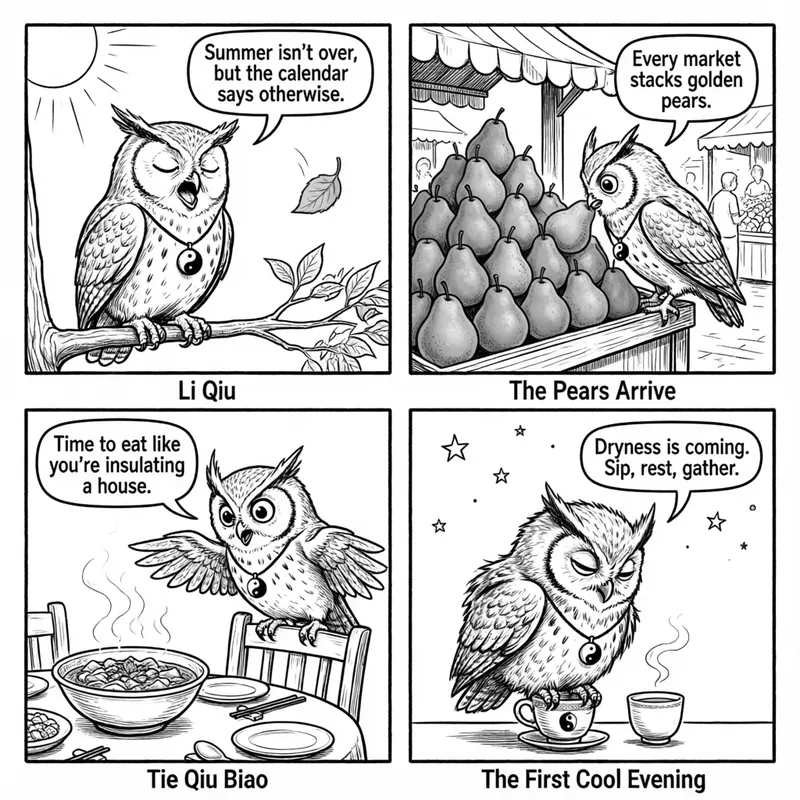
Ollie's take: Hoo-hoo! The first leaf just fell, and nobody in my forest panicked. The trees are already sending their energy down to the roots, and the market pears are stacked higher than my favorite perch. Summer isn't over, but the wise ones are already getting ready. Watch what the trees do in August — they don't fight the season, they lean into it. Grab a pear, find a shady spot, and practice doing less on purpose. Autumn is coming, and that's a good thing.
Fighting Dryness with… Pears? The Logic of Autumn Eating
This is where the pears come in. If the primary challenge of autumn is dryness that targets the Lungs, the strategy is to moisten the Lungs with nourishing foods. In Chinese food therapy, certain foods are prized not for their vitamins or minerals, but for their energetic temperature, flavor, and the organ systems they target. For autumn, the holy trinity of moistening foods is pears, lily bulbs, and white fungus. Pears (梨, lí): The undisputed king of autumn foods. Asian pears are especially valued. They are cooling, sweet, and directly enter the Lung and Stomach channels. They help generate fluids, moisten dryness, and transform phlegm. You’ll see them everywhere in China starting in August. I remember visiting markets in early fall and seeing pyramids of golden-brown pears, with shoppers carefully selecting the best ones, knowing they were buying medicine that just happened to be delicious. Lily Bulb (百合, bǎi hé): The edible bulb of the lily flower is a TCM herb and a delicate food. It has a slightly sweet, slightly bitter taste and a cooling nature. *Bai he* is famous for moistening the Lungs, stopping coughs, and calming the spirit (*Shen*). Its gentle nature helps soothe the anxiety or sadness that can sometimes surface in the autumn. White Fungus (银耳, yín ěr): Also known as snow fungus or tremella, this beautiful, gelatinous fungus is a superstar for nourishing Yin. It’s neutral in temperature and sweet, making it suitable for almost everyone. It’s particularly good at lubricating the Lungs and nourishing Stomach Yin. A simple soup of pear, white fungus, and a few dates, gently simmered, is the classic Chinese remedy for a dry autumn cough. These foods aren’t “superfoods” in the Western sense. They are simply the right tool for the job. You are meeting the season’s specific challenge—dryness—with the specific solution nature provides: moistening foods. It’s an elegant, intuitive system.Ollie ruffles his ear tufts and adjusts the small yin-yang pendant hanging from his neck, squinting at the sky. "The first leaf just fell," he hoots softly. "It didn't make a big fuss. It just let go. The trees don't panic in September. They know it's time to gather their energy and send it down to the roots. They're not losing; they're storing. Honestly, I've been doing this my whole life without even thinking about it—us owls just know when it's time to fluff up and hunker down. Maybe that's the trick: don't overthink it."
The "Fattening" Ritual Explained
Now, let’s go back to that counter-intuitive tradition of *tiē qiū biāo*—pasting on autumn fat. Why eat meat on a hot day? Summer is a season of high activity and heat. To stay comfortable, we naturally eat lighter, more cooling foods like salads, fruits, and watermelon. This is appropriate for the season, but it can also be depleting. In TCM, this is called “bitter summer” (*kǔ xià*, 苦夏), where the heat and humidity can lead to a loss of appetite and a drain on the body’s Qi and fluids. Li Qiu is the signal that this phase is over. It’s time to start replenishing what was lost. Eating a hearty, nourishing meal of meat is a way to fortify the Spleen and Stomach, rebuild Qi and Blood, and prepare the body for the coming cold. It’s a deliberate act of fortification. You’re not trying to gain weight in an unhealthy way. You are mindfully giving your body the substantial resources it needs to build a strong defense system (*Wei Qi*) before the cold and flu season arrives. It’s proactive wellness, disguised as a family feast. Ollie, who has just spotted a particularly plump beetle, clicks his beak and fluffs his chest feathers in solemn agreement. Replenishing stores is serious business.Beyond the Dinner Table: Autumn Habits for Body and Mind
Syncing with the season goes beyond what’s on your plate. As the energy of the world begins to contract and draw inward, your own habits can reflect this shift. Adjust Your Sleep: The *Su Wen* (Chapter 2 of the *Neijing*) advises "going to bed early and rising early" in the autumn, mirroring the chickens. As the days shorten, align your sleep schedule with the natural light. This helps the body conserve its Yin and Qi. Shift Your Movement: The intense, sweaty cardio of summer can give way to more gentle, internal forms of exercise. Think yoga, Tai Chi, Qigong, or long walks in nature. The goal is to move the Qi without scattering it, to stretch and breathe deeply without creating exhaustion. Start with Warmth: A cup of warm water, perhaps with a small drop of honey, is a wonderful way to start an autumn morning. It gently wakes up your digestive system and provides a bit of moisture to a throat that might be dry from the night air. Pay Attention to Your Skin: Your skin is the outer expression of your Lung health. If you notice it becoming dry, flaky, or itchy, see it as a message from your Lungs. In addition to eating moistening foods, consider using simple, natural moisturizers like jojoba or almond oil. Embrace the Emotion of Autumn: The Metal element’s emotion is grief or sadness. This isn’t something to be afraid of. Autumn is the natural time for letting go, just as trees let go of their leaves. It’s a powerful season for introspection, for clearing out old emotional baggage, and for appreciating the beauty in release. So as you go about your day, even if it’s hot and sticky, take a moment. Notice the light. Feel the air. Maybe grab a pear for a snack. You’re not just eating a piece of fruit; you’re participating in a conversation with the season, a tradition of wellness that has stood the test of time. You’re getting ready.FAQ
Is it really a good idea to eat heavy meat dishes on a hot day for "tie qiu biao"?
From a modern Western perspective, it can seem strange. But in the TCM framework, it’s about timing and purpose. The summer season, with its heat and humidity, often leads to a poor appetite and reliance on lighter, cooling foods. This can deplete the body's reserves of Qi and Blood. Li Qiu marks the energetic turning point. The "autumn fattening" ritual is a conscious decision to begin replenishing those stores before the cold weather arrives. It's a single, symbolic meal meant to fortify the digestive system and signal a shift from dispersing heat to building resources for the demanding winter ahead.
Do all types of pears work for moistening the Lungs? Should I eat them raw or cooked?
While most pears offer some benefit, Asian pears (like the round, golden-brown varieties) are especially prized in Chinese food therapy for their potent Lung-moistening properties. As for how to eat them, both raw and cooked are good, but they serve slightly different functions. Eating a raw pear is excellent for clearing heat and providing immediate fluid, much like on a hot day. However, for a deeper, more therapeutic effect on Lung dryness and coughs, cooked pears are superior. Steaming or simmering them in soups makes them easier to digest and enhances their ability to nourish Yin, making them a gentler and more powerful remedy.
Why is autumn associated with sadness or grief in Chinese medicine?
In Five Element theory, each season is linked to an organ system and a corresponding emotion. Autumn is the season of the Metal element, which governs the Lungs. The emotion of the Lungs is grief or sadness. This isn't seen as a negative thing, but as a natural part of the cycle. Autumn is a time when nature lets go—leaves fall, plants wither, and energy draws inward. This process of release and retraction can resonate with our own feelings of loss or nostalgia. It’s a season that encourages introspection and clearing out what no longer serves us, which can sometimes bring up feelings of sadness.
Sources
- Maoshing Ni. (1995). *The Yellow Emperor's Classic of Medicine: A New Translation of the Neijing Suwen with Commentary*. Shambhala Publications. (Specifically Chapter 2: "On Preserving Health in Accordance with the Four Seasons")
- China Meteorological Administration. "The Twenty-four Solar Terms." cma.gov.cn.
- Liao, Xiangjun. (2016). *Traditional Chinese Festivals*. China International Press.
- Lu, Henry C. (2005). *Chinese Natural Cures: Traditional Methods for Remedy and Prevention*. Black Dog & Leventhal Publishers.