
When Food Stops Being Food — Understanding the Taiyin Stage
You know the feeling. You sit down to a meal, maybe even a "healthy" one, and an hour later, it's still just… sitting there. A heavy, uncomfortable lump in your stomach. You're bloated, tired, and the last thing you want to think about is your next meal. You might not even be hungry in the first place.
For many of us, this isn't a one-off bad dinner. It's a chronic state of being. Food, which should be the very source of our energy and vitality, starts to feel like a burden. Instead of nourishing you, eating exhausts you.
If this sounds familiar, you might be getting a glimpse into what Traditional Chinese Medicine calls the Taiyin stage. This isn't just a sluggish metabolism; the entire digestive engine is grinding to a halt.
The Kitchen Is Closed: What Is the Taiyin Stage?
In our ongoing exploration of the Shanghan Lun, we've mapped how illness moves deeper through six stages. We've seen the fight at the gates (Taiyang), the frustrating back-and-forth (Shaoyang), and the raging internal fire (Yangming).
The Taiyin stage is what happens after the fire burns out.
Think of your digestive system — what TCM calls the Spleen and Stomach — as a bustling kitchen. The Stomach is the pot that receives food, and the Spleen is the fire beneath it, "cooking" food into Qi and Blood, the very essence of your life force.
In the Taiyin stage, the fire under the pot has gone out. The kitchen is cold, dark, and damp. Food comes in, but instead of being transformed, it just sits in the cold pot, fermenting and causing that telltale bloating, fullness, and exhaustion. The body has lost its fundamental ability to make fuel.
 Ollie's Take
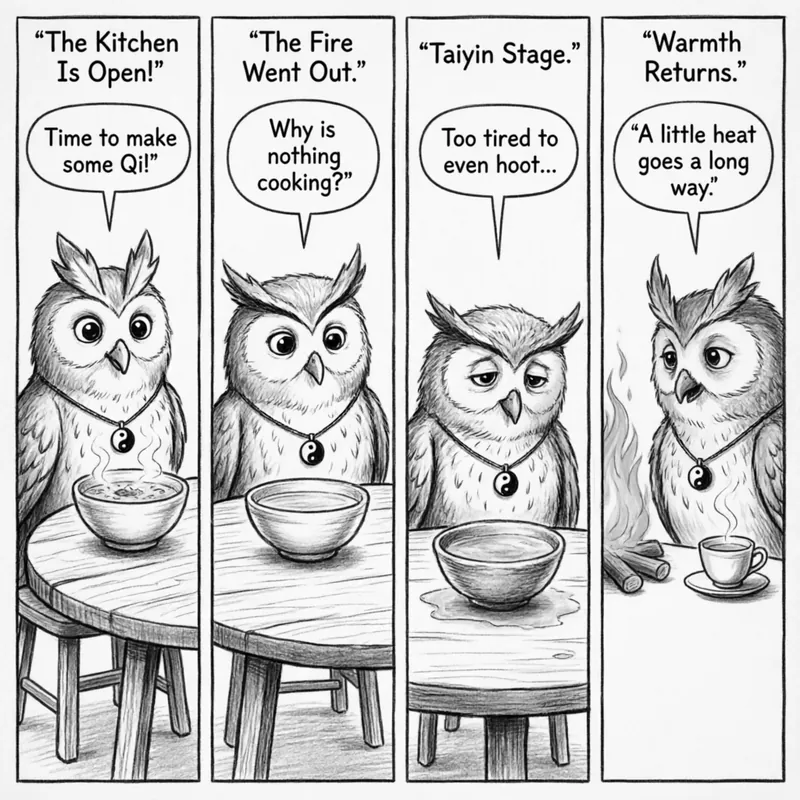
How a Fire Becomes a Flood
How does the body get this cold? It rarely happens overnight. The Taiyin stage is often the result of a long, drawn-out battle.
Remember the Yangming stage? That was the body's all-out war — high fever, drenching sweats, raging thirst. But after a huge fire burns, the fuel is gone. In the body, that fuel is precious Yin, fluids, and vital energy.
When the Yangming fire dies down, it can leave behind a cold, empty interior. The internal furnace has burned itself out. This allows Dampness — that heavy, sticky, stagnant energy — to pool and accumulate. The Spleen, which despises Dampness, becomes overwhelmed and shuts down.
It's like a town after a week-long festival. The party was wild, but now the streets are empty, and everyone is too exhausted to clean up. That's the Spleen in the Taiyin stage — too weak and bogged down to perform its basic duties.
The Telltale Signs of a Cold Interior
What does this digestive collapse look like in real life? The symptoms are chronic and stubbornly persistent:
- Abdominal Fullness and Bloating: A constant, uncomfortable pressure that doesn't go away, even when your stomach is empty.
- No Appetite: The thought of food is unappealing. Your body knows it can't handle anything new.
- Loose Stools or Diarrhea: The Spleen is too weak to transform fluids. Undigested food in the stool is a clear sign the "kitchen fire" is out.
- Deep Fatigue: Bone-deep weariness that sleep doesn't fix, especially after eating, because the body exhausts its meager reserves trying to digest.
- Feeling Cold: An internal cold that has nothing to do with the weather — bundled up and still chilled to the core.
- Pale, Swollen Tongue: The tongue looks pale and puffy, often with teeth marks on the sides. The Spleen Qi is so weak it can't even hold the tongue in its proper shape.
The Shanghan Lun describes it succinctly in line 273: "In Taiyin disease, the abdomen is full and there is vomiting, inability to get food down, and severe spontaneous diarrhea." A clear picture of systemic failure.
Rekindling the Digestive Fire
You can't bully a Taiyin system back to health with roughage and cold-pressed juices. That's like throwing a frozen steak into a cold pot and expecting it to cook. The strategy is simple: warm the interior and strengthen the Spleen.
This is where powerful warming formulas come in. Li Zhong Wan (Regulate the Middle Pill) gently but powerfully warms the Spleen and Stomach, drives out Cold, and restores digestion. It's a lifeline for a system on the verge of collapse.
For more severe cases — where the cold has reached the body's ultimate pilot light (Kidney Yang) — a practitioner might turn to Si Ni Tang (Frigid Extremities Decoction). These are rescue-level formulas for when the body is truly cold and failing.
Remember: these are powerful tools used by trained practitioners. This is understanding the strategy — warming and tonifying — not self-prescribing.
The Gentle Path Back to Nourishment
If your system is in a Taiyin-like state, recovery is all about gentleness, warmth, and energy conservation.
Warm Your Core: Switch to warm, cooked, easy-to-digest foods. Nourishing broths, simple soups, congee (rice porridge). These are "pre-digested" and place little strain on the Spleen. Strictly avoid raw foods, iced drinks, and dairy — they all introduce Cold and Dampness.
Spice Is Your Friend: Gently warming culinary spices help enormously. Fresh ginger is a superstar for warming the stomach. Cinnamon, cardamom, and fennel are wonderful allies.
Rest. Seriously. Your body is running on fumes. Pushing through with intense workouts will only deplete you further. This is a time for naps, gentle walks, and conserving your precious Qi.
Hoo, friends. My little ear tufts always get a sympathetic droop when we talk about the Taiyin stage. It sounds so… exhausting. I'm perched up here on a stack of warm books, and even I feel a little chill thinking about it.
When folks hear "Spleen collapse," they get worried. But I like to think of it like my old portable radio. Sometimes, the batteries just die. You can fiddle with the antenna and turn the volume knob all you want, but you won't get any music until you put in fresh, charged batteries.
In the Taiyin stage, your body's batteries are completely drained. Eating food is like trying to run the radio without batteries — it does nothing. The goal isn't to force the music; it's to gently and patiently put new batteries in. That's what warming foods and herbs do. They're not the music; they're the power source that allows the music to play again.
I was watching a human friend try to get through this once. They kept eating giant salads, thinking it was "healthy." I wanted to hoot and tell them, "That's like asking a sleepy little owl to carry a giant log!" A nice, warm bowl of soup, on the other hand… now that's more like a tasty, easy-to-carry field mouse. My yin-yang pendant feels warmer just thinking about it. Be gentle with yourselves. Your body is asking for a little warmth and a long nap. It's earned it.
— Ollie
FAQ
Is the Taiyin stage the same as IBS or SIBO?
They aren't the same, but they can overlap. Western medicine diagnoses IBS or SIBO based on symptoms and test results. TCM diagnoses the underlying pattern that allows those symptoms to arise. A Taiyin pattern of Spleen Qi Deficiency and internal Cold creates the perfect environment — a cold, stagnant gut — for issues like SIBO to develop. From a TCM perspective, Taiyin can be the root cause of symptoms labeled as IBS or SIBO.
I get really bloated, but I also have acid reflux. Is that Taiyin?
Probably not, or at least not a simple, classic Taiyin pattern. Acid reflux and heartburn almost always involve some form of Heat or rebellious Qi rising upward. Taiyin is defined by its overwhelming Cold nature. What you're describing sounds more like a complex, mixed pattern — perhaps Cold in the lower abdomen with Heat in the stomach. This highlights why a proper diagnosis from a practitioner is so important.
Can I just drink ginger tea and eat soup to fix this?
For a mild case, absolutely! Dietary changes are the essential first step. Ginger tea is fantastic for warming the Stomach. However, if you're in a true, chronic Taiyin stage as described in the Shanghan Lun, that's a sign of deep deficiency. Diet is your foundation, but it might be like using a candle to heat a freezing house. A professionally prescribed herbal formula provides a much more targeted and powerful boost.
Sources
- Zhang, Zhongjing. Discussion of Cold Damage (Shang Han Lun), Lines 273-277.
- Huangdi Neijing (Yellow Emperor's Inner Classic), for foundational theories on the function of the Spleen and Stomach.
— Ollie
Enjoyed this?
Subscribe via RSS — new articles delivered to your feed reader.
Have a question? Reply by email — good questions become future articles.