Eat With The Sun: The TCM Clock For Food
Intermittent fasting is everywhere. You’ve seen the headlines, heard the podcasts, and maybe even tried skipping breakfast yourself, hoping for that promised surge of energy and mental clarity.
I certainly did. For about six months, I religiously skipped breakfast, convinced I was bio-hacking my way to peak performance. The result? By 3 PM every day, I’d hit a wall so hard I could have left a cartoon-shaped outline in it. My brain felt like it was wading through mud, and my energy was completely shot.
It turns out, Traditional Chinese Medicine (TCM) had a much more nuanced take on meal timing figured out about 2,000 years ago. It’s not just about *when* you start and stop eating. The key is syncing your meals with your body’s own internal, God-given schedule.
The TCM Lens on Digestion
Before we get to the clock, it's helpful to understand a key difference. Western medicine often views digestion as a mechanical and chemical process: enzymes, acids, and muscular contractions breaking down food into components. TCM sees it as a dynamic, energetic transformation. It speaks of a "digestive fire" (part of our Spleen and Stomach function) that must be strong to "cook" the food we eat and extract its essence. This perspective shifts the focus from what you eat to *how* and *when* your body can best transform it into life-giving energy.
This schedule is known as the Meridian Clock, or Ziwu Liuzhu (子午流注), a powerful concept first detailed in the classical text, the Ling Shu (灵枢). It’s one of the most practical and powerful tools for transforming your daily well-being. Forget fasting fads. Let’s talk about feasting with the sun.
 Ollie's Take
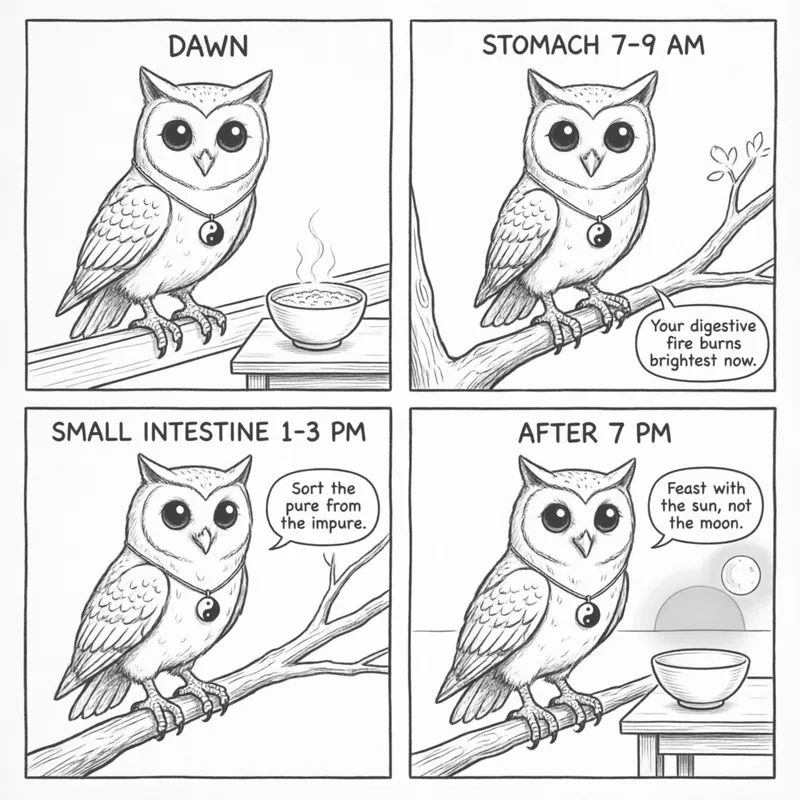
A screech owl perches on the kitchen windowsill, adjusting his jade pendant with one talon. "Your body has been following this clock for millennia," Ollie hoots, blinking his amber eyes. "You just forgot to read the manual."
Your Body Has a Schedule (And It’s Not on Your Phone)
Imagine your body is a bustling city. Each organ is a different department—the Ministry of Energy Production, the Department of Waste Management, the Office of the President. For the city to run smoothly, each department can’t be working at full blast all at once. It would be chaos.
From his perch on the bookshelf, Ollie the screech owl ruffled his downy feathers, his wise amber eyes blinking slowly as if to say, "Finally, he gets it."
Instead, there’s a schedule. The Meridian Clock is that schedule.
In TCM, we understand that Qi—the vital substance that powers all physiological functions—circulates through 12 primary meridians, or energy pathways, in a 24-hour cycle. Each of your major organs gets a two-hour window where Qi is at its peak, allowing that organ to perform its primary functions most effectively.
Think of it as a divine internal rota. From 7 AM to 9 AM, the Stomach department is fully staffed and ready to go. From 1 PM to 3 PM, the Small Intestine crew is on high alert for nutrient processing.
Why should you care? Because when you align your activities—especially eating—with this natural flow, everything just works better. Your digestion becomes smoother, your energy stabilizes, and that feeling of being "off" starts to fade. You’re no longer fighting your body; you’re working with it.
The Golden Hours for Digestion: 7 AM to 3 PM
If you remember one thing from this article, let it be this: your digestive system’s primetime is in the morning and early afternoon. This is when your "digestive fire"—the metabolic heat needed to break down food—is roaring.
7 AM - 9 AM: Stomach Time (Breakfast Like a King)
Ding, ding, ding! The clock strikes 7 AM, and your Stomach meridian is at its peak. In TCM, the Stomach is seen as a cooking pot, responsible for receiving food and "ripening" it. This two-hour window is when the fire under that pot is at its hottest.
This is why the old adage "Breakfast like a king, lunch like a prince, and dinner like a pauper" is pure TCM gold. Your body is screaming for fuel to start the day. Giving it a substantial, warm, and nourishing meal now is the most efficient thing you can do.
What happens when you skip it, like I did? Your stomach still produces acid, ready to work. But with no food to digest, that acid can start to irritate the stomach lining. You’re asking your star chef to come in for the morning shift and then giving them nothing to cook. It’s a waste of powerful energy and can lead to problems down the line.
9 AM - 11 AM: Spleen Time (The Great Transformer)
Right after the Stomach’s peak comes the Spleen’s time to shine. The Spleen in TCM is the master of transformation and transportation. It takes the "food soup" prepared by the Stomach and miraculously transforms it into Qi and Blood—the very building blocks of your vitality. The Spleen transforms food essence and must lift this clear Qi upward to the Lungs and Heart. When the Spleen is weak, this lifting fails, causing the foggy-headed feeling as clear Qi fails to reach the brain.
When you eat a good breakfast before 9 AM, you provide the Spleen with high-quality raw materials to work with all morning. The Spleen can then efficiently create the energy you need for focus, strength, and a balanced mood. Ollie, who had flown to a perch on the kitchen cabinet, hooted softly and adjusted the small jade pendant he wore around his neck, a sign of his approval for a well-fed Spleen.
If you skip breakfast, the Spleen has nothing to transform. It’s like a factory with no supplies. This is a direct cause of that mid-morning brain fog, and that feeling of needing a coffee and a pastry to push through is your Spleen crying out for help. Over time, a weak Spleen can lead to more persistent issues like bloating, loose stools, and chronic fatigue.
11 AM - 1 PM: Heart Time (A Joyful, Social Lunch)
As the morning winds down, the energy shifts to the Heart. In TCM, the Heart is the emperor of all organs and houses the Shen, our spirit and consciousness. This is a time for joy, connection, and warmth. It’s the perfect time to share a meal with others, take a break from stressful work, and nourish your spirit as well as your body. Eating in a stressed or rushed state during Heart time can agitate the Shen, leading to anxiety and poor nutrient absorption.
1 PM - 3 PM: Small Intestine Time (Sort and Absorb)
After your pleasant lunch, the Small Intestine takes over. Its job is to separate the "pure" from the "impure" from the food you’ve eaten. The pure essence is sent to the rest of the body for nourishment, while the impure waste is passed down to the Large Intestine and Bladder for excretion.
This is the final powerhouse hour for digestion. By eating your main meal (lunch) before 1 PM, you give the Small Intestine a full two-hour window to do its critical sorting job without being rushed. This is how you avoid that dreaded 3 PM slump. When your body has been given the right fuel at the right time, the Small Intestine can efficiently deliver a steady stream of energy all afternoon. My old 3 PM crash was a direct result of giving my Small Intestine nothing to work with until it was already past its prime.
The Disaster of Late-Night Eating
So, what happens on the other side of the clock? As the sun sets, your digestive fire dials down to a mere pilot light. From 7 PM to 9 PM, the energy is peaking in the Pericardium meridian (often associated with the Triple Burner in this context), which is focused on protecting the Heart and regulating circulation. The body’s focus is shifting from digestion to repair, restoration, and rest.
Eating a large, heavy meal late at night is like dropping a frozen turkey into a smoldering campfire. The digestive system simply doesn't have the "fire" to break it down properly. Instead of being transformed into Qi and Blood, the food sits and stagnates in your gut. This creates 'Dampness' (heavy, sluggish feeling with loose stools) or if combined with heat, 'Phlegm' (thick mucus, mental fogginess, nodules)—pathogenic factors that can lead to weight gain, a feeling of heaviness, brain fog, and poor sleep as your body tries to deal with a mess it wasn't equipped to handle.
Ollie Speaks: My Personal Turnaround
Hoo, friends! From my perch, I watched my practitioner friend stumble around every afternoon, his energy as low as a winter sun. He was trying that 'intermittent fasting' thing, skipping his morning meal. A fledgling mistake! His Spleen Qi was crying out for fuel. The difference, when he finally listened to this old owl's wisdom, was as clear as a moonlit night. He swapped his big, late dinners for a hearty, warm breakfast. Within a week, that 3 PM crash vanished. He could glide through his afternoons with clear focus. The secret wasn't in some complicated human fad—it was simply honoring the ancient rhythm of the sun. Makes perfect sense when you think about it.
The Science Is Catching Up
Here's what's fascinating: modern science is now proving what TCM has known for millennia. in 2017, the Nobel Prize in Physiology or Medicine was awarded to three scientists for their discoveries of the molecular mechanisms controlling our circadian rhythms. They proved, on a cellular level, that nearly every organ in our body has its own internal clock.
Modern research now shows that our bodies are more insulin-sensitive in the morning, meaning we can process carbohydrates more effectively. Digestive enzyme production and gut motility are also higher in the first half of the day. This emerging field, known as "chrono-nutrition," is Western science validating the 2,000-year-old wisdom of the Meridian Clock. They just gave it a new name.
Practical Tips: What Does a TCM-Approved Breakfast Look Like?
Eating like a king doesn't mean a greasy fry-up. The goal is to eat something warm, nourishing, and easy to digest. Cold food, like an iced smoothie or yogurt from the fridge, can actually put out your digestive fire first thing in the morning. Ollie blinked his large amber eyes, tilting his head as if inspecting the steaming bowl of congee below.
- Congee: A savory rice porridge that’s the ultimate comfort food for your gut. You can add ginger, scallions, chicken, or mushrooms.
- Oatmeal or other cooked whole grains: Avoid instant packets loaded with sugar. Make it yourself and add cinnamon, walnuts, and stewed pears.
- Scrambled Eggs with Sautéed Greens: Eggs are a fantastic source of protein, and cooking them with greens like spinach or kale adds extra nutrients. Just be sure not to eat them cold.
- Nourishing Broth or Soup: In many Asian cultures, a savory soup is a common breakfast. A simple miso soup or a bone broth with some vegetables is incredibly gentle and warming for your digestive system.
FAQ
But I'm never hungry in the morning. What should I do?
This usually means your digestive fire is weak from irregular eating habits. Start small—just a cup of warm bone broth or ginger tea. Within a week or two of this gentle approach, your natural morning appetite will likely return.
Does this mean I can never eat after 7 PM again?
Think of this as a guiding principle, not a rigid, unbreakable law. Life is for living! There will be dinner parties, late work nights, and special occasions. The goal is to make an early, light dinner your default setting. Follow the 80/20 rule: if you align with the clock 80% of the time, your body will be much more resilient and better able to handle the occasional late meal.
What about my morning coffee?
From a TCM perspective, coffee is a powerful stimulant. Its bitter and warm nature can give a jolt of energy, but it often does so by draining your deep reserves (your Kidney essence) rather than creating new energy. It can also be harsh on the Stomach lining, especially on an empty stomach. The best practice is to have your coffee after your warm breakfast, not before.
Your One-Week Experiment
The beauty is, you don't need a pill or trendy diet. Just try this for one week: shift your eating schedule. Eat your largest meal at breakfast or lunch, and make your dinner smaller, simpler, and before 7 PM. That’s it. Don’t even change *what* you eat, just *when* you eat it. Pay attention. How is your energy at 3 PM? How do you sleep? How do you feel when you wake up? You might be surprised to find that the quiet logic of the TCM clock is the most effective "bio-hack" you've ever tried.
Sources
- Huangdi Neijing Ling Shu (The Yellow Emperor's Inner Canon: Spiritual Pivot): The classical Chinese medical text that first detailed the Meridian Clock.
- The Nobel Prize in Physiology or Medicine 2017. NobelPrize.org. Nobel Prize Outreach AB 2024. For discoveries of molecular mechanisms controlling the circadian rhythm.