The Season of Letting Go: What the Neijing Knew About Autumn
You know that feeling. The air gets a sudden, sharp edge. The light shifts, turning golden and slanted. And a deep, primal part of you wants to buy a new planner, sharpen a box of pencils, and get back to business.
In the West, autumn is the season of the hustle. It’s our unofficial New Year—a time for new schedules, new goals, and a renewed push for productivity after the lazy days of summer. We’re all about gearing up.
But what if I told you that one of the foundational texts of Chinese medicine says the exact opposite? Autumn isn’t for starting up, but for slowing down. Not for accumulating, but for letting go.
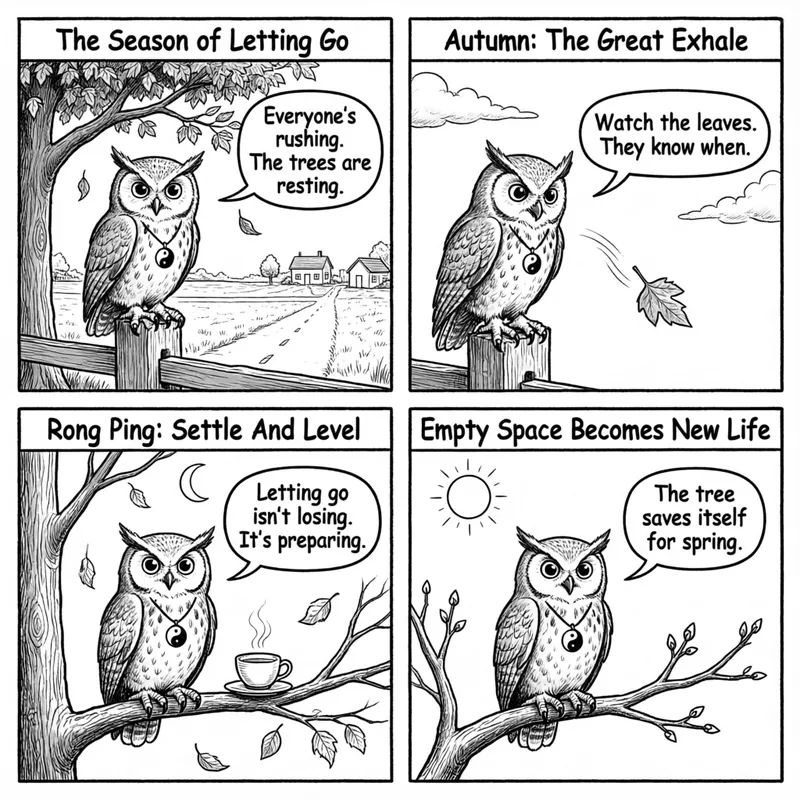
Our little screech owl mascot, Ollie, sees it in the woods. The squirrels are busy, yes, but the trees are starting their long, slow exhale. The *Huangdi Neijing* (Yellow Emperor's Inner Canon) saw it too, over two thousand years ago. And it left us a beautiful, counter-intuitive plan for navigating this season of deep change.
The Neijing’s Radical Prescription for Autumn
In the second chapter of the *Suwen* (Plain Questions), the *Neijing* lays out a guide for living in harmony with the four seasons. When it gets to autumn, it doesn’t talk about productivity or new beginnings. Instead, it opens with a startlingly quiet and gentle phrase:
“秋三月,此谓容平” (qiū sān yuè, cǐ wèi róng píng).
“The three months of autumn, these are called *Rong Ping*.”
Let’s sit with that for a moment. *Rong* (容) means to contain, to hold, to allow, or to be at ease. *Ping* (平) means level, calm, balanced, and peaceful. Together, they describe a state of calm containment, of settling and leveling out. It’s the energy of a lake after the wind dies down—the ripples soften, and the surface becomes smooth, reflecting the sky.
This isn't the energy of a fresh start; it’s the energy of a graceful conclusion. The text continues, painting a vivid picture of the season's Qi:
“天气以急,地气以明” (tiān qì yǐ jí, dì qì yǐ míng). “Heaven’s Qi becomes sharp, and Earth’s Qi becomes clear.” You know this feeling. It’s the crisp, almost biting quality of the autumn air and the brilliant, clarifying light of a sunny fall day. The world is coming into sharp focus before it softens into winter.
So, how are we to live in this sharp, clear world? The *Neijing* advises:
“早卧早起,与鸡俱兴” (zǎo wò zǎo qǐ, yǔ jī jù xīng). “Go to bed early and rise early, in rhythm with the rooster.” As the days shorten, our sleep schedule should naturally follow. We begin to turn inward, honoring the sun’s retreat.
And what about our minds, which are so often revving up this time of year? The instruction is clear: “使志安宁” (shǐ zhì ān níng), which means to “keep the spirit-mind calm and at peace.” We are to “收敛神气” (shōu liǎn shén qì), to “gather and restrain the spirit-qi.”
Think of the explosive, outward energy of summer—parties, travel, long sunny days. Autumn is the reverse. The energy is no longer expanding; it’s contracting, gathering, and moving inward and downward. The whole point of this practice is to “使秋气平” (shǐ qiū qì píng), to “keep the autumn Qi balanced” within ourselves.
If we fight this natural gathering and instead push for summer-level expansion, we create a disturbance. The *Neijing* warns that this can injure the Lungs, leading to problems in the winter.
Metal, Lungs, and the Misunderstood Gift of Grief
To understand why the *Neijing* links autumn to the Lungs and a quiet spirit, we have to look at the Five Element framework. In this system, every season has a corresponding element, organ system, emotion, and more. Autumn belongs to the Metal element (金, Jīn).
In Chinese medicine, the Lungs do more than just breathe. They are considered the "tender organ" — jiao zang (娇脏) in classical terminology, meaning delicate and easily affected. They are the first line of defense against external environmental factors like wind, cold, and dryness. They command the Qi of the entire body and are responsible for taking in the new (pure Qi from the air) and releasing the old (waste Qi). Autumn dryness — what the classics call zao (燥) — is considered a distinct seasonal influence that the Lungs are especially sensitive to, which is why moistening foods and gentle hydration play such a central role in traditional autumn practice.
The emotion associated with the Metal element and the Lungs is grief or sadness (悲, Bēi).
Now, this is where many Westerners get a little nervous. We hear "grief" and think something is wrong. But the Five Element framework doesn't see it that way. It’s not that autumn is supposed to make you clinically depressed. Rather, autumn is the season that provides the perfect energetic container for *processing* grief and sadness.
It’s the designated time in the inner calendar to acknowledge what has been lost, what is over, and what needs to be released. Just as a tree must let go of its leaves to conserve energy for the winter, we must let go of old sorrows, disappointments, and attachments that no longer serve us.
The *Neijing* also notes the other side of this relationship: when grief is held onto too long, or when we refuse to process it at all, the TCM view holds that it can deplete the Lungs — the organ that, in this framework, is already the most vulnerable to the sharp, dry air of autumn. It's a two-way street. The season invites us to grieve well, not to grieve endlessly.
Grief is the natural emotion of letting go. When we try to “stay positive” and hustle through autumn, we are telling our Lungs and our spirit to hold onto all those dead leaves. This clutters our internal world and can, in the TCM view, weaken the Lung Qi, leaving us more vulnerable. Even our friend Ollie knows you can't fly with weighed-down wings.
Ollie, who watches all of this from his favorite branch, has his own way of putting it:
Ollie Speaks: "Hoo-hoo! The forest isn't sad when it drops its leaves. It's getting ready. Autumn is the season of the great exhale. You can exhale, too."
The Practical Art of Letting Go
So how do we actually *live* this in our modern, 24/7 world? Accepting the spirit of *Rong Ping* doesn’t mean you have to quit your job and become a hermit from September to November. It’s about small, conscious shifts in your daily rhythm.
I was walking through my neighborhood the other day and was struck by the oak trees. They weren’t struggling to hold onto their leaves. There was no angst. When a leaf was ready, it just… detached. It drifted. It let go. That is our model. As Ollie likes to put it from his perch: "Watch any oak in October. The tree isn't giving up — it's saving itself for the spring."
Here are a few ways to practice this "art of letting go" and align with the season:
1. Reclaim Your Evenings. The *Neijing*’s advice to “go to bed early” is a direct response to the fading light. Instead of fighting the darkness with bright screens and late-night work, lean into it. An hour before bed, dim the lights. Put away the laptop. Read a physical book. Listen to quiet music. Let your energy begin its natural descent with the sun.
2. Take a "Harvest" Walk. Go for a walk without headphones, not for cardio, but for observation. Notice the "sharp Qi" in the air and the "clear Qi" of the light. As you walk, take a gentle inventory of your year so far. What have you "harvested"? What projects have come to fruition? What ideas have run their course? This isn't about judgment; it's about acknowledging what is complete. There's an old saying among the trees, and Ollie repeats it often: you can't see the forest floor if you never let the leaves fall.
3. Practice a Small Letting-Go Ritual. The Metal element is about refinement and discernment—distinguishing the precious from the impure. You can mirror this physically. Clean out a junk drawer. Go through your closet and donate clothes you haven't worn. Delete old files from your computer. Write down a nagging resentment on a piece of paper and (safely!) burn it. The physical act of releasing sends a powerful signal to your mind and spirit.
4. Breathe with the Lungs. Since this is the season of the Lungs, give them some attention. Find a few minutes each day to sit quietly and focus on your breath. Inhale the cool, crisp air, and with every exhale, imagine you are releasing something you no longer need to carry: a worry, a deadline, a bit of tension in your shoulders.
Why We Burn Out in the Fall
If this all sounds deeply counter-cultural, that’s because it is. Our society is built on a model of perpetual, linear growth. We expect every quarter to be better than the last. We confuse resting with failing.
The "back-to-school" and "end-of-year" pushes are fundamentally spring-like energies. Spring is the season of the Wood element, of bursting forth, new plans, and upward growth. When we try to force that explosive energy onto the autumn season, we create an internal clash.
Think about it: Nature is contracting, and we are trying to expand. The world is quieting down, and we are trying to speed up. This is a recipe for burnout. It’s like trying to swim against a powerful current. You might make some headway for a little while, but eventually, you’ll be exhausted.
From the perspective of the *Neijing*, much of the anxiety, stress, and fatigue we feel in the fall comes from this fundamental mismatch. We are ignoring the wisdom of our own bodies and the environment we are part of.
Embracing *Rong Ping*—that calm, settling energy—is a radical act of self-care and preservation. It's a quiet permission, written 2,000 years ago, to stop pushing and start gathering. It’s the wisdom to know that true strength for the coming winter is found not in more activity, but in thoughtful consolidation.
Autumn isn’t a failure of summer’s vibrancy. It is its own season with its own deep purpose: to release, to refine, and to return to the quiet core of our being. It teaches us that letting go isn’t an act of defeat, but an act of grace. It creates the beautiful, necessary emptiness that allows for deep rest and, eventually, new life to begin again in the spring.
So this week, find one small thing you can release. An old magazine, a lingering grudge, an unnecessary task on your to-do list. Let it go, and notice the space it creates. That space is the beginning of living in harmony with autumn. And the next time the season whispers its familiar call — buy the planner, sharpen the pencils, get back to business — you can smile, close the notebook, and step outside to watch the leaves drift. The trees have been doing this for millions of years. They know what they're doing.
 Ollie's Take
Hoo-hoo! The squirrels are stuffing their cheeks and the geese are getting restless, and every leaf in my forest is letting go without a single complaint. The humans think autumn means new schedules and fresh starts. But the trees know better — the work of autumn is release. From my branch, I watch the whole world exhale. You can, too. Drop one thing you've been carrying. Just one. You'll be amazed how light the flight home feels.
FAQ
What kinds of foods are good for autumn in the TCM framework?
In the TCM framework, autumn is about countering dryness and supporting the Lung organ system. The focus shifts to foods that are moistening, nourishing, and gently warming. Pears are a classic choice for moistening the Lungs. Other great options include pumpkin, winter squash, and sweet potatoes, which are nourishing and reflect the harvest. Honey and white fungus (snow fungus, often used in soups) are traditional go-tos for autumn dryness, as is lily bulb. Adding pungent flavors like fresh ginger (Sheng Jiang) or cinnamon (Rou Gui) in moderation can help disperse pathogens and warm the body — though ginger, being warming, is traditionally used more sparingly by people who tend to run hot. (In the classics, fresh ginger is considered warmer and more dispersing than dried ginger, Gan Jiang, which is used more for warming the interior.) Root vegetables are also excellent for their grounding quality. As the weather cools, it's generally advised to ease up on cold and raw foods, which can be harder on the digestive system this time of year.
I feel more sad or melancholic in the fall. Is that normal from a TCM perspective?
Yes, it's considered very normal. Autumn is the season of the Metal element, and its associated emotion is grief or sadness. This isn't seen as a problem to be fixed, but as a natural emotional current of the season. The energy of fall is about turning inward, reflecting, and letting go. This process can naturally bring up feelings of loss or melancholy. The TCM perspective encourages you to allow space for these feelings to arise and move through you, rather than suppressing them. It is the perfect time to process old grief, allowing you to enter winter with a clearer spirit. At the same time, if sadness feels heavy, persistent, or starts interfering with daily life, it's wise to reach out to a mental health professional — seasonal wisdom is a complement to care, not a replacement for it.
The Neijing says to "rise early with the rooster." I'm not a morning person! How can I adapt this?
The spirit of this advice is more important than the literal interpretation. "With the rooster" was ancient shorthand for aligning with the sun. In autumn, the sun rises later than in summer, so this is actually permission to sleep in a little longer! The core principle is to synchronize your personal rhythm with the season's rhythm. This means going to bed earlier as the nights grow longer and waking as the world brightens. It's about respecting the increase of Yin (darkness, rest) and the decrease of Yang (light, activity). Don't force a rigid schedule; instead, listen to your body and the light outside.
Sources:
- Huangdi Neijing: Suwen, Chapter 2 (黄帝内经·素问·四气调神大论)
- Huangdi Neijing: Suwen, Chapter 22 (黄帝内经·素问·脏气法时论)
- Maciocia, Giovanni. The Foundations of Chinese Medicine (3rd ed.), 2015 — for the Five Element framework and Lung/Metal correspondences.
- Rosenthal, Norman. Winter Blues, 2006 — modern research on seasonal affective patterns and the light-sleep connection.
Food and lifestyle suggestions here are cultural traditions and general observations from the TCM framework — not medical prescriptions. Always consult a qualified professional for personal health decisions.