San Fu Tian: The Ancient "Summer Moxibustion Window" — and Why It's About to Close
It’s August. The air is thick, the sun is relentless, and the asphalt feels like a freshly-paved-in-molten-lava parking lot. Your first instinct is probably to seek refuge in front of an air conditioner, clutching a glass of something icy. Now, picture this: in cities and towns across China, millions of people are doing the exact opposite. They are willingly, even eagerly, sitting in clinics and homes, having small, smoldering bundles of dried herbs held near their skin. They are adding heat to the heat. It sounds completely backward, doesn't it? Why would anyone seek out fire therapy during the hottest days of the year? Welcome to San Fu Tian (三伏天), the "Three Fu Days." This is a specific period in the traditional Chinese calendar considered the most potent time for a special kind of moxibustion. It's based on a principle that might change how you think about the seasons: "winter disease, summer treatment." And right now — in early August — that window is closing for the year. Ollie's Take
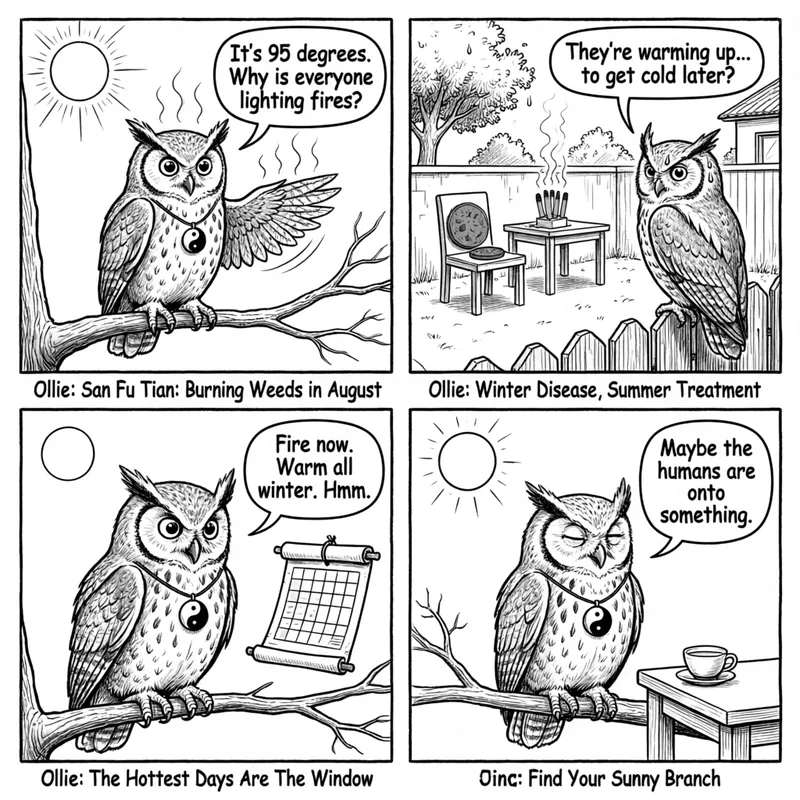
Ollie's take: Hoo-hoo! In my forest we don't have clinics, but we do have sunny branches — and everyone knows the hottest days are when you warm your bones for winter. The humans have turned it into a calendar and a science. Very fancy. Me? I'll take a warm perch and a nap, and let the summer do the work. Respect to anyone roasting out there on purpose. That's commitment.
Fighting Fire with Fire: The Logic of "Winter Disease, Summer Treatment"
To understand San Fu Tian, you have to appreciate a core concept in Chinese culture known as 冬病夏治 (Dōng Bìng Xià Zhì), or "treating winter's ailments in the summer." Picture a pipe that freezes and bursts every single winter. You could patch it up in the dead of January, with numb fingers and frozen tools. Or, you could take advantage of the summer’s warmth to insulate it properly, reinforce its weak points, and ensure it’s strong enough to withstand the coming cold. The TCM framework views the body in a similar way. Certain conditions that flare up in winter—like chronic coughs, asthma, joint pain that aches with the cold, or constantly having cold hands and feet—are traditionally seen as stemming from a deep-seated "cold" (寒, Hán) that has lodged itself in the body's deeper layers. During winter, the body’s own defensive energy (Yang Qi) is thought to be drawn inward, conserving resources. It's busy keeping the core warm, and it may not have the extra power to expel that deep, lingering cold. But in summer, everything changes. The natural world is bursting with Yang energy. The sun is at its peak, and according to this view, so is the body's external, active energy. The pores are open, circulation is more vigorous, and the body's channels are more receptive. This, the theory goes, is the perfect opportunity. The body is already in an "outward-pushing" state. San Fu Tian moxibustion is seen as the extra nudge—the torch that helps the body’s summer-stoked furnace finally burn away the last of winter’s chill. It's not about adding heat to a hot person; it's about using the season's power to drive out a deeper, more stubborn cold.Decoding the Calendar: What Exactly is San Fu Tian?
So, what makes this period so special? "San Fu Tian" isn’t a casual name for "the dog days of summer." It's a precisely calculated period based on the traditional Chinese lunisolar calendar. "San Fu" (三伏) means "Three Hiding Periods." In classical interpretation, the character 伏 (fu) means to submit or hide — the idea being that even the fierce Yang energy of summer is forced to hide and store itself beneath the overwhelming heat. These periods are tied to specific astronomical markers called "Geng days" (庚日), which follow the summer solstice. The three periods are:- Chu Fu (初伏): The "Beginning Fu," starting on the third Geng day after the summer solstice.
- Zhong Fu (中伏): The "Middle Fu," starting on the fourth Geng day. This one can be 10 or 20 days long.
- Mo Fu (末伏): The "Final Fu," starting on the first Geng day after the "Start of Autumn" solar term.
- Chu Fu: July 16 - July 25
- Zhong Fu: July 26 - August 14
- Mo Fu: August 15 - August 24
(Dates based on the 2026 lunisolar calendar; they shift slightly each year — always confirm with a Chinese calendar resource or your practitioner.)
As you can see, we are currently at the very tail end of the "Zhong Fu" period, with the final window of "Mo Fu" ahead. For practitioners and followers of this tradition, the clock is ticking. This isn't a year-round therapy; its perceived power is tied directly to this fleeting seasonal alignment.Ollie Speaks
Hoo-boy, let me tell you. I was perched on a windowsill in Shanghai last month, fanning myself with a wing while my little yin-yang pendant swung with every beat, and I saw the humans next door doing this. Sitting there, in 35°C heat, with smoke coming off their backs. My first thought? "These mammals have finally lost it. I have a perfectly good, half-eaten ice cream cone they could use instead."
But then I listened. They were talking about "pushing out the winter cold." It's like pre-heating the nest. You don't wait until the first frost to patch the holes; you do it when the sun is out and the mud is soft. It's planning ahead! So, while I still think a nice, cool breeze is the better choice for a July afternoon, I have to admit... they're not roasting themselves for fun. They're playing the long game. Respect.
The Practice: A Closer Look at Summer Moxibustion
The star of the show in any moxibustion session is Ai Ye (艾叶), or dried mugwort leaf. This common herb has been a cornerstone of TCM for centuries, prized for the unique quality of its heat when burned. For San Fu Tian, the mugwort is typically prepared and applied in a few different ways:- Moxa Sticks: Dried, refined mugwort is rolled tightly into a cigar-like stick. The stick is lit and held by a practitioner an inch or two away from the skin, moving it slowly over specific acupoints. The goal is a pleasant, penetrating warmth, not a burning sensation.
- Moxa Cones: Small cones of moxa "wool" are placed on a slice of ginger or a cardboard base, which is then placed over an acupoint. This method provides a more concentrated, direct heat.
- San Fu Tie (三伏贴): In modern China, the most common form of San Fu Tian treatment isn't burning moxa at all — it's a small herbal paste patch placed on specific acupoints and worn for a few hours. You'll see clinic courtyards full of people in summer, each with a few round patches on their backs. The same seasonal logic applies: the herbs are chosen to warm and support, timed to the hottest weeks of the year. One note: some of these patches contain warming herbs like Bai Jie Zi (white mustard seed) that can cause redness, itching, or even blistering on the skin — clinics warn you to remove them if irritation becomes strong, and they're never left on longer than recommended.
A Crucial Note on Safety
This needs to be said clearly: Moxibustion involves open fire and intense heat. It is not a DIY therapy to be tried at home after watching a video. An untrained person can easily cause painful burns and scarring. A qualified TCM practitioner is trained to manage the heat, maintain the correct distance from the skin, and recognize when the point has received enough stimulation. They also know how to properly extinguish the moxa materials. And because moxa is burned, it produces smoke. In a well-ventilated space that's fine, but moxa smoke contains fine particulate matter, and it can be irritating for people with asthma, allergies, or other respiratory sensitivities — even in people without those conditions if the space is poorly ventilated. This is another reason the practice is best done with a trained practitioner who manages airflow and positioning. In the TCM tradition, San Fu Tian moxibustion is also not for everyone. It has traditionally been avoided for people with signs of heat in the body (what the classics call Yin deficiency with heat signs), for pregnant women, for anyone with an active fever or infection, and for areas of the skin that are damaged or irritated. A practitioner assesses each person's situation before recommending it — the seasonal window is only part of the picture. Even Ollie, who loves a warm spot, knows better than to sit on a branch that's actually on fire. If you are interested in this therapy, please seek out a licensed acupuncturist or TCM practitioner. Your safety is the most important thing.What the Science is Looking At
While "driving out cold" is a traditional concept, modern science is exploring the effects of localized heat therapy from different angles. This research provides a contemporary lens, though it doesn't directly validate ancient theories. Studies have looked into how targeted heat can trigger the production of "heat shock proteins" (HSPs). These are special proteins that help protect cells from stress and support cellular repair. Other research investigates how heat can increase local circulation (vasodilation), bringing more oxygen and nutrients to an area. There is also growing interest in how thermal stimulation might influence the nervous system and modulate immune responses. While this scientific exploration is distinct from TCM, it shows a modern interest in the physiological effects of applying warmth to the body.Ollie Speaks
Humans love putting fancy labels on things. "Heat shock proteins." "Vasodilation." It sounds very important and complicated.
Up in my nest, we just call it "sitting on the sunny branch." You feel a bit stiff, you find a good patch of sunlight, and you let the warmth sink into your feathers. It loosens you up. You feel better. You don't need a textbook to tell you that warmth is good for an old ache. The humans in their clinics are being a bit more organized about it. They've found the sunniest branches on the whole tree and are marking them on a map. Clever, I'll give them that.
FAQ
Who traditionally seeks out San Fu Tian treatments?
Traditionally, San Fu Tian moxibustion is sought by individuals who experience conditions that are worse in the cold, damp winter months. This includes people with chronic respiratory issues like asthma or persistent coughs that flare up when the temperature drops. It's also common for those who struggle with joint pain, such as certain types of arthritis, that ache more in the cold. And people who generally feel cold, have poor circulation with constantly cold hands and feet, or feel they have a weak constitution that makes them susceptible to winter illnesses often turn to this therapy as a preventative measure to build up their resilience before the cold season arrives.
Does it hurt? What does moxibustion feel like?
Moxibustion should not be painful. The intended sensation is a pleasant, penetrating warmth that spreads out from the acupoint. A skilled practitioner will carefully control the distance and duration to avoid any burning feeling. You will feel a distinct heat, but it should feel comforting and relaxing, not sharp or scary. Your skin will likely become red in the treated area, which is a normal and expected response, indicating increased circulation. Some people report feeling a deep sense of relaxation or even sleepiness during or after a session. If you ever feel that the heat is too intense, you should immediately tell your practitioner so they can adjust.
I missed the San Fu Tian window. Is there any point to moxibustion now?
Yes, absolutely. While San Fu Tian is considered a uniquely potent time for "winter disease, summer treatment," moxibustion is a valuable therapy used year-round in TCM. The San Fu Tian period is seen as a special opportunity to leverage the season's Yang energy for a particularly deep effect on "cold" conditions. However, a practitioner can use moxibustion at any time of year to warm the channels, promote circulation, and support the body's energy. Don't feel that you've missed your only chance. You can still benefit from the therapy outside of this specific summer window, though the treatment principle and goals might be adjusted by your practitioner based on the season.
Sources
- Deng, H., & Shen, X. (2013). The Mechanism of Moxibustion: Ancient Theory and Modern Research. Evidence-Based Complementary and Alternative Medicine, 2013, 379291.
- Liang, Y., et al. (2021). Effect of heat-sensitive moxibustion on chronic fatigue syndrome: A protocol for systematic review and meta-analysis. Medicine (Baltimore), 100(2), e24220.
- Zhao, B., et al. (2017). A review of the neurological mechanisms of moxibustion. Evidence-Based Complementary and Alternative Medicine, 2017, 5023521.
Ollie Speaks
One more thing before you go. I've been watching the humans do this San Fu thing for a few seasons now, and here's what I've figured out: they're not afraid of the heat — they're using it. Every July they sit out there with their little fires and their calendar charts, and they look like the busiest owls I've ever seen, except upside down. It made me rethink my own habits. I used to complain about the hot months. Now I find the warmest branch I can, fluff my feathers, and let the afternoon soak in. The mice can wait.
So if this August feels heavy — if the heat is getting to you and the year is half over — maybe borrow one idea from the San Fu calendar. Find your version of the sunny branch. Sit in it. Let the season work on you for a while. The humans have been doing this for over a thousand years, and they're onto something.