Why Your Acupuncturist Hasn't Told You About Moxibustion
 Ollie's Take
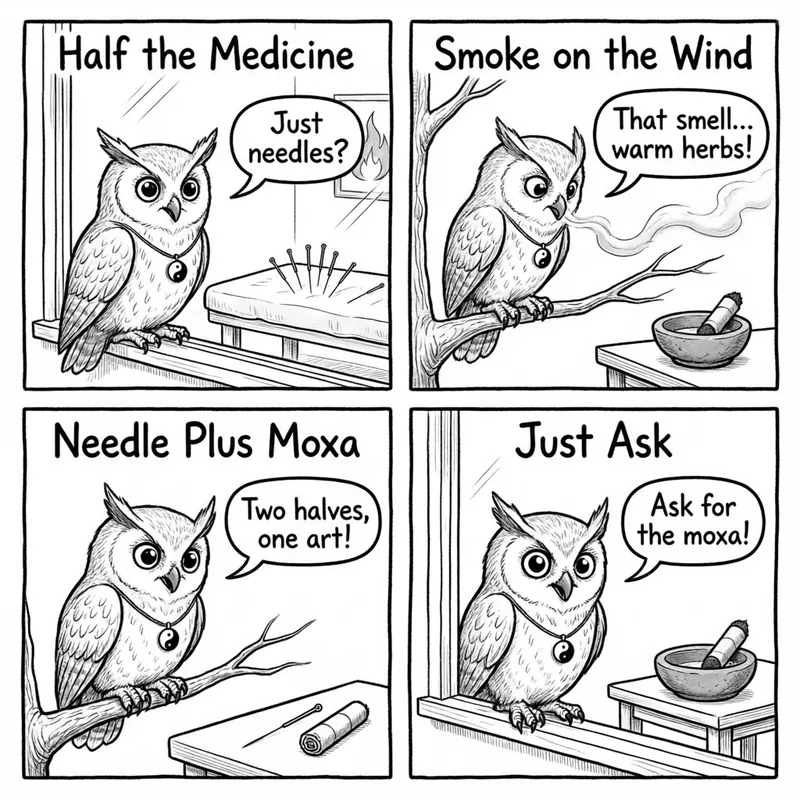
Ollie's take: Hoo-boy! Is that a forest fire, or is someone just warming up their Qi down there? I can smell that earthy mugwort scent all the way from my oak tree branch. The humans keep the fire a secret, but I say: if it smells like roasted herbs and feels like a sunbeam, it deserves a mention.
The Smoldering Secret of the Golden Mugwort
Moxibustion is the art of warming specific acupoints using a spongy, dried herb called mugwort, known in Pinyin as ai ye (艾叶). Practitioners age the leaves of this perennial plant, grind them into a soft wool, and then shape them. Sometimes they roll the wool into cigar-like sticks. Other times, they shape it into tiny, golden cones placed directly on top of ginger slices or garlic cloves resting on your skin. That second method is called indirect moxa: the herb never touches you, and a thin layer of ginger, garlic, or salt carries the warmth gently. Direct moxa, where a tiny cone burns directly on the skin, is rarer in modern clinics and almost always handled by experienced practitioners. The practitioner lights the moxa, letting it smolder slowly. It never burns your skin. Instead, it generates a deep, penetrating heat that travels far beneath the surface. This heat is different from a standard heating pad. It feels alive. In traditional Chinese medicine, moxa is believed to strongly tonify Yang, the warming, active principle of the body. It kickstarts the flow of Qi (vital life force) when coldness or stagnation has settled deep into your muscles and joints. In the classical TCM framework, this therapeutic warmth is traditionally used to address specific internal patterns. It is most commonly associated with Cold-stagnation and Yang-deficiency patterns. People with these patterns often struggle with cold limbs, fatigue, a pale tongue, and a dull, lingering pain that feels significantly better when you apply a warm compress or a hot water bottle. On the flip side, you will want to steer clear of moxa if your body is running on Excess Heat or Yin-deficiency Heat patterns. If you are experiencing acute inflammation with redness, a high fever, hot flashes, or night sweats, adding more fire to your system is the last thing you want to do.The Smoke Problem
If this therapy is so central to the tradition, why hasn't your acupuncturist brought it up? The answer usually has nothing to do with clinical efficacy. It comes down to modern real estate, local laws, and dry business realities. First, there is the smoke. Traditional moxa produces a thick, pungent white smoke that lingers. If your acupuncturist rents an office in a modern corporate building, the landlord will not tolerate the smell. Smoke detectors are another major headache. A single stick of high-quality moxa can trigger a building-wide fire alarm in seconds. This forces many city practitioners to invest in expensive, heavy-duty air filtration units or skip the therapy altogether to avoid angry calls from neighbors. Then come the insurance companies. Many commercial liability policies charge higher premiums for therapies involving open flames. Needles are simple, sterile, and carry very little fire risk. For a small business owner, the added insurance cost and strict local fire department regulations can make traditional moxa a financial burden. And it's certainly not a lack of training—most licensed acupuncturists spend hundreds of hours mastering moxibustion in school. The real barrier isn't skill; it's red tape. Finally, there is the issue of patient expectations. Westerners expect quiet, clean, odorless medical environments. Your practitioner might simply assume you would find the intense smell and smoke off-putting, or they may worry you will mistake the therapy for something unsafe.What the Classical Texts and Modern Labs Say
Moxibustion has a rich, documented history that spans more than two thousand years. In their landmark twentieth-century scholarly work, Celestial Lancets, researchers Lu Gwei-Djen and Joseph Needham document how this thermal therapy evolved alongside needling as an equal partner in classical Chinese medicine. Rather than being a secondary choice, moxa was often deemed indispensable. In the ancient classical medical text Huangdi Neijing (specifically the Lingshu or Spiritual Pivot), it is written: "针所不为,灸之所宜." This translates to "what the needle cannot reach, moxa is fit for." It is a reminder that when a person's Qi is too depleted to be redirected by a needle, raw warmth must be introduced directly into the channels to rebuild their strength. Modern researchers are also taking a closer look at this ancient heat therapy. They are studying how the specific infrared spectrum of burning mugwort penetrates the skin to stimulate local blood flow and support the body's natural healing processes. Take a 2024 meta-analysis published in Medicine which evaluated 10 randomized controlled trials covering 987 people with chronic low back pain. The study authors found that the group receiving moxibustion reported significantly better physical function and comfort than the control group, suggesting that the targeted heat helps relax deep muscle tissues. Similar findings emerged in a 2023 review on knee osteoarthritis published in Evidence-Based Complementary and Alternative Medicine. There, data suggested that combining infrared warmth with mugwort's volatile compounds may help thaw stubborn joint stiffness by driving fresh blood flow into cold, congested joints.Ollie Speaks
Hoo! Let me tell you, as a bird who appreciates a good, warm thermal draft, cold is the enemy of movement. When your joints feel like rusty hinges on an old barn door, a little heat is exactly what the doctor ordered. I might have feathers to keep me warm, but humans need all the help they can get. Don't let a little smoke scare you away from feeling cozy!
What a Real Moxa Session Feels Like
If you decide to try moxibustion, prepare for a sensory experience. The smell will hit you first—earthy, heavy, and deeply relaxing for most, though some find it a bit intense. As the practitioner hovers the burning moxa stick over your skin, you will feel a mild, pleasant warmth. Gradually, that warmth begins to spread outward. The sensation is not the sharp heat of a stove or the buzz of an electric pad; it is a slow, deepening warmth, like sunshine moving through you from one spot outward. When the session ends, the warmth lingers. For an hour or more afterward, that spot keeps radiating a gentle heat, long after the ember has been put out. During a session, your practitioner will target specific classical acupoints. One of the most famous is ST36, known in Pinyin as Zusanli (足三里), which translates to "Leg Three Miles." Located on the lower leg, this point is traditionally used to build up Qi, support digestive health, and strengthen the body when you feel completely run down. Another vital point is Ren 4 (CV4), or Guanyuan (关元), which translates to the "Gate of Origin." Located on the lower abdomen, this point is the primary anchor where your Original Qi (Yuan Qi) and Essence (Jing) are traditionally said to be rooted and replenished. Warming Ren 4 (CV4) with moxa is traditionally used to restore depleted energy, warm the lower abdomen, and support reproductive wellness. As the heat penetrates these points, it feels as if a warm wave is traveling along your meridians, melting away tension you did not even know you were holding. It is a deeply grounding sensation that often induces a light nap. You do not need to prepare much for a first session. Wear loose, comfortable clothing that lets the practitioner reach your lower legs, back, or abdomen — the spots moxa most often visits. Arrive with a full stomach, not an empty one, and skip strong perfume; the clinic air will already be doing enough heavy lifting. If you have never felt moxa before, tell your practitioner, and they will start at a gentler distance while you get used to the sensation. The whole point is to stay relaxed; a nervous body is a tense body, and tense bodies hold their heat differently. Before you book a session, remember that safety comes first. While moxibustion is generally very safe when performed by a licensed professional, certain precautions apply. Moxa should be used with particular caution around the face and near major arteries. Pregnant people, individuals with highly sensitive skin, those with open wounds, or people living with neuropathy (who may not easily feel changes in temperature) should always consult their healthcare provider and inform their practitioner before any moxa session begins. When you are ready to book, call your clinic and ask a few direct questions. Find out if they have proper ventilation, if they offer smokeless alternatives, and how they customize the treatment for your specific TCM pattern.FAQ
Does moxibustion hurt or burn your skin?
No, professional moxibustion should not hurt. In indirect moxa, the burning mugwort stick is held a few inches away from your skin, or placed on a protective barrier like a slice of ginger or a thick layer of salt. You feel deep, pleasant warmth, never a burn. Your practitioner monitors the heat closely and moves the moxa long before it becomes uncomfortable. If a point ever feels too hot, say so, and the treatment is adjusted immediately. That is how it should feel: warm, safe, and fully under your control.
Is there a way to do moxa without all the heavy smoke?
Yes. Many modern clinics use smokeless moxa rolls made from carbonized mugwort, which burn with almost no visible smoke. They still deliver the same deep, warming heat, just with a faint charcoal scent rather than a plume of smoke filling the room. That makes them a practical choice for apartments, offices, and buildings with strict fire alarms. Some practitioners offer both styles, so you can choose the one that suits your space and your nose. Either way, you are getting the same warming therapy at the heart of the tradition.
Can I safely try moxibustion on myself at home?
You can, but get hands-on training from your licensed acupuncturist first. They will teach you how to light, hold, and extinguish the moxa roll, and show you the exact points on your body to warm. When you finish, press the glowing tip into a bowl of dry rice or sand rather than water, which can ruin the roll. Never attempt it without professional guidance, since open flames can easily cause accidental burns or household fires. Treat a moxa stick the way you would treat a lit candle.
Sources
- Lu, G. D., & Needham, J. (2002). Celestial Lancets: A History and Rationale of Acupuncture and Moxa. Routledge reprint.
- "Moxibustion for Chronic Low Back Pain: A Systematic Review and Meta-Analysis of 10 Randomized Controlled Trials." Medicine, volume 103, issue 8, February 2024.
- "Efficacy and Safety of Moxibustion Therapy for Knee Osteoarthritis: A Systematic Review and Meta-Analysis." Evidence-Based Complementary and Alternative Medicine, volume 2023, article ID 8831041, June 2023.
Your Actionable Takeaway for This Week: Call your acupuncturist's office before your next appointment and ask if they offer moxibustion, or if they can recommend a local colleague who specializes in traditional warm-needle techniques.
"Keep your Qi moving and your nest warm, my friends!" — Ollie