
He Gu (LI4): The “Hand Monster” and Five Centuries of Headache Lore
 Ollie's Take
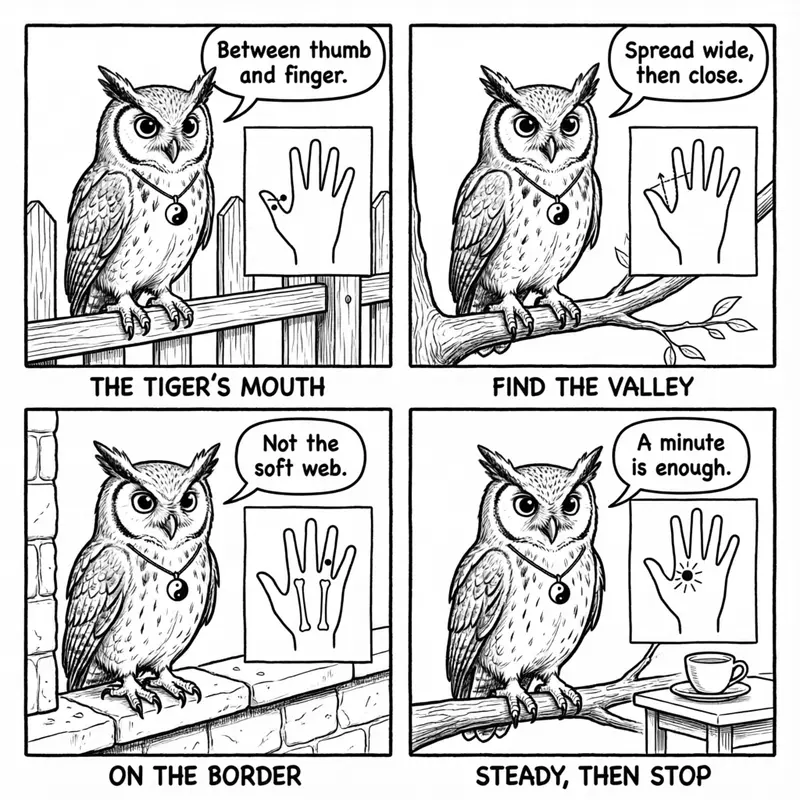
Ollie's take: Hoo-hoo! Pinch the valley, breathe, and stop before your hand goes numb. A minute is longer than you think.
Somewhere right now, a person is stuck in traffic, squinting at windshield glare, and clamping a thumb into the web of the opposite hand. They may not know that Chinese medicine calls this point He Gu (Joining Valley) or that modern charts label it Large Intestine 4 (LI4). They only know that their mother, their martial arts instructor, or a coworker once told them: Squeeze right here when your head throbs.
That small patch of muscle is also the point most people outside China have heard of, thanks to acupressure charts and the occasional kung fu scene.
Ollie, perched on a stack of Ming-dynasty woodblock reprints, adjusts his miniature jade Yin-Yang pendant with one talon and clicks his beak. "Humans have remarkably squishy hands," he mutters, "which makes it very easy to poke the wrong spot and wonder why the headache is still there."
The Joining Valley in the Tiger's Mouth
To understand the point, look down at your hand. Open your palm and spread your thumb away from your index finger. In Chinese anatomy, the V-shaped webbing between those two digits is called hu kou, the "tiger's mouth."
The name He Gu paints a picture. He means to join, close, or meet; gu means a valley or ravine. When you spread your thumb wide, the valley opens; bring the thumb tight against the index finger, and the valley closes as the muscle bunches into a rounded mound.
Standard references put it like this:
- On the back (dorsum) of the hand, find the long bone running from the index knuckle toward the wrist: the second metacarpal.
- He Gu sits in the first dorsal interosseous space, on the radial side of the second metacarpal, roughly at the midpoint of that bone.
- Bringing your thumb flat against your index finger, so the muscle mound rises, helps you see the region; the point itself lies on the radial border of the bone, where a firm press gives a distinct, heavy sensation.
- Relax your hand, then press there with the opposite thumb, using steady pressure on the tissue over that edge rather than jabbing into the soft webbing.
Many people feel a dull, heavy ache here, the sensation Chinese medicine calls de qi (the arrival of Qi). Not everyone does, and ordinary pressure can ache too, so treat it as a description of the tradition rather than a pass-fail test.
In Chinese medicine's home tradition, pressing the tiger's mouth is described as an everyday habit. A toothache, a dizzy spell, a headache coming on: someone reaches for the spot and presses until the other person winces. Nobody calls it a miracle; they call it common sense.
The Meridian Path: Why a Hand Point Reaches the Face
Here is what trips people up: a hand point should not fix a headache, not in the Western map anyway.
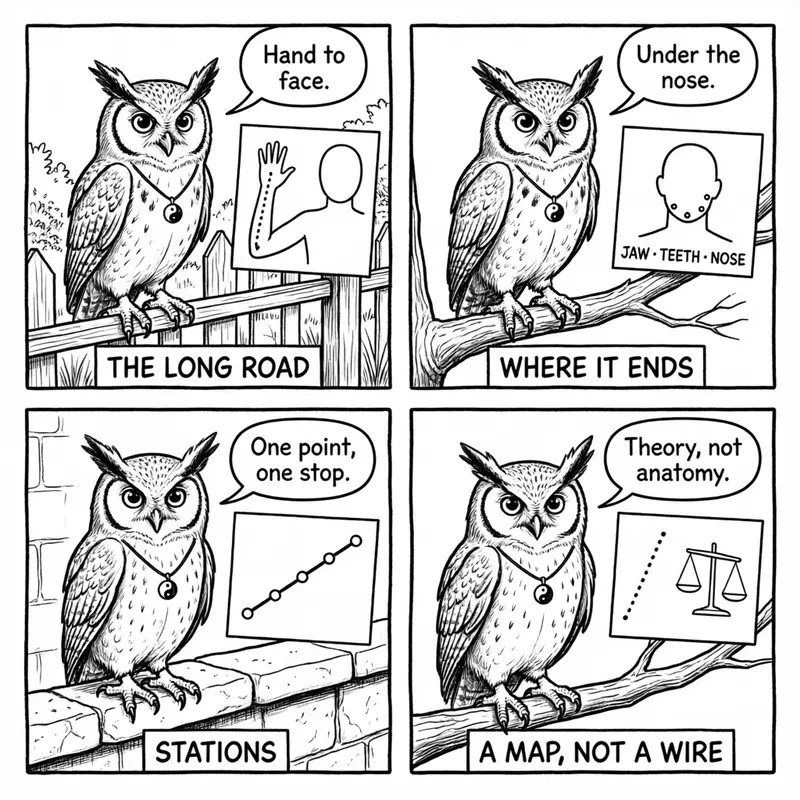
In the traditional model, the body's surface is mapped by twelve primary channels or meridians (jing luo): a network of relationships linking the limbs to the internal organs, not a dissection of muscle, fascia, or nerve. He Gu sits on the Hand Yangming Large Intestine channel (Shou Yangming Dachang Jing).
The channel is described as starting at the tip of the index finger, running along the edge of the hand through He Gu, traveling up the outer side of the forearm, crossing the crest of the shoulder, climbing the neck, passing across the lower cheek, entering the lower gums, curving around the lips, and crossing under the nose to end beside the opposite nostril.
In classical theory, a point influences everything along its channel, and the Large Intestine channel is described as reaching the jaw, teeth, cheek, and nose. On that logic, the tradition holds that a point on the hand can clear tension in the face and skull.
He Gu holds special rank on this channel: it is the Yuan-Source point (yuan xue). In classical theory, Yuan-Source points are where an organ's core Qi rises close to the surface, like a spring feeding a stream, so, within that framework, working one is understood to reach the channel's deeper reservoir rather than only surface tension.
Ollie tilts his head ninety degrees, ear tufts flattening against his skull, and fixes his round yellow eyes on my notebook. "A direct telephone wire from the claw to the beak," he observes. "Though why you would want a channel named after an intestine running through your nose is a question best left to human philosophers."
The Four Command Points Song
During the Ming dynasty, an acupuncturist named Gao Wu compiled a collection of classical wisdom titled Zhen Jiu Ju Ying (Collected Gems of Acupuncture and Moxibustion, 1529). In it, he recorded a short mnemonic verse known as the Si Zong Xue Ge (The Four Command Points Song).
Rhythmic songs were a standard way to memorize clinical maps, and this verse names four points that govern four regions of the body:
- Belly and abdomen: Zu San Li (ST36)
- Low back and lumbar: Wei Zhong (BL40)
- Head and nape: Lie Que (LU7)
- Face and mouth: He Gu (LI4)
That final line, mian kou he gu shou ("face and mouth belong to He Gu"), became a rule of thumb for five centuries of practitioners. The verse itself ties the face and mouth to He Gu; over time practitioners extended it to a wider range of upper-body complaints, from a clamped jaw to a throbbing forehead.
The logic rested on the Yangming system. In channel theory, the Yangming (Bright Yang) pair consists of the Stomach and Large Intestine channels. Because they are considered rich in both Qi and Blood, points along them are described as strong movers, capable of clearing heat and breaking through stagnation in the upper body.
What the Classical Texts List
Open a classical compendium like the Zhen Jiu Da Cheng (The Great Compendium of Acupuncture and Moxibustion, 1601) and He Gu appears on page after page.
The historical indications read like an inventory of upper-body discomforts:
- Head and Face: One-sided headaches, frontal headaches, dizziness, facial swelling, and jaw stiffness. It points He Gu toward frontal and one-sided headaches tied to wind or Yangming heat. In the tradition's pattern reading, vertex headaches point to Liver patterns and call for different points, while occipital tension leads practitioners toward Bladder-channel work.
- Eyes, Ears, and Nose: Red and painful eyes, nosebleeds, loss of smell, and chronic nasal blockage.
- Mouth and Throat: Toothache (especially in the lower jaw), gum swelling, sore throat, and loss of voice.
- External Pathogens: Classical texts describe He Gu as a tool for "expelling wind" (qu feng) and clearing "wind-heat" (feng re). This refers to the early stages of seasonal chills, body aches, stiff necks, and hot, irritated fevers.
- Pain Anywhere in the Body: Because of its role as a Yuan-Source point on a Yangming channel, older texts often paired it with Tai Chong (LR3, on the foot) in a combination known as the "Four Gates" (Si Guan), said to open circulation throughout the body.
Classical texts also record another action within the traditional model: He Gu is said to move Qi strongly downward. On that reasoning, historical practitioners used it to hasten delayed labor and help expel a retained placenta.
That downward action is the origin of a three-part picture: classical texts list the point for labor, modern textbooks advise against strong, unsupervised stimulation during pregnancy, and the clinical evidence that ordinary acupressure here can induce labor remains limited. Practically, that means a traditional precaution plus a conversation with an obstetric professional, not a settled proof of danger.
What Modern Laboratory Research Found
Researchers have spent decades testing this ancient point, starting with a simple question: does needling it produce changes beyond placebo?
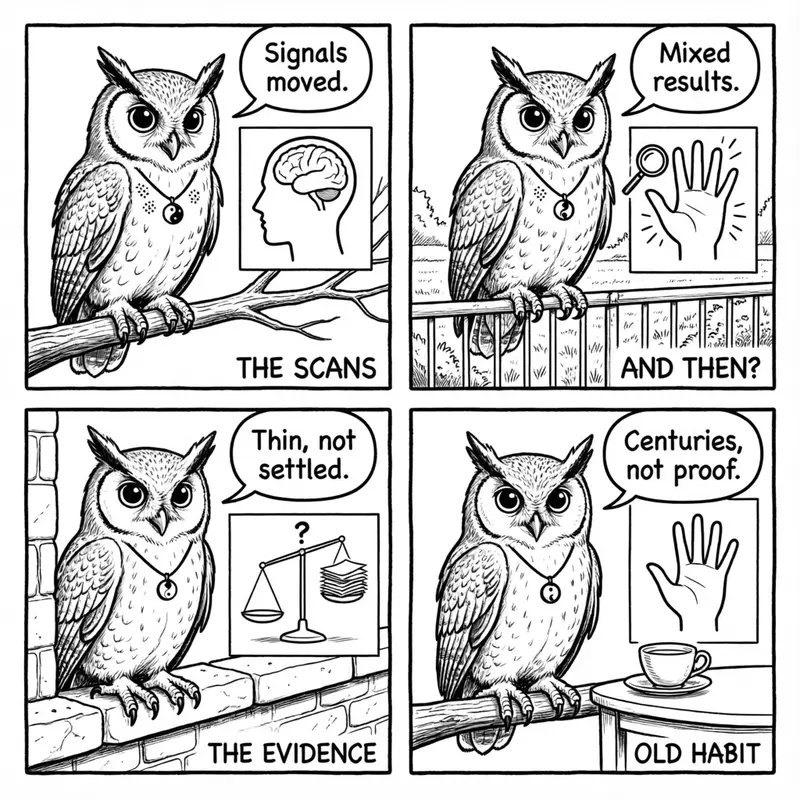
A landmark 2000 study led by Dr. Kathleen Hui at Harvard Medical School used functional Magnetic Resonance Imaging (fMRI) to scan healthy volunteers while needles were inserted into LI4. The scans reported signal decreases in parts of the limbic system and subcortical gray structures, areas involved in how pain and emotional distress are processed. The study measured brain-signal changes during stimulation, not pain relief; it did not test effects beyond placebo, and it establishes nothing specific about LI4.
Small trials have tested acupressure at LI4 for tension headaches and other pain, with mixed results. The nearest systematic reviews — Cochrane reviews of acupuncture for preventing tension-type headache and of acupuncture or acupressure for labor induction — cover needling more than home acupressure; the labor review found no clear benefit, with low-certainty evidence.
Read these studies with clear eyes. The trials suffer from small samples, varying techniques, and imperfect "sham" controls, and the evidence remains mixed and debated. Pressing tissue in the hand does stimulate sensory nerves, and sensory stimulation of any kind can engage the body's own descending pain-modulation circuits. That effect is not specific to this point, and it does not establish that LI4 relieves headaches. Nothing here has validated the existence of invisible energy channels either.
Chinese medicine does not need He Gu to behave like a modern drug for the point to matter. Its value sits in centuries of observational practice and a working model of how the body's regions communicate.
How to Work the Point (And When to Step Back)
Acupuncturists use fine, sterile needles on He Gu, often 10 to 20 mm deep, aiming for that heavy de qi sensation. At home, acupressure is the standard method.
If you want to explore it yourself:
- Find the Point: On the back of your opposite hand, find the second metacarpal bone and press just to the thumb-side of it, around the bone's midpoint.
- Apply Steady Pressure: Press toward the radial border of the second metacarpal, the edge facing the thumb. No need to jab or dig underneath the bone; firm, steady pressure is enough until a dull ache spreads through the web of the hand.
- Breathe and Hold: Keep the pressure for 30 to 60 seconds while breathing slowly from your belly. Hold still, or move your thumb in tiny circles.
- Switch Sides: Release slowly and repeat the process on the other hand.
Two boundaries apply: strong stimulation is traditionally avoided during pregnancy (check with an obstetric professional first), and you should skip areas with broken skin, bruises, infection, or inflammation. Gentle pressure is the point; force is not.
This is self-care, not emergency medicine. Forceful pressure can cause pain or bruising, so ease off if it stings or burns. A severe, sudden, or persistent headache (especially with neurological symptoms) needs medical evaluation rather than acupressure. Anything that worries you is worth raising with a professional.
Summary of the Tradition
He Gu endures because it carries the core elegance of Chinese thought: the idea that distant parts of a whole are in constant conversation. You do not always resolve a disturbance by striking at its center; sometimes you quiet the storm at the summit by tending to the valley down below.
Ollie Speaks: I adjust my jade pendant with one talon, fluff my chest feathers, and peer down at my own zygodactyl feet: two toes forward, two back, excellent for snatching field mice, terrible for classical acupressure. Humans are endlessly proud of their opposable thumbs, and I'll admit two flexible digits make finding He Gu easier. Owls have no thumbs, so you will never catch me pressing a valley between my toes and calling it medicine.
When I watch people poke their own hands, they look frantic: sharp fingernails, gritted teeth, three seconds of pinching, as if that could undo six hours in front of a glowing screen.
Chinese medicine was never a collection of panic buttons. He Gu belongs to a whole system: balance, breath, movement, all of it woven together. When I watch humans press the point, the ones who seem to settle most are the ones who slow down first. They drop their shoulders. They unclench their jaw. They take a breath. The valley between your fingers has been there for five hundred years. It is not going anywhere.
FAQ
Where exactly is He Gu, and how do I find it?
He Gu sits on the back of your hand, in the first dorsal interosseous space: on the radial side of the second metacarpal bone, the long bone running from the index knuckle toward the wrist, around its midpoint. Bringing your thumb flat against your index finger helps the muscle mound rise, but the point itself sits on the radial border of that bone. Press there with the opposite thumb, firmly and steadily. A dull, heavy ache is the traditional sign of de qi, though not everyone feels it; sharp or stinging pain means ease off.
Why would a point on my hand affect my head?
In Chinese medicine the body is mapped as a linked system, not a set of isolated parts. Think of the Large Intestine channel as a subway line: in that traditional map it starts at your index finger, runs up your arm, crosses your shoulder, and ends at your nose. He Gu is a major station on the line. Some small fMRI studies have reported changes in brain activity when LI4 is stimulated in healthy volunteers: interesting, but not the same as showing that the point relieves headaches. Those scans also cannot confirm that channels exist as physical structures.
Is it safe to press He Gu myself?
Gentle to moderate acupressure on He Gu is generally described as low-risk self-care: the usual downsides are soreness or a small bruise, and firm pressure can leave the hand tender. Never press over broken or infected skin. Use steady pressure for 30 to 60 seconds and ease off if it stings. Because classical texts describe this point as strongly moving Qi downward, textbooks advise against strong, unsupervised stimulation during pregnancy; if you are pregnant, ask an obstetric professional first. A severe, new, or persistent headache, or one with neurological symptoms, needs medical evaluation rather than acupressure.
Sources
- Huangdi Neijing, Lingshu — classical foundations of the channel system.
- Si Zong Xue Ge (Four Command Points Song), in Gao Wu's Zhen Jiu Ju Ying, Ming dynasty, 1529.
- Zhen Jiu Da Cheng (The Great Compendium of Acupuncture and Moxibustion) by Yang Jizhou, 1601 — classical compendium of point locations and indications.
- Deadman, P., Al-Khafaji, M., & Baker, K. A Manual of Acupuncture. Journal of Chinese Medicine Publications, 2007 — modern standard reference for channel pathways and clinical cautions.
- Hui, K. K., Liu, J., Makris, N., et al. "Acupuncture modulates the limbic system and subcortical gray structures of the human brain: evidence from fMRI studies in normal subjects." Human Brain Mapping, 2000; 9(1): 13–25.
- Linde, K., Allais, G., Brinkhaus, B., et al. "Acupuncture for the prevention of tension-type headache." Cochrane Database of Systematic Reviews, 2016; 4: CD007587.
- Smith, C. A., Armour, M., & Dahlen, H. G. "Acupuncture or acupressure for induction of labour." Cochrane Database of Systematic Reviews, 2020; 10: CD002962.