The 8 "Extraordinary" Vessels: What Makes Them Special?
 Ollie's Take
A slim metal needle rests in the skin of the inner wrist, just above the styloid process. The point is Lieque, the seventh point on the Lung channel. After inserting the needle, the practitioner steps back and explains that this point is being used to open the Conception Vessel.
The Conception Vessel runs along the front midline of the torso, nowhere near the thumb or the radial artery. It does not belong to the Lungs. In classical theory, it does not belong to any single internal organ.
That small mismatch is the doorway into the system's second layer. Beneath the familiar twelve primary channels lies an older network known as the eight extraordinary vessels (qi jing ba mai). Once the second layer clicks, a treatment that works a wrist point for a pelvic or sleep complaint stops looking arbitrary. A practitioner may pair Lieque on the wrist with Zhaohai near the inner ankle when a pattern includes sleep problems, urinary symptoms, or reproductive complaints --- not because one wrist point reaches the pelvis, but because the pair is traditionally used to engage Ren Mai inside a larger pattern.
Ollie's take: Preen your feathers. Do not scrape a stranger's back.
Rivers and Reservoirs: The Two-Layer Map
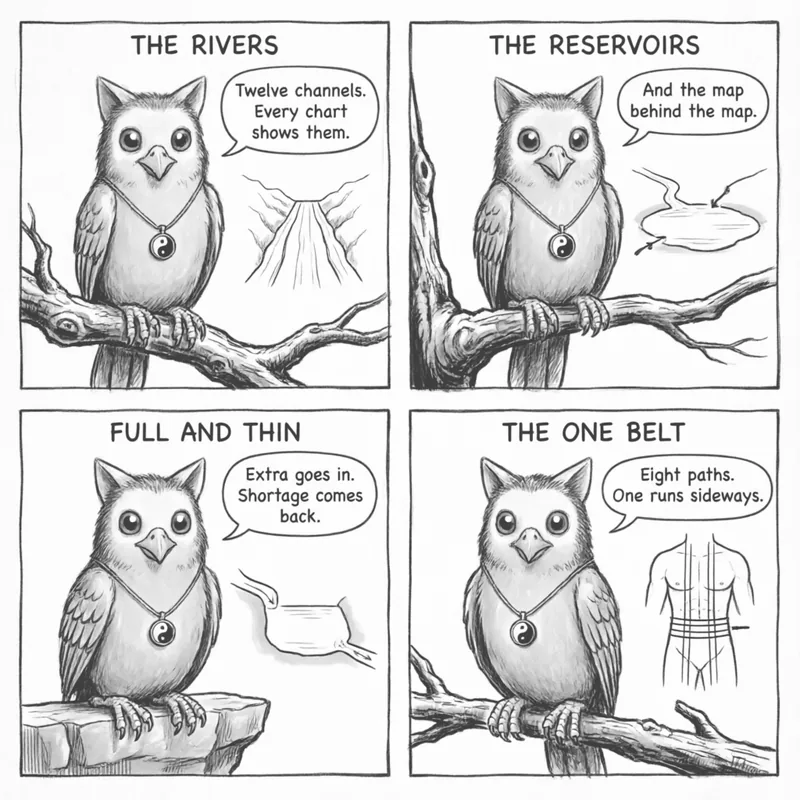
Every standard acupuncture chart shows twelve primary channels. These channels behave like rivers. Each one connects directly to an internal organ, pairs with a partner in a Yin-Yang relationship, and carries Qi in a steady, twenty-four-hour circuit across the body.
The eight extraordinary vessels are organized around a different clinical logic, though they stay closely connected with the primary channels. Classical texts describe them not as rivers, but as lakes, ditches, and reservoirs. When heavy rains fill the riverbeds, the excess water spills outward into the surrounding basins. When dry weather sets in, those same basins feed water back into the main streams.
In the body, the primary channels handle everyday circulation. Classical texts use reservoir language here: the vessels are described as regulating excess and shortage in the primary channels. This is a theoretical model within Chinese medicine, not a claim that the vessels are anatomical storage tanks. That regulatory role is the central idea behind the entire network.
Ollie, our resident screech owl, likes to observe this dynamic from his branch. To a bird who tracks streams across the forest floor, the logic is plain: moving currents keep the valley green, but deep lakes keep the rivers from drying up in the heat.
Two Thousand Years of Footnotes: Where the Idea Began
The concept did not appear all at once in medical history. Individual vessels received brief mentions in the earliest surviving medical compendiums, the Huangdi Neijing (Suwen and Lingshu). Those early chapters recorded specific pathways along the spine or abdomen, but they did not treat them as a single organized family.
That systematic shift is traditionally credited to the Nanjing (The Classic of Difficult Issues), a text dated to the Han period and probably shaped by more than one hand. Difficulties 27 and 28 set out the vessels' distinct status and pathways, and the way those passages describe their relationship to the primary channels is the source of the later reservoir interpretation. Difficulty 29 turns to channel pathology more broadly.
Centuries later, Ming dynasty physicians expanded on how to apply these ideas. Li Shizhen gave the subject a dedicated treatment in Qijing Bamai Kao (An Examination of the Eight Extraordinary Vessels). That discussion, together with material in his writings on pulse diagnosis and materia medica, helped shape later clinical interpretations of the vessels and their confluent points.
The Neijing preserves some of the earliest observations, the Nanjing organizes the vessels more systematically, and later physicians developed their clinical applications.
Why "Extraordinary"
The word translated as "extraordinary" is qi --- not the qi that means vital energy, but a different character with a rising tone, meaning unusual or odd, as in an odd number without a partner. These eight were the odd ones out.
Four specific characteristics separate these eight pathways from the twelve primary channels:
First, they are not assigned to one organ the way the primary channels are. The Heart channel belongs to the Heart; the extraordinary vessels are not tied to a single zang-fu organ --- though several of them have close classical relationships with the Kidneys, the Heart, the uterus, and the movement of Qi and Blood.
Second, they have no interior-exterior pairs. The primary channels come in couples --- Lung with Large Intestine, and so on --- that balance each other across the inner and outer surfaces of a limb. These eight do not pair up that way.
Third, they sit outside the daily circulation model. The primary channels are described as passing Qi from one to the next in an unbroken loop. The extraordinary vessels are not part of that schedule; classical theory describes them as reservoirs that receive or supply Qi and Blood when the primary channels run full or thin.
Fourth, only two of the eight carry their own acupuncture points. The Governing and Conception Vessels run along the body's midlines and have points of their own; the other six borrow points from the twelve primary channels.
The Central Lines: Du Mai and Ren Mai
The two most visible extraordinary vessels form a vertical loop around the trunk of the body. Because they contain their own dedicated points, modern textbooks frequently teach them alongside the twelve primary channels.
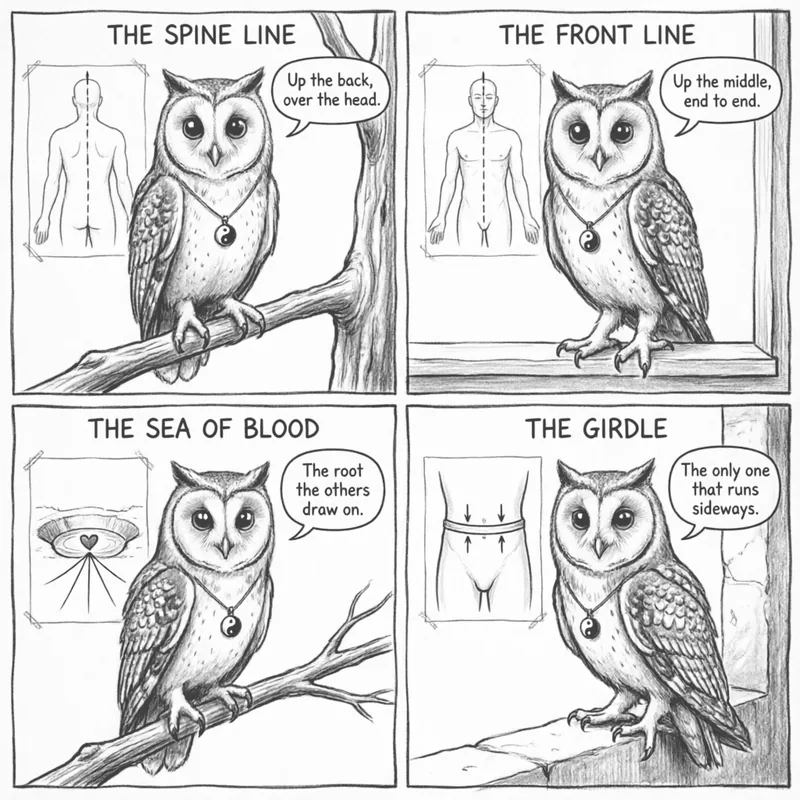
Du Mai, the Governing Vessel, travels up the midline of the back. It starts in the pelvic cavity, ascends through the spinal column, arches over the crown of the head, and terminates inside the upper lip. Classical theory calls it the "Sea of Yang." It gathers the Qi of all the yang channels that traverse the back and limbs, making it a central reference point in traditional discussions of spinal alignment and back tension.
Ren Mai, the Conception Vessel, travels up the midline of the front. It rises from the pelvic floor, ascends along the abdomen and chest, and ends just below the lower lip. The tradition calls it the "Sea of Yin." It is associated with the yin channels and with the front of the body, especially the abdomen, chest, and reproductive system. Du Mai and Ren Mai anchor the midline. Six vessels remain.
The Core, the Belt, and the Weavers
The Chong Mai, often translated as the Penetrating Vessel, is associated with the lower abdomen, the chest, and the movement of Qi and Blood through the whole body. Classical texts call it the "Sea of Blood" and the "Sea of the Twelve Channels" --- a way of describing its broad influence, not a literal location.
The Dai Mai, or Girdling Vessel, is unique: it is the only horizontal pathway in the body. Wrapping around the waistline like a belt, the Dai Mai binds all the vertical channels together. It holds the upward and downward flows of Qi in structural harmony, preventing the lower body and upper body from drifting out of balance.
The Linking Vessels—Yin Wei Mai and Yang Wei Mai—act as dynamic nets. The Yin Wei Mai links the yin channels and is classically associated with the interior, the Heart, and the chest. Modern practitioners sometimes discuss emotional symptoms here too, but that is a clinical reading rather than a definition. The Yang Wei Mai connects the yang channels and is classically associated with the body's exterior, the lateral regions, and patterns of alternating chills and fever. Modern practitioners sometimes read it through broader ideas of adaptation and outside stress.
Finally, the Motility Vessels—Yin Qiao Mai and Yang Qiao Mai—govern stepping, agility, and muscular balance. Originating at the inner and outer heels, they ascend to the inner corners of the eyes. Yang Qiao Mai is associated with the lateral, yang side of movement and with wakefulness; Yin Qiao Mai with the medial, yin side, with inward movement, and with the ability to close the eyes and rest.
Opening the Reservoirs: The Eight Confluent Points
Because six of these vessels do not possess their own designated points, ancient practitioners discovered a practical bridge: the Eight Confluent Points (Ba Mai Jiao Hui Xue).
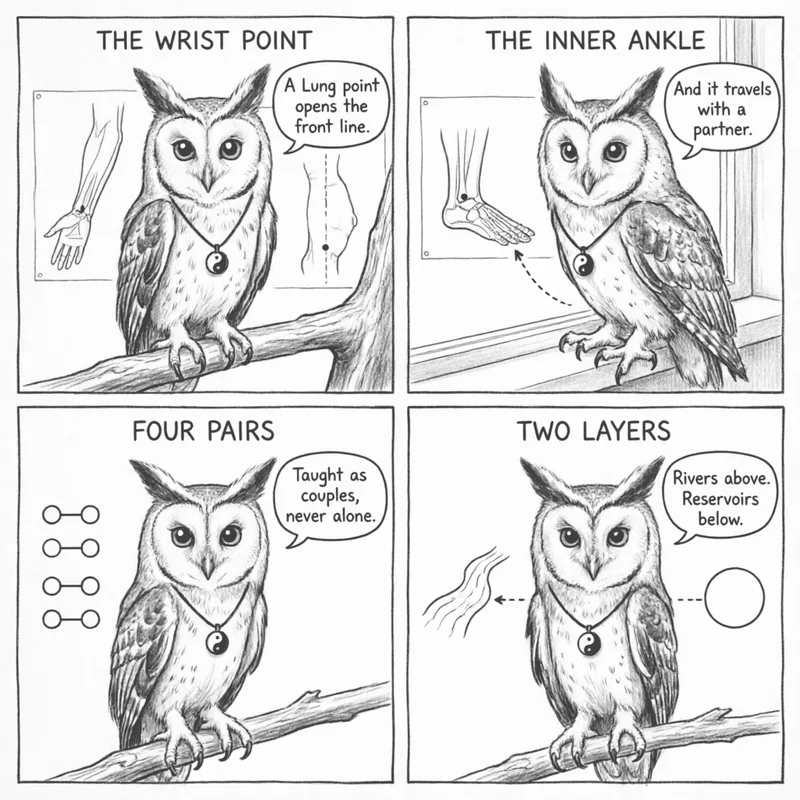
These special points sit on the primary channels below the elbows and knees. By needling a single confluent point, an acupuncturist opens the gateway to an entire extraordinary vessel --- in the classical account. This is not a do-it-yourself map; point selection and needling belong with a qualified practitioner. For example, needling Lieque (LU-7) on the wrist accesses the Conception Vessel, while Shenmai (BL-62) on the outer ankle opens the Yang Motility Vessel.
Practitioners usually work them in matched pairs, an arrangement later teachers described as master and guest: Lieque on the wrist with Zhaohai at the inner ankle; Houxi at the outer hand with Shenmai at the outer ankle; Neiguan on the inner forearm with Gongsun on the inner foot; Waiguan on the outer forearm with Zulinqi on the outer foot. Each pair joins one vessel with its partner, which is why teachers present them as pairs rather than one at a time.
The Language of the "Seas"
Classical Chinese medicine frequently turns to oceanic metaphors to describe these deep channels. The Lingshu describes four seas: Marrow (the brain), Qi (the chest), Water and Grain (the stomach), and Blood. Separately, later channel theory identifies the Chong Mai as the Sea of Blood, tying that vessel to the storage and movement of Blood.
These designations highlight the sheer holding capacity of the extraordinary vessels. While a primary meridian works like a river delivering nourishment to a single valley, a Sea holds the vital substance for the entire territory. When the body encounters deep exhaustion or structural shifts, practitioners look past the rivers and draw upon these great inner oceans.
Ollie blinks at all the ocean talk. A reservoir, he seems to think, matters most when the streams run thin --- a reminder that these vessels were built to explain depth and reserve, not every passing ache.
Modern Perspectives and Research
For decades, the extraordinary vessels remained somewhat enigmatic in the West, often treated as advanced or esoteric theory. That perspective shifted with the work of writers such as Giovanni Maciocia, whose book on the secondary channels and extraordinary vessels bridged classical sources and clinical practice, and Charles Chace and Miki Shima, whose exposition of the vessels reads the classical texts closely.
Scientific interest in these ancient pathways continues to evolve. A 2025 modelling study in Briefings in Bioinformatics used time-resolved colored Petri nets to simulate how the eight vessels might behave as a regulatory network (Gan et al.). Their model treats the vessels as dynamic buffers, a computational reading of the classical reservoir image rather than a measurement of it. Whether that resemblance means anything beyond the model is an open question.
Understanding the eight extraordinary vessels reveals that Chinese medicine is far more than a simple map of individual points. It is a multi-layered regulatory system, using deep reservoirs to keep our everyday rivers flowing smoothly.
Ollie Speaks
Ruffles feathers and tilts head.
Hoot! Looking at the body's channels from high up in my oak tree makes the whole picture clear. Most folks spend their time watching the busy little streams on the surface, but an old owl knows that the deep pools underneath are what really keep the forest alive.
Adjusts jade pendant with a quiet tap of the beak.
In the traditional model, the vessels are the body's storehouses --- a second layer built for the moments when the everyday currents run thin or too full. Next time you see an acupuncturist work a point on the wrist or ankle for a complaint somewhere else entirely, this pairing system is part of how the choice gets explained.
If a practitioner ever mentions one of these vessels in your own case, it is fair to ask which classical signs pointed there, how the vessel connects to the rest of the pattern, and what change would suggest the approach is working.
FAQ
When do practitioners choose extraordinary vessels over primary channels?
A practitioner does not reach for an extraordinary vessel just because a problem is long-running or severe. The choice runs on pattern differentiation: where symptoms sit, what the tongue and pulse show, the person's history, and whether the classical indications fit. A single blocked channel or a fresh exterior pattern usually belongs to the primary channels. Different vessels carry different associations --- the Chong Mai with Blood and reproductive patterns, the Dai Mai with girdling and lower-body presentations, the Qiao vessels with movement, posture, and sleep --- but those sit underneath the full pattern, not above it.
Do all eight extraordinary vessels have their own unique acupuncture points?
No, only two of the eight extraordinary vessels feature their own dedicated acupuncture points. The Governing Vessel, known as Du Mai, and the Conception Vessel, known as Ren Mai, possess their own midline points. The other six vessels do not have independent points along their pathways. Instead, they intersect with and borrow specific points from the twelve primary meridians. Acupuncturists access these six vessels through eight confluent master points situated on the hands and feet. Needling these master points acts like unlocking a gate, redirecting Qi into the deeper reservoir network.
How are the extraordinary vessels connected to everyday sleep and movement?
The Motility vessels, known as Yin Qiao Mai and Yang Qiao Mai, play a fundamental role in coordinating physical agility and the natural circadian cycle. In classical Chinese medicine, Yang Qiao Mai governs the active exterior and wakefulness, while Yin Qiao Mai governs the restful interior and sleep. Both vessels originate around the inner and outer ankle bones and ascend toward the eyes. When Yin and Yang within these channels remain balanced, the body moves with ease and transitions smoothly between day and night, opening the eyes for morning alertness and closing them for restful sleep.