
Does “Burning Weeds” Really Work?
 Ollie's Take
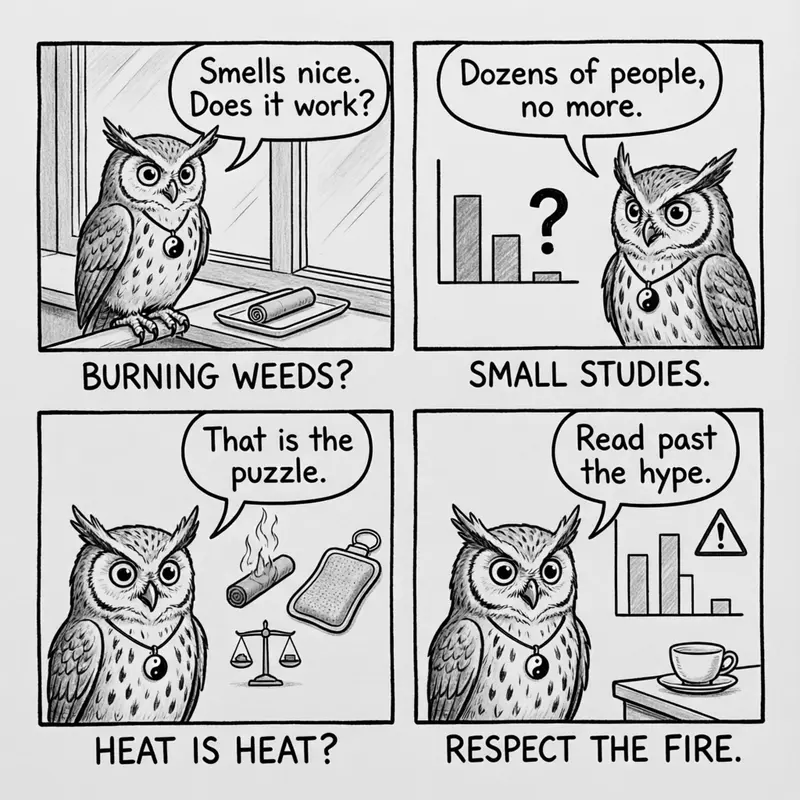
Ollie's take: Hoo-hoo! Warm is warm, and proof is proof. Keep the two apart and you will sleep better than anyone on the table.
To an outsider walking past an open clinic window, the scene looks bizarre: someone lying face down on a table while a practitioner waves a smoldering, cigar-shaped stick of dried plant matter two centimeters above their skin. The air smells like autumn leaves, cedar, and sage, and the patient's arm carries a faint line of goosebumps where the heat has already passed. To a hardened skeptic, this is burning weeds over a person's body and calling it healthcare.
To East Asian medicine, this practice is moxibustion, an ancient pillar of traditional therapeutics. We covered the physical mechanics in earlier articles. The question here is narrower. Strip away the history, the aroma, and the clinical reverence — what does the research say? Does holding glowing mugwort over specific points create measurable biological changes, or is it a smoky placebo?
After decades of trials, the answer frustrates everyone. It is not magic. It is not fraud. It is real heat doing real things, tangled up with small studies, cultural bias, and research that cannot fake a placebo smoke cloud.
A screech owl on the windowsill fluffs his chest feathers, blinks twice at the smoldering stick, and taps his jade yin-yang pendant against the sill. "Smells nice," Ollie mutters. "But does nice-smelling heat do anything special?" He settles in to watch, one talon curled over the windowsill edge.
The Shape of the Research: Small Numbers and Hard Blinds
Testing moxibustion to modern standards is hard. A blood pressure pill can be tested against an identical-looking sugar pill, neither side knowing who got what.
With moxibustion, that setup collapses.
A burning moxa stick runs hot enough to measure in the hundreds of degrees Celsius at its tip, though the exact figure varies with the product and the measurement, and the temperature delivered to skin depends on technique, distance, and site. It also gives off heavy, distinctive smoke that no sham device has successfully imitated.
Researchers have tried sham devices: insulating sheaths, non-burning moxa, electric heaters. Each has been tested, and each has limits; none fully reproduces the feel of burning moxa.
The research has three built-in problems. The trials are usually small, and large multi-site studies are rare. Many appear in Chinese-language journals, and reviews of that literature raise publication-bias concerns. And technique varies wildly — cones, sticks at different heights, moxa on top of needles, moxa over ginger. Pooling all that compares apples to oranges.
Reviews that pool the data for a specific condition have usually rated the certainty as low or very low, though a few outcomes, such as cephalic version in the breech trials, have reached moderate certainty. Low ratings do not mean moxibustion is proven false. They mean the trials carry too much risk of bias for confident conclusions.
The Clinical Audit: What the Trials Show
Here is what the trials show in the five most-studied areas.
### 1. Turning Breech Babies The most famous use of moxibustion in Western research is trying to turn breech babies head-down before labor, holding burning moxa near the outer corner of the fifth toenail, at Zhiyin (BL67), usually around weeks 33 to 35.
In 2012, Coyle, Smith, and Peat published a Cochrane review of randomized trials of moxibustion for breech version, comparing moxa to sham treatment, acupuncture, or standard care.
The picture has shifted slowly since. The 2012 review found the evidence too weak to support routine use; later analyses have reported that adding moxibustion to usual care may reduce non-cephalic presentation at birth, while rating most outcomes below high certainty. The honest reading is a qualified maybe, not a settled yes or no.
### 2. Calming Irritable Guts A common traditional use of indirect moxa is warming the lower abdomen for loose stools and cramping, at points such as Tianshu (ST25) and Shenque (CV8, the navel).
Several small randomized trials report lower irritable-bowel severity scores among participants who received moxibustion alongside usual care. Reviews of those trials have downgraded the certainty to low or very low, citing weak allocation concealment, small samples, and short follow-up. The signals are there; the foundation under them is not.
### 3. Stiff Knees and Aching Backs Small trials have tested it against knee osteoarthritis and chronic low back stiffness.
The published trials frequently show modest improvements in pain scores and joint mobility. When researchers pool these studies into meta-analyses, moxibustion shows statistical superiority over inactive controls. Yet the central problem remains: is the improvement driven by the specific herb and point selection, or is it simply the soothing result of applying 42 °C heat to a painful joint? Because sham devices fail to mimic real heat convincingly, isolating the specific mechanism remains an unsolved puzzle.
### 4. Wounds That Will Not Close Some East Asian hospitals have tested indirect moxibustion around non-healing pressure ulcers. The hypothesis: warmth dilates capillaries.
Small regional studies have reported faster wound closure when moxibustion accompanies standard dressing changes. They cluster in a few institutions, are rarely pre-registered, and stay small. Interesting signals, far short of consensus.
### 5. The Cancer-Support Question Oncology researchers have asked whether warming eases treatment-related fatigue, appetite loss, and nausea. Points such as ST36 and CV12 are standard choices.
Pilot trials report better quality-of-life scores among people who received supportive moxibustion alongside regular care. They are strictly exploratory: moxibustion is not a cancer treatment, and its value as comfort care is unproven.
The Heat Conundrum: Is It the Herb or Just the Warmth?
Here lies the fundamental knot of moxibustion research: heat feels good.
Apply thermal energy to skin and several things follow: local blood vessels dilate, heat receptors such as TRPV1 respond at higher temperatures (around 43 °C and up), and muscle fibers relax under sustained gentle warmth.
If you hold a ceramic heating element, an electric heat wand, or a roll of burning mugwort over an acupoint, all three produce thermal stimulation. Proponents of moxibustion argue that Artemisia argyi (mugwort) possesses distinct thermodynamic and biochemical properties that ordinary heating pads lack.
Laboratory work shows that burning mugwort emits infrared radiation across a range of wavelengths. Whether that particular spectrum does anything that ordinary heat cannot is not established.
Researchers have also isolated volatile compounds from moxa smoke, proposing that they might interact with smell or skin pathways.
These observations are legitimate hypotheses. The leap to "burning mugwort turns breech babies and settles inflamed intestines," however, requires clinical proof. That bridge has not been built.
Ollie shifts his weight from one claw to the other, ear tufts swiveling as he watches the practitioner guide the moxa stick in slow circles. "So it is warm," he says. "We know it is warm. The question is whether this warm thing beats any other warm thing — and nobody has figured out how to test that cleanly."
What the Classics Describe vs. What the Lab Measures
The framework behind it developed centuries before the thermometer or the clinical trial.
The Huangdi Neijing Suwen describes moxibustion as a therapy born in the cold, windy north of ancient China: where external cold settles into flesh and bone, needles alone cannot resolve the stagnation. Heat has to thaw the pathway.
Classical theory identifies mugwort (ai ye) as an herb of pure Yang character. In the Bencao Gangmu (Compendium of Materia Medica), Li Shizhen's 1596 pharmacological masterwork, the author recorded that aged mugwort penetrates all twelve primary channels, warms the interior, and expels deep cold-damp. Mencius gave the practice its oldest line in Li Lou Shang: "a seven-year illness seeks three-year-old moxa" — the tradition aged the leaves for years to get a gentler, deeper heat.
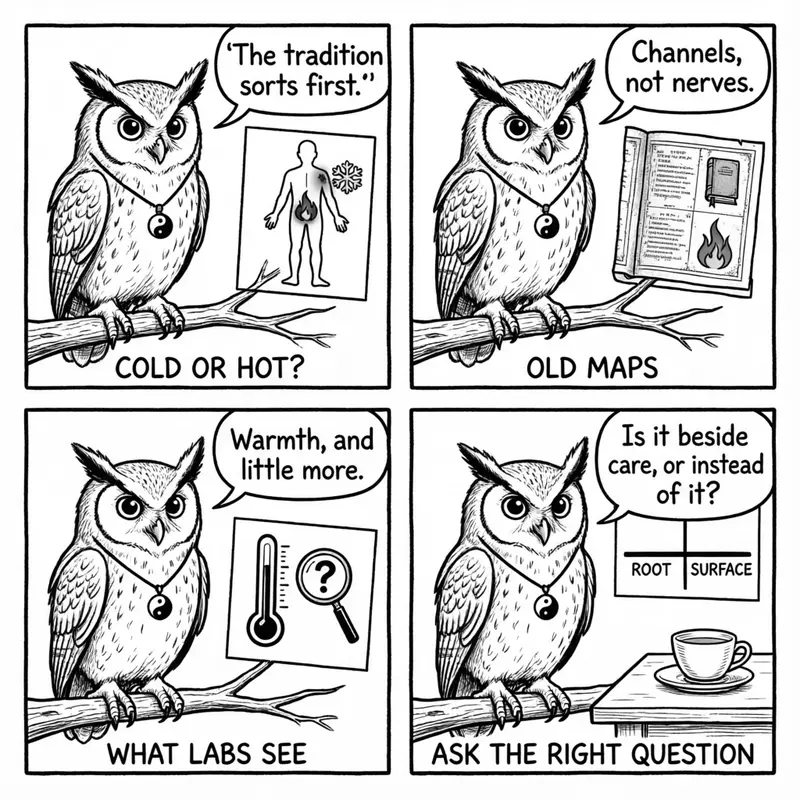
The tradition also draws a line between patterns that want warmth and patterns that do not. Cold patterns — pale tongue, slow pulse, a person who feels cold and craves heat — are what moxa aims at. Heat patterns run the other way: red tongue with yellow coating, rapid pulse, thirst, angry skin. The classical rule is blunt: han zhe re zhi, "what is cold is treated with warmth." Fire on an already hot pattern makes things worse. Deficiency can produce heat too: yin xu, yin deficiency, tends to show a red tongue with little coating and a thin, rapid pulse. Telling excess heat from deficiency heat is part of the tradition's differential work.
The classical framework describes energetic channels, pathogenic cold, and the movement of Qi and Blood. The modern laboratory describes cutaneous thermoreceptors, microcirculatory vasodilation, and systemic inflammatory markers.
The two systems speak different languages. A classical practitioner sees cold-damp expelled by Yang heat; a physiologist sees thermal analgesia and shifting blood flow. Claiming that modern physics has "proved" channel theory is dishonest. The models run in parallel: one an ancient navigation system, the other a materialist critique.
Real Fire, Real Smoke: Safety and Practical Risks
Because moxibustion relies on open combustion, it carries physical risks that acupressure does not.
### 1. Thermal Burns and Blisters The tip of a moxa stick runs above 500 °C. Held too close, dropped, or left unattended, it produces first- to third-degree burns. Historical "direct" moxibustion burned cones down to the skin on purpose, blistering it into permanent scars. Modern practice rarely uses scarring moxa; an accidental burn is a complication, not a technique.
### 2. Neuropathy and Blunted Sensation People with reduced sensation — diabetic neuropathy, advanced spinal stenosis, heavy pain medication — face the highest risk. Their nerves cannot gauge overheating, so burns can start before they feel anything.
### 3. Respiratory Irritation from Smoke Moxa smoke is not harmless herbal steam. It is combustion smoke containing particulate matter and gases whose exact mix varies by product and by room. In poorly ventilated rooms, sustained exposure causes eye irritation, coughing, and bronchospasm in people with asthma or COPD. Clinics mitigate this with smoke hoods, exhaust fans, or carbonized "smokeless" moxa.
### 4. Traditional Point and Physiological Cautions Classical texts caution against moxa on the face near the eyes, directly over major superficial vessels, and across the lower abdomen or low back during pregnancy — alongside one of the best-studied uses of all: moxibustion at BL67, on the toe, for breech presentation in late pregnancy.
A warning worth taking seriously: moxibustion is usually a practitioner's technique. The documented injuries are burns, blisters, and permanent scars, and the smoke is a lung irritant. Historical and modern sources record those risks with unsupervised use, and trials of moxibustion have mostly studied practitioner-administered protocols, with some allowing instructed home use.
The Honest Balance Sheet
Moxibustion is neither a panacea nor a parlor trick. It is old thermal technology: dried mugwort burned to warm a chosen spot.
The heat itself is measurable, and laboratory studies describe local vasodilation and short-term shifts in pain signaling during heating — findings that are usually reported as brief and non-specific. The lineage in texts like the Huangdi Neijing reflects centuries of careful observation.
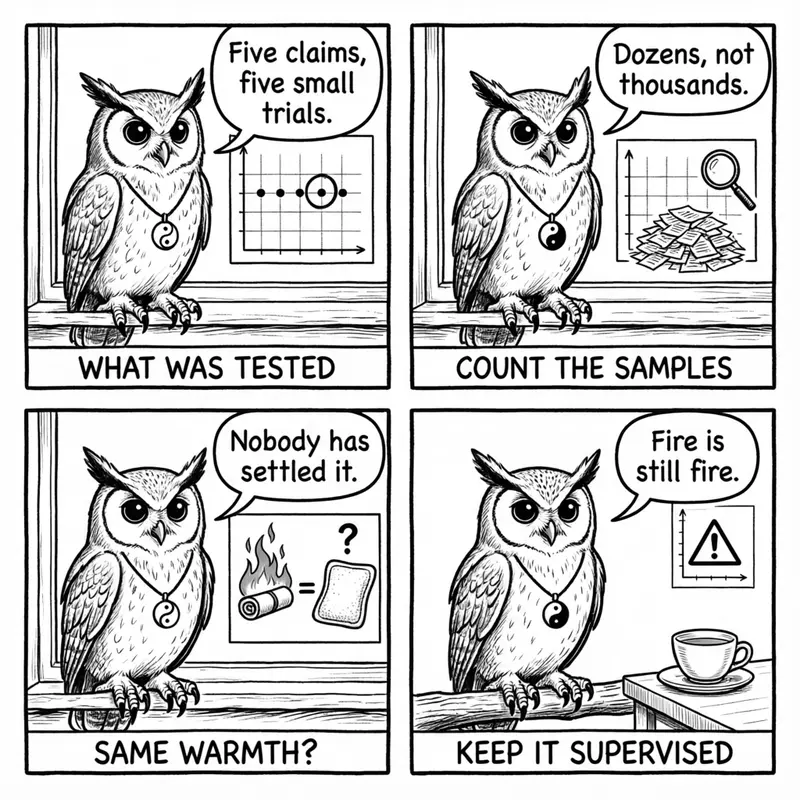
The clinical evidence stays thin. Reviews for specific conditions report low certainty, citing small samples, poor blinding, and uneven quality.
The honest summary is short: the warmth is real, the small trials on knee pain, low back pain, and irritable bowel symptoms are intriguing rather than convincing, and the proof is not there yet.
If You Are Curious
The unsettled evidence makes practical questions matter more. Who is holding the moxa, and is the room ventilated? Curiously, the most useful question is the last one: is moxa offered alongside ordinary care, or as a replacement for it? Trials have tested both; none of it makes moxibustion a substitute for indicated medical treatment.
Ollie Speaks: The screech owl shifts his weight on the cedar branch, lifts a claw to adjust the jade yin-yang pendant against his chest, and tilts his head ninety degrees at the glowing coal.
I am writing this from my branch, feathers fluffed, the jade pendant warm against my chest from the room's heat. I love the smell of burning mugwort — a crisp autumn evening in one breath. And gentle heat over a cold, aching muscle feels good.
But I like clear answers, and this research does not give me any yet. If a study looked at twenty-four people in one clinic and nobody checked whether the control group could smell smoke, that is not proof. It is interesting. It is unfinished.
Respect the fire — I have seen what an ember does to a feather. Appreciate the warmth for what it is. And keep asking for better trials.
FAQ
Can modern clinical trials definitively prove that moxibustion works?
No. The studies are small, clustered in one country, and hard to blind. Researchers have published hundreds of trials, but most use small groups. Reviews of that evidence usually rate its certainty as low, with a few outcomes reaching moderate. Blinding participants to distinct thermal sensations and pungent smoke presents an enormous methodological obstacle, making it hard to rule out placebo effects. Variations in technique and point selection add more noise. Large multicenter trials with standardized protocols are what the field still needs.
Is moxibustion identical to using an electric heating pad?
Not identical, but closer than the marketing suggests. A heating pad delivers steady, adjustable warmth with no smoke and no combustion. Moxibustion burns dried mugwort a few centimeters away, adding radiant infrared heat and airborne compounds. Classical theory attributes distinct energetic qualities to the burning herb, viewing it as a pure Yang agent that moves Qi and Blood. Modern laboratory research has measured specific infrared wavelengths emitted by smoldering moxa, but clinical trials have not demonstrated whether those properties produce better outcomes than simple, clean electrical heat.
What are the primary safety risks associated with moxibustion?
Burns, first and foremost. Smoldering herb rolls held too close cause painful burns, blisters, and sometimes permanent scarring. People with reduced temperature sensation face higher risk because they cannot gauge tissue overheating. The dense smoke also carries particulates and gases that irritate the airways, which makes ventilation essential. Clinics use smoke hoods and exhaust to lower that exposure. Finally, classical literature identifies specific anatomical areas, sensitive skin regions, and certain stages of pregnancy where applying direct or indirect thermal stimulation requires strict professional caution
Sources
- Coyle, M. E., Smith, C. A., & Peat, B. "Cephalic version by moxibustion for breech presentation." Cochrane Database of Systematic Reviews, 2012; 5: CD003928.
- Deadman, P., Al-Khafaji, M., & Baker, K. A Manual of Acupuncture. Journal of Chinese Medicine Publications, 2007 — channel theory, point locations, and traditional moxa methods.
- Huangdi Neijing, Suwen (The Yellow Emperor's Inner Classic, Basic Questions) — classical references to moxibustion and to the rule han zhe re zhi.
- Mencius (Mengzi), "Li Lou Shang" — the classical line about a seven-year illness and three-year-old moxa.
- Bencao Gangmu (Compendium of Materia Medica) by Li Shizhen, 1596 — the entry on mugwort (ai ye).
- Note on evidence: the trials summarized here are indexed under "moxibustion" in PubMed and the Cochrane Library. This essay summarizes the general tenor of that literature rather than restating each study; the Cochrane review above is the clearest single example.