How to Explain Moxibustion to Your Scared Partner
 Ollie's Take
You strike a match, the dark compressed stick begins to smolder, and within thirty seconds a thick, herbal plume rises toward the ceiling. Right on cue, the kitchen door swings open. Your partner freezes, looks at the glowing cylinder in your hand, glances nervously at the living room curtains, and asks the question they have clearly been rehearsing: "Please tell me you are not going to burn the apartment down."
To an outsider, it looks less like self-care and more like a visit from the fire department.
This is not a conversion script. Your partner does not need to believe in Qi to accept a contained routine; they need the mechanics, the boundaries, and the calm.
From his perch on the bookcase, Ollie watches with one talon curled tight, the way he sits whenever humans argue about smoke.
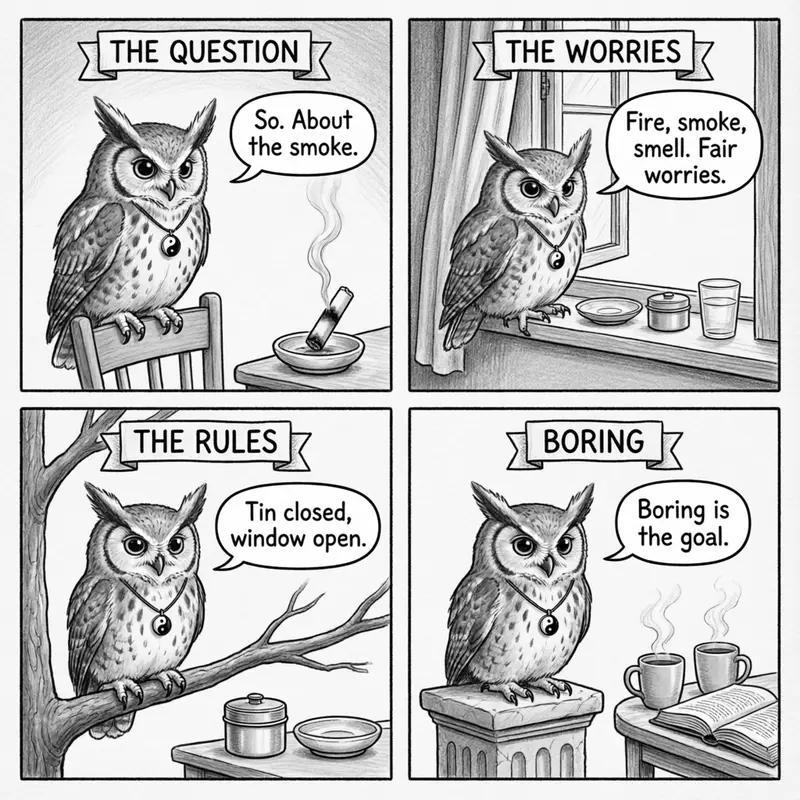
Ollie's take: Respect the ember and let the calm do the talking.
What They Are Afraid Of
A partner who objects is rarely debating theory; they are thinking about household threats.
First, fire: a glowing ember that stays hot for a long time. Second is smoke: particulate matter entering lungs, settling into wool coats, or sticking to sofa upholstery. Third is the possibility of skin burns. Then there are pets, building smoke detectors, and a quiet domestic anxiety: "I do not want to live with a hobby that puts our shared home at risk."
Early on, I tried telling a skeptical housemate that people have used this herb continuously for two thousand years across East Asia. The immediate, reasonable reply was: "People burned their houses down two thousand years ago, too."
Treat the conversation as a household safety negotiation; once your partner sees that you respect the shared space more than your own enthusiasm, tension drops.
What Moxa Is, in One Honest Paragraph
Moxa is dried, aged Chinese mugwort (Artemisia argyi, known in Pinyin as ai ye) ground, sifted into soft wool, and rolled into a tight stick. In home use, the lit tip stays two to three centimetres from the skin; it never touches the body.
The English word "moxa" came into European languages through Japanese, derived from mogusa, meaning "burning herb." In Chinese, the word for acupuncture is zhen jiu, translating as "needle and moxibustion"—needles are only half the system. The character jiu is written with fire beneath the component that gives it its sound. Moxa is not a scented candle, it is not incense, and it is not a cure.
In TCM theory, moxibustion belongs to the warming and supplementing methods, known as wen bu. The tradition describes it as expelling cold, warming the channels, and supporting Yang in the patterns it reads as cold or depleted. The classical rule han zhe re zhi holds that what is cold is met with warmth. It is not about cold hands on a winter day; patterns are read through the tongue, the pulse, and the whole picture, which is why a practitioner's assessment comes first.
The Fire Question, Answered Straight
Measured tip temperatures run into the hundreds of degrees Celsius. If pressed against bare skin, it produces an immediate burn. If knocked onto fabric, it can scorch or leave a burn mark. If left smoldering in a trash can, it can start a structure fire.
Documented burns stem from specific conditions: reduced nerve sensation (diabetic neuropathy, advanced spinal stenosis), falling asleep, multitasking, or holding a stick over a wriggling child or pet. Normal sensation is a useful warning, though attention does the real work.
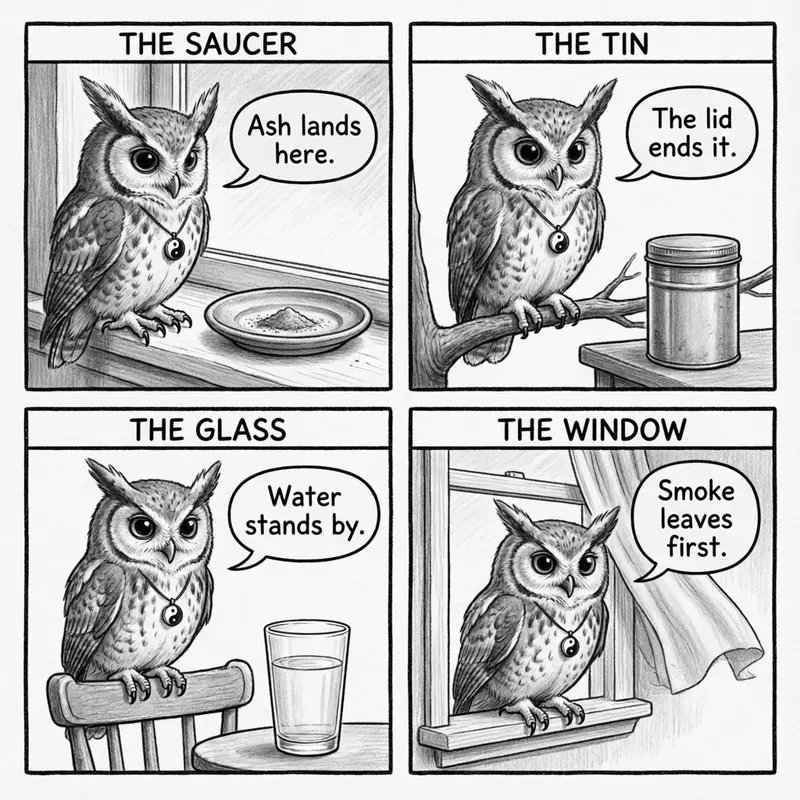
The containment setup itself is basic:
- A heavy ceramic saucer to catch falling ash.
- A dedicated metal tin with a tight-fitting lid or a brass moxa extinguisher to smother the ember.
- A glass of water within reach.
- An open window creating a steady outward draft.
The rule for pets and young children is absolute: out of the room, door latched, every session. A dog bumping your elbow turns a warm-up into a dropped coal. Smoke alarms detect particulate density quickly, so pick a well-aired room away from the detector. The fire is not the problem; unmanaged fire is.
The Smoke Question
Combustion smoke is airborne particulate matter, not purifying mist. In an unventilated room, smoke irritates eyes, tickles throats, and settles into fabrics. For households where someone has asthma, chronic obstructive pulmonary disease, or severe airway sensitivity, the smoke question is settled: do not burn standard moxa sticks at home. For those households, the answer is a clinic with professional ventilation, or nothing.
Ollie votes with the partner on this one: window open, or no session. He has seen what smoke does to feathers, and he is in no hurry for a repeat.
Ventilation is non-negotiable: the window opens before lighting, the interior door stays shut so smoke does not drift into shared living areas, and the room airs for half an hour afterward. The aroma is earthy and resinous, like autumn leaves, cedar, and sage. In a well-aired room with a cross-breeze, the scent dissipates within a couple of hours.
If the smell remains a sticking point, carbonized smokeless moxa sticks offer a practical compromise. These sticks emit far less smoke and almost no visible plume, though their heat varies by product and they lack the rich botanical aroma of raw aged leaf. Running a session while your partner is out, then airing the room, builds more goodwill than any reassurance.
What the Evidence Says
Published trials are small, and blinding is nearly impossible: nobody can be fooled about whether a glowing, aromatic stick is burning three centimetres away.
The most researched use is moxibustion at Zhiyin (BL67), the outer corner of the fifth toenail, between weeks 33 and 35 of pregnancy, traditionally used to encourage a breech baby to turn head-down. A 2012 Cochrane review led by Coyle, Smith, and Peat compared moxa with sham treatment, acupuncture, or standard care. It concluded the evidence was too weak for routine recommendation; later pooled analyses suggest adding moxibustion to usual care may modestly reduce non-cephalic presentation at birth. Most outcomes across the literature sit at low to moderate certainty.
Systematic reviews evaluating moxibustion for knee osteoarthritis and chronic low back pain show modest short-term improvements in pain and mobility scores compared to inactive control groups. Researchers still debate whether these benefits stem from the chemical properties of burning Artemisia argyi or from thirty minutes of targeted, relaxing local heat. Trials for irritable bowel patterns remain small with low certainty ratings. The honest stance is: "I like how it feels, and it is not replacing my doctor." Moxibustion is a comfort ritual, not a substitute for medical care.
Pick a Starter Kit That Will Not Alarm Anyone
Three starter options cover most homes.
The first option is the classic paper-wrapped moxa roll, which allows precise handheld control over a single point. The second option is a wooden moxa box, a container with a metal mesh screen that encloses the ember and rests stably over broader areas like the lower back. The third option is the carbonized smokeless stick, ideal for apartments with sensitive fire alarms.
Packages show grade ratios like 10:1 or 30:1: raw mugwort leaf in, refined floss out. A 30:1 stick means thirty kilograms of raw leaf became one kilogram of pale, soft floss. Higher ratios burn cleaner and more evenly, but a standard 10:1 or 15:1 stick is reliable and affordable for home use.
Keep your tool set minimal: a long-reach lighter, a saucer, and a metal extinguishing cap. Loose cones designed to burn directly on bare skin and blends with unlabeled additives are best left on the shelf; the supply itself keeps best dry and sealed.
The Ten-Minute Safety Ritual
There is an old working answer to how long: about ten minutes for a first session. The number matters less than the discipline behind it: a setup that never changes, a fire that never moves, and attention that never leaves the stick.
That discipline is why the practice is traditionally taught hand to hand. A practitioner shows the distance on a student's own skin, watches the student work, and only then lets them go alone. The details of angle, distance, and timing are the part a blog cannot honestly deliver. A practitioner guiding someone into home care teaches the boring version: same window, same saucer, same tin, same ten minutes.
The household rules never relax: a saucer for the ash, a lidded tin for the stick, water within reach, pets and children out of the room, and the window open while the stick burns and for a while after. A small notebook of what was done and how it felt is how this tradition has always learned, case by case, not guess by guess.
Pregnancy, circulation disorders, and reduced sensation raise safety questions that call for qualified medical advice rather than a living-room experiment. More than an occasional guided session should be learned from a practitioner's hands, not from a kit and a weekend of videos.
The Scenario Cheat Sheet
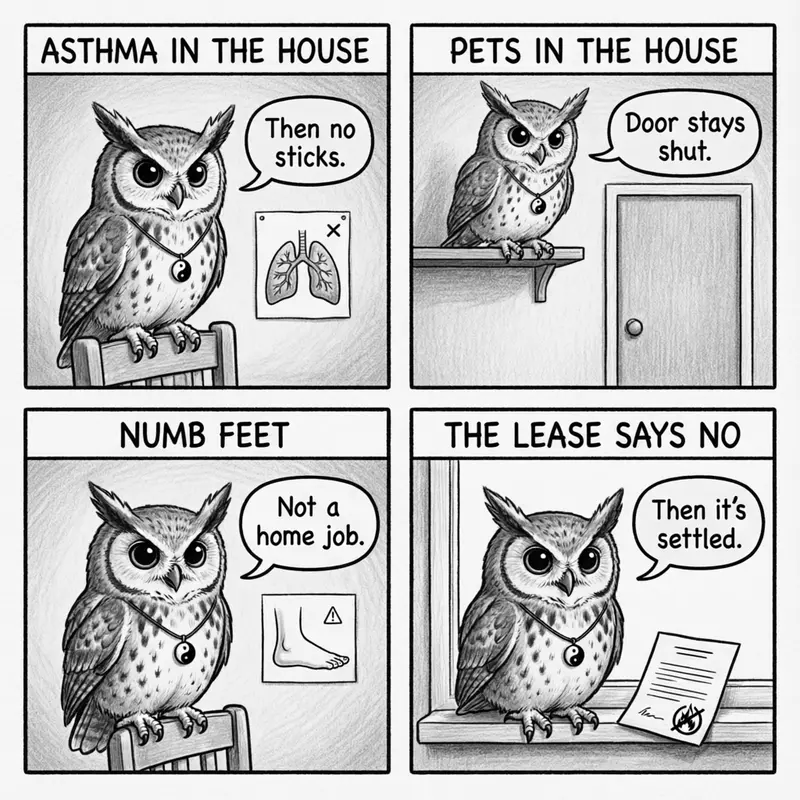
Your partner has asthma or reactive airways.
The smoke settles it: no sticks in the house; sessions belong in a clinic with professional ventilation.
Your partner hates the lingering herbal smell.
Switch to carbonized smokeless sticks, keep the window open, and wear a washable overshirt. Air fresheners only make the mixture heavier.
You have a curious cat or dog.
Practice behind a closed, latched door with the pet in another room. Never leave a smoldering stick unattended, even briefly to answer the doorbell.
Your apartment has sensitive alarms and a strict lease.
Check your lease agreement for open-flame restrictions. If allowed, use a covered moxa box positioned next to an open window with an exhaust fan moving air outward.
An older family member wants moxa for numb feet.
Reduced temperature sensation from conditions like diabetic neuropathy sharply raises the burn risk; this one calls for qualified medical advice rather than a home session.
Your partner thinks the whole concept is silly.
Do not argue or cite classical texts; run your routine cleanly and let the calm speak.
If They Still Say No
Shared living spaces require shared consent. If your partner still feels unsafe with open embers in the apartment, accept the boundary. A refusal of smoke in the living room is not a rejection of you.
Trust and domestic peace at home matter far more than winning an argument over a stick of dried mugwort.
You have alternatives: a community clinic once a week, a private patio on mild days, a hot water bottle. Some partners change their minds after watching you handle a few sessions with spotless fire hygiene; others never warm up to the smell. Both outcomes are fine.
The Warmest Room
It is a chilly Tuesday evening. The bedroom window is propped open two fingers wide, letting in a cool draft of fresh air. On the bedside table, the moxa stick rests inside its tin, clicking softly as it cools. The saucer sits clean and the aroma is already thinning in the breeze.
Two meters away on the sofa, your partner turns a page in their book without looking up. The smoke detector stays silent. Your shoulder carries a steady, comforting warmth that lingers long after the flame is out, and nobody had to call the fire department.
Ollie Speaks: Screech owls respect fire. A glowing coal cares only about oxygen and fuel, and feathers and smoke never mix. I keep an eye on anyone lighting matches in my territory.
When humans sit down with moxa, I watch how they prepare, ear tufts angled forward, one talon braced on the edge of my perch. The ones who set out water, a dish, and a tin first get to enjoy the warmth. My jade Yin-Yang pendant rests against my chest feathers as the ember fades safely into the tin.
If the person you live with is nervous, their instincts are keeping your shared nest intact. Trust that. Show them the metal box and the open window; an old tool can be handled with modern sense.
FAQ
Is it safe to do moxibustion at home?
In fire-safety terms, home moxibustion is manageable when an attentive adult uses indirect methods with strict containment, and hazardous when people ignore fire protocols, multitask, or apply heat over skin with reduced nerve sensation. Always keep a ceramic saucer beneath the stick, place a metal extinguishing tin on your table, keep pets out of the room, and open a window for proper ventilation. Direct applications, numb skin, the face, and pregnancy all raise safety concerns that call for qualified advice first.
Should I buy a moxa stick or a moxa box?
A standard paper-wrapped moxa stick gives you precise manual control for warming individual acupoints on the arms, legs, or shoulders. You hold it near the skin, feeling the radiant heat and moving the tip continuously to avoid hot spots. A moxa box is better for warming broader flat areas like the lower back. The box hides the ember behind a mesh screen that catches ash. If you want direct point accuracy, choose the stick; for hands-free coverage over a wider area, choose the box.
The smell bothers my partner. How do I get it out of the room?
Mugwort smoke carries a distinctive herbal scent that clings to fabrics if airflow is restricted. A window open before lighting and a shut interior door keep smoke from drifting into other rooms; after a session, the window stays cracked with an exhaust fan for half an hour. Switching to carbonized smokeless moxa sticks will cut odor and produce almost no visible plume. Store the moxa in an airtight jar; a dedicated washable shirt keeps the scent out of the rest of your clothes.
Sources
- Lu, G. D., & Needham, J. (2002). Celestial Lancets: A History and Rationale of Acupuncture and Moxa. Routledge.
- Deadman, P., Al-Khafaji, M., & Baker, K. (2007). A Manual of Acupuncture. Journal of Chinese Medicine Publications.
- Huangdi Neijing, Suwen — classical references to moxibustion and the therapeutic principle of han zhe re zhi.
- Li Shizhen. (1596). Bencao Gangmu (Compendium of Materia Medica) — monograph on mugwort (ai ye).
- Coyle, M. E., Smith, C. A., & Peat, B. (2012). "Cephalic version by moxibustion for breech presentation." Cochrane Database of Systematic Reviews, 5: CD003928.
- Zhang, Q., et al. (2024). "Moxibustion for Chronic Low Back Pain: A Systematic Review and Meta-Analysis of Randomized Controlled Trials." Medicine (Baltimore), 103(8).
- "Efficacy and Safety of Moxibustion Therapy for Knee Osteoarthritis: A Systematic Review and Meta-Analysis." Evidence-Based Complementary and Alternative Medicine, 2023.
- Note on evidence: the trials summarized here are indexed under "moxibustion" in PubMed and the Cochrane Library; this essay reflects the general tenor of that literature rather than restating each study.