
Why Grief Lives in Your Lungs
 Ollie's Take
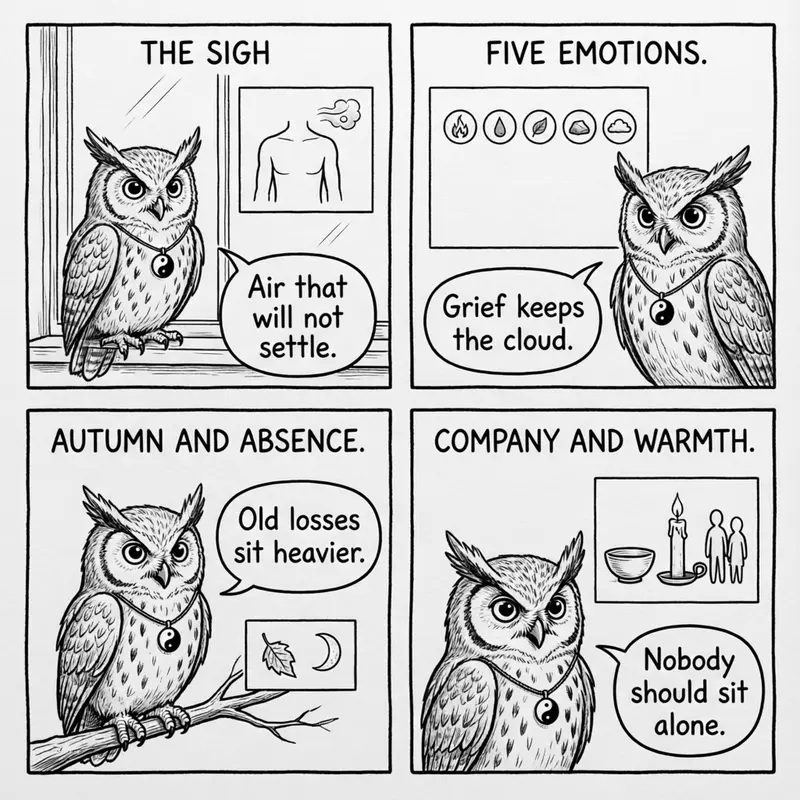
Ollie's take: Hoo-hoo! Owls sit with the grieving and say very little. It turns out that is most of the job.
The kitchen table is quiet. Across from you sits someone who lost a parent three weeks ago. They are talking about ordinary things — mail, the weather, groceries — when their speech falters. A long, shuddering sigh drops out of them without warning. Their shoulders curve inward, and when they speak again, the voice has thinned to a dry rasp.
Anyone who has sat with real sorrow recognizes this posture. The air stops moving into the belly. The ribs feel cast in iron, and breathing becomes work — like pulling water through a crimped straw.
Western culture tends to treat that collapse as metaphor. In Chinese medicine it is not figurative — but the association is not an anatomical claim either. The tradition maps emotions onto organs as a working model of function and relationship, and in that map grief belongs to the Lungs. The title of this article is a piece of that map, not a lab finding.
The Organ of Sighing
The classical five-phase system pairs each internal network with an emotion: anger with the Liver, excessive joy with the Heart, worry with the Spleen, fear with the Kidneys, and grief (bei) with the Lungs. Not every text uses the same list, and a few assign sorrow differently; the pairing of grief and the Lungs is the one that stuck, and it shapes how generations of practitioners listened to a grieving person.
The Huangdi Neijing (The Yellow Emperor's Inner Classic) does not offer these pairings as decoration. It treats emotional life as physiology: when an emotion surges, it changes the direction of the body's vital movement.
Our mascot Ollie knows this. The screech owl perches on a high shelf, jade pendant against his gray feathers, and watches the throat and breast of anyone who weeps. Owls do not waste movement, and they notice the catch in a breath.
Classical texts give the Lungs an official title — usually "Prime Minister" or "Minister of the Chancellor" — while the Heart houses the conscious spirit. The Lungs are described as governing qi and the waterways. They are also described as the organ most directly exposed to outside air, which is why the tradition calls them the "tender organ" (jiao zang) — first to feel cold, wind, dryness, and inner turbulence.
In the tradition, the organ that mediates between inside and outside is also the first to register a deep loss.
Bei Ze Qi Xiao: Grief Diminishes Qi
The Suwen contains the Nine Qi passage (ju tong lun), which details how each emotion disrupts internal movement.
Anger makes qi rise (nu ze qi shang). Fear makes it sink (kong ze qi xia). Excessive thinking makes it knot (si ze qi jie).
Grief behaves differently: bei ze qi xiao — "sorrow diminishes qi." The verb is closer to consume or diminish than to scatter, and the line is brief; most of what has been built on it over the centuries is commentary.
The difference between stagnation and diminishment explains why grief drains so differently. Anger and anxiety feel trapped, pressurized, pacing behind the ribs like an animal in a cage; stagnation is dense and pushes outward.
The classical line itself is four words: grief diminishes qi. Generations of commentary have gone further, reading a breath that does not settle and a person left hollowed; that is commentary speaking, not the text.
The Lungs are also the home of the po, the corporeal soul. Where the hun wanders in dreams, the po is rooted in flesh and sensation — the part of us that feels a draft on bare skin, flinches at a sharp noise, and clings to life through the rhythm of breathing.
Later tradition reads the po as tied to physical survival, and therefore as mourning physical absence: when someone we love vanishes from the senses, the breath falters first. That is poetry doing the work of doctrine, and the tradition has always been comfortable with both.
What Grief Looks Like in a Body
The tradition does not treat prolonged sorrow as a character defect or a failure of will. It treats it as a pattern in the body — and here the sources thin out. Classical texts say relatively little about grief's physical signs, so much of what follows is later commentary and modern teaching rather than a line from the classics.
Later teachers describe what grief can look like: a voice that thins, shoulders that round forward, a chest that will not quite fill, crying that leaves a person wrung out instead of lighter. Sighing often appears in that picture too, though the tradition ties frequent sighing more firmly to stuck Liver qi than to grief itself. None of this is a measurement or a diagnosis. It is the tradition's language for an experience most people recognize the moment it is named.
Read as a whole, the picture is of a system under strain: not failing, but working with less air than it is used to. Nothing in that picture is a diagnosis, and none of it is meant to be applied to a person like a test result.
The Girl Who Coughed and Wept
Cao Xueqin's eighteenth-century novel Dream of the Red Chamber (Hong Lou Meng) is where Chinese readers most often feel this connection, even though the book is literature rather than medicine. Its young poet Lin Daiyu is Chinese literature's clearest portrait of grief living in the chest.
From the moment Daiyu enters the grand household of the Jia family, her sorrow and her lungs are written into the exact same line. She is orphaned young, hyper-aware of her fragile standing, and hopelessly in love with her cousin Baoyu. Daiyu does not yell, fight, or demand; she weeps silently into silk handkerchiefs, writes verses about dying flowers, and coughs throughout the night.
A Western reader may see a Victorian consumptive. Readers and critics have often read Daiyu through the tradition's lens — sorrow wearing down the Lungs, the cough tracking her grief. That is an interpretation of a novel, not a case record, and plenty of Chinese readers simply see a tragic heroine.
Daiyu's story endures because it speaks to an ancient cultural understanding: grief that cannot find expression in the outer world will slowly consume the room where air is made.
The calendar agrees. Grief belongs to autumn, the Metal phase, and dryness; folklore holds that old losses sit heaviest when the outer world mirrors the inward drying of the chest.
Broken Hearts and Modern Research
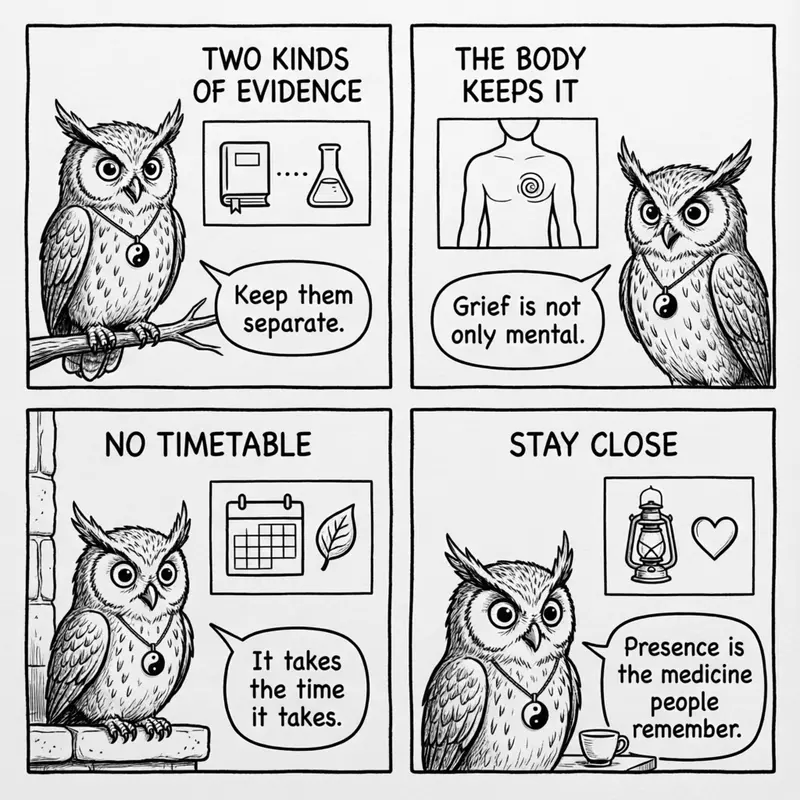
Modern medical science uses none of that language. Researchers have studied bereavement and health, and the findings vary widely. One well-known cohort study found a markedly higher risk of heart attack in the days after the death of a significant person (Mostofsky et al., Circulation, 2012). Cardiology recognizes Takotsubo cardiomyopathy, "broken-heart" syndrome, where acute shock temporarily weakens heart muscle (Templin et al., NEJM, 2015). Separately, neuroscientists have mapped the brainstem circuit that produces sighs (Li et al., Nature, 2016). None of it validates the traditional organ map; the medical studies and the classical texts are different kinds of evidence, and they are listed separately below. What the research supports is plainer than the map: grief is not only mental, and the body keeps the receipt.
What the Tradition Does With Grief
Because the tradition reads grief as a scattering of qi, its folk practices rarely answer sorrow with isolation or a demand to move on. They steady the body while the mind weeps.
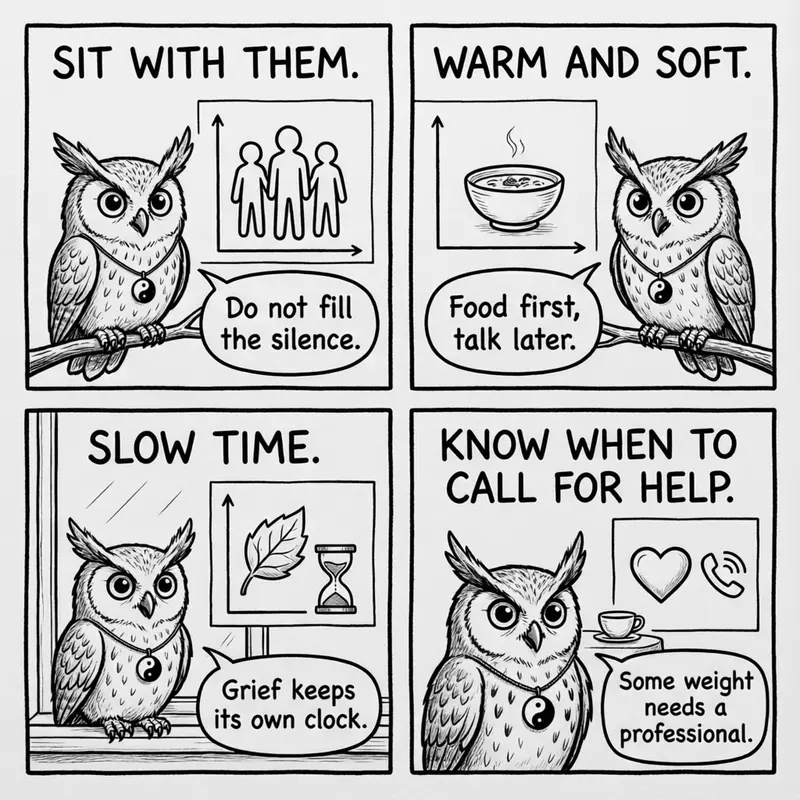
Ollie shifts on his perch when the talk turns to caring for sorrow: wings rustled, feathers drawn close. Owls know you do not shout at someone who cannot catch their breath. You sit nearby and keep the room warm.
Traditional culture handles grief through somatic, environmental support rather than aggressive interventions:
### 1. Warming and Moistening In many Chinese households — customs vary by region, generation, and family — a grieving visitor is handed something warm to eat. Kitchens may brew broths with lily bulb or adenophora root, simmered with pears or white fungus; in traditional dietary thought these pale, moist foods are read as gentle on the Lungs. Not every family does this, and none of it is medicine.
### 2. Lengthening the Breath Qigong and daoyin describe slow, complete exhalations rather than forcing air in — and the same traditions caution against pushing or prolonging the breath until it makes a person dizzy. The classical logic: fresh qi cannot enter until the spent air has left.
### 3. Communal Warmth Mourning customs vary widely, but many of them keep the bereaved surrounded: relatives sit with the family, cook, and handle daily logistics. In the tradition's language, that presence is a living boundary for the scattered po.
### 4. Ritual and Movement Grief is meant to move. Incense, grave-sweeping at Qingming, chanting, prostration: ritual gives sorrow a track to travel instead of leaving it to wander.
None of this is medical treatment. These are cultural containers, built by generations who understood that a grieving person needs warmth, breath, and company.
A Necessary Line: When Grief Needs Medical Care
Understanding the body's natural response to loss is comforting, but it should never replace professional care. Grief can cross from a natural somatic process into clinical conditions that require formal intervention.
Some situations belong with a doctor or a crisis service rather than with an essay like this one:
- Crushing chest pain, pressure radiating to the jaw or left arm, or acute shortness of breath (these require emergency medical evaluation).
- Persistent inability to sleep, eat, or perform basic daily tasks lasting several weeks.
- Feelings of severe hopelessness, persistent panic attacks, or thoughts of self-harm.
- A pre-existing respiratory or cardiac condition that worsens significantly following a loss.
Traditional concepts provide a philosophical framework for understanding human sadness; they are not a substitute for clinical diagnostics, therapy, or emergency medicine.
The Value of the Ancient Map
The beauty of the Chinese medical model does not depend on whether a laboratory can locate an emotion inside an organ. The value lies in how the tradition refuses to split the human experience in two.
In this ancient view, you are not a brain carrying around an inconvenient meat suit. You are an integrated ecosystem. When your heart breaks, your lungs know it. When someone disappears from your life, your breath registers the absence before your rational mind finishes processing the news.
When you find yourself sighing for no reason, when your chest feels tight after a difficult year, or when your voice falters while speaking about someone you miss, you do not have to judge yourself. Your body is doing exactly what bodies have done for thousands of years: it is carrying your love and your loss through the only vessel it has.
Ollie Speaks: I see you sitting there, shoulders rounded like a pair of tucked wings, trying to pull a deep breath through a chest that feels like dry slate. You think you ought to be further along by now. You think you should be speaking in full sentences without that crack in your throat.
Look at me. When an owl loses a mate, he does not fly through the pines pretending his wings work the same as they did yesterday. He sits on the branch. He fluffs his gray feathers against the frost, lets his eyelids drop half-shut, and allows the winter wind to blow past his ears. He waits.
My little jade pendant is cold against my breast until my body warms it. That takes time. The old breathing traditions do not pull at the breath like a locked door. They let the air go all the way out, let the shoulders drop, and let the lungs be sad for a while.
FAQ
Does the tradition say that grief causes lung disease?
No. The classical association is about function and relationship, not pathology. Grief is said to affect how qi moves, and the Lungs are the organ that governs qi and breath in the tradition's map. Nothing in that map says sorrow damages lung tissue, and the classical texts do not describe grief as a cause of respiratory illness. If someone has a persistent cough, breathlessness, or chest pain, that is a matter for a doctor — the mapping is a way of talking about experience, not a diagnosis.
Does crying too much harm the respiratory system?
Later commentary, not the classical line itself, holds that prolonged weeping drains qi and fluids, showing up as a dry throat, a raspy voice, and deep fatigue. It does not cause permanent anatomical damage, but the tradition reads long crying as strain on the chest and the voice, and it can leave a person wrung out. The tradition's counsel is to let grief move through crying rather than swallowing it, and to balance intense tears with rest, fluids, warmth, and quiet company so the body can replenish afterward.
What is the connection between the autumn season and grief?
In classical five-phase philosophy, autumn corresponds to the Metal element, the climate of dryness, and the Lungs. Just as trees shed their leaves and nature withdraws inward, the human body naturally shifts toward reflection and conservation during the fall. Traditional culture suggests that unresolved loss feels more noticeable now, because the drying, cooling weather mirrors the internal qualities the tradition associates with the Lungs. Many people find autumn makes room for reflection; for the grieving, that same quiet can make an absence louder.
Sources
- Huangdi Neijing, Suwen — the Nine Qi passage (ju tong lun) and the five-emotion correspondences.
- Huangdi Neijing, Lingshu — the po (corporeal soul) and the Lungs.
- Cao Xueqin, Dream of the Red Chamber (Hong Lou Meng), 18th century — the character Lin Daiyu.
- Maciocia, G. The Psyche in Chinese Medicine. Churchill Livingstone, 2009.
- Kaptchuk, T. J. The Web That Has No Weaver. McGraw-Hill, 2000.
- Mostofsky, E., et al. "Risk of acute myocardial infarction after the death of a significant person in one's life." Circulation, 2012; 125(3): 491–496.
- Templin, C., et al. "Clinical Features and Outcomes of Takotsubo (Stress) Cardiomyopathy." New England Journal of Medicine, 2015; 373: 929–938.
- Li, P., et al. "The peptidergic control circuit for sighing." Nature, 2016; 530: 293–297.