Gua Sha Isn't a Beauty Hack — It's a Medical Tradition
 Ollie's Take
A child sits on a wooden kitchen chair, turned away from the table. His grandmother sets down warm oil and a clean porcelain soup spoon. She dips the edge, presses it flat against his neck, and pulls down in short firm strokes.
The skin goes pink. Red dots rise and run into streaks. The boy squirms; the friction feels hot and strange, not sharp. By morning he has sweated through a heavy quilt and the heaviness has lifted. The marks are still on his shoulders, bright and unmistakable. This is family memory rather than a case record, a scene repeated across southern China.
That speckled pattern is not a side effect. In the tradition's view, raising it is the point.
Ollie watched from a cupboard top, one ear tuft angled toward the spoon. He looked sleepy enough to approve of anything that started after breakfast.
Ollie's take: Preen your feathers. Do not scrape a stranger's back.
A Spoon, Not a Stone
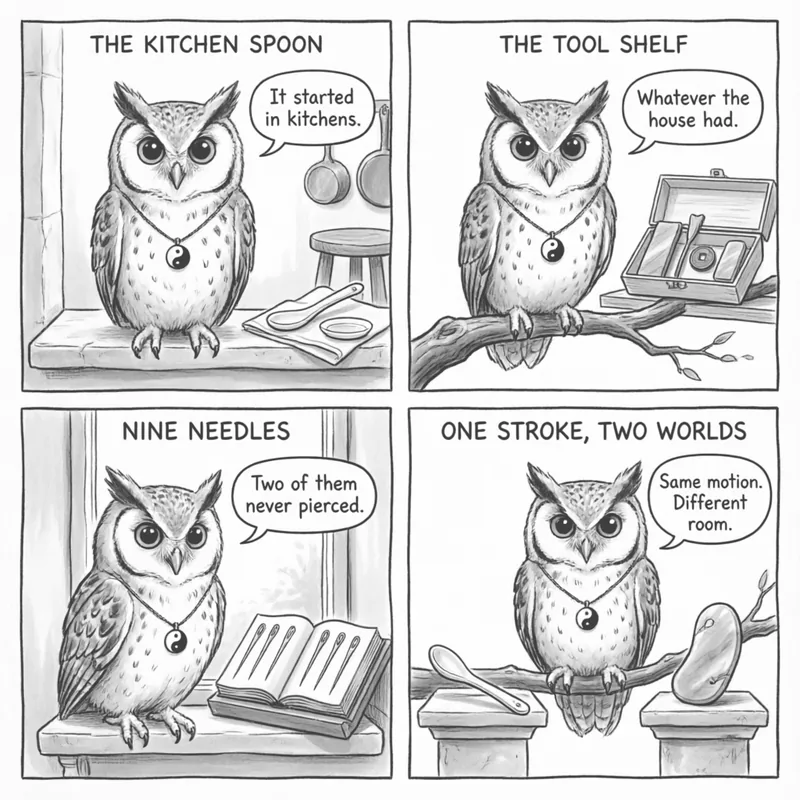
Gua sha is usually translated as scraping away the sha. In contemporary teaching, sha refers to the red speckling the tool raises; some practitioners also use the word for the gritty feel under the edge. Meanings vary by lineage.
Families rarely bought special tools. They used what sat on the shelf: horn, stone, bone, coins. The ceramic soup spoon won out because its rounded bevel fit a neck's curve without cutting it. What matters is the edge, the angle, the oil, and the stroke, not the material.
Older Than the Needle
Polished stone scraping plates have been unearthed in Inner Mongolia and Shandong. The Huangdi Neijing discusses stone instruments, and its Lingshu section lists nine needle forms, including blunt tools for pressing and rubbing rather than piercing. Such passages show non-penetrating techniques are old; they do not establish gua sha as a direct continuation of any one instrument.
In 1337 the Yuan physician Wei Yilin recorded a recipe in Shi Yi De Xiao Fang: soak hemp fiber in water, scrape the neck, elbows, knees, and wrists until fine spots appear, then wrap the person in thick clothes and give rice porridge or scallion tea. Once the person began to sweat lightly, the illness was thought to have dispersed. Scraping, herbs, and sweating ran as one sequence, an approach already organized by the fourteenth century. It is history, not a protocol to follow.
The Kitchen Table and the Clinic
For most of its life, gua sha lived in the house. Pulse reading belonged to physicians; scraping belonged to mothers and grandmothers.
That changed late in the twentieth century. In the 1990s, the physician Zhang Xiuqin published Holographic Meridian Scraping Therapy with instructional videos, mapping channel theory onto teachable protocols. The method moved onto treatment tables, alongside acupuncture and herbs.
What a Scrape Does to Skin
A practitioner oils the skin, holds a smooth edge at a low angle, and draws it along the muscle. The friction pulls at the smallest vessels in the top layer until a little blood leaks underneath. The surface stays unbroken, but the marks are still tissue injury: petechiae, or a light bruise, fading over two to five days. Short-term blood-flow changes are measurable; whether they explain the relief people report is still open.
In 2007, Arya Nielsen and colleagues measured what happens underneath. Eleven healthy adults received one session on the back, and laser Doppler imaging showed local blood flow rising about fourfold in the first seven and a half minutes, staying elevated for twenty-five. All eleven reported immediate relief of soreness, at the treated spot and elsewhere. Eleven people is a small sample, and blood flow alone does not explain why pain changes.
A 2009 animal study by Kwong and colleagues offered a possible explanation: scraping raised heme oxygenase-1, an enzyme that processes heme from broken-down red cells. A mouse is not a person; this is a hypothesis, not proof.
Ollie landed on the desk edge and arranged his feathers until every quill lay flat. Owls draw a smooth beak along their wing coverts every morning. Same principle, he seemed to say; nobody calls it medicine.

Reading the Marks
Practitioners read the sha by how fast it rises, how bright it is, how long it fades, and how the skin feels under the tool. Some practitioners read bright red as heat, dark purple as something more settled, pale pink as deficiency, and a gritty catch under the edge as tightness. These are clues within a pattern, not diagnostic criteria, and they vary between teachers.
In the tradition's language, the scrape may be chosen to move stagnant blood and Qi, release an exterior constraint, or address localized stasis. The choice does not rest on redness alone. A practitioner weighs whether the presentation looks like an exterior pattern, qi stagnation, blood stasis, or a deficiency that makes strong treatment inappropriate, then reads the location against the channels. The same-looking mark can mean different things in different people.
That reading is tradition, not a lab test, and color alone decides nothing. A practitioner reads the marks alongside the whole presentation: cold and warmth, where the pain sits, the tongue and pulse.
What the Trials Show
Twenty years of trials have produced a mixed picture.
A 2011 randomized trial by Braun and colleagues gave 48 outpatients with chronic mechanical neck pain either a single gua sha session or a local heat pack. After a week, the scraped group was better by 29.9 points on a 100-point scale, one session, no blinding.
A 2012 pilot (Lauche et al.) found similar short-term improvement against a waiting list in 40 people.
A 2017 crossover in older adults with chronic low-back pain found no significant difference against hot packs, though pain trends favored scraping, 21 to 25 percent versus 16 to 18.
Later trials reported better mobility (Saha, 2019), and a 2025 study found fascia-thickness changes alongside reported pain (Wang). Neither shows a durable structural change.
Then the review. Yuan and colleagues gathered the controlled trials in 2015 and concluded the evidence was insufficient to confirm broad efficacy: small samples, inconsistent protocols, high risk of bias. Real short-term signals, mostly for muscle aches, and no proof yet.
Physical therapists use a Western cousin: instrument-assisted soft tissue mobilization, often branded as the Graston technique. The stroking overlaps; the tools, training, and explanations differ. The overlap deserves acknowledgment without treating the two as interchangeable.
The Jade Stone on the Vanity
Around 2021, gua sha crossed over in the West. The singer Lizzo posted a short video of her facial routine with a polished flat stone, and within two months search volume rose roughly 300 percent while more than 300,000 social posts showed jade tools beside expensive creams.
The household practice became a beauty trend. The tools look similar; the pressure, purpose, and training do not. Body gua sha uses firm pressure along large muscle groups; the marks are a result, not a target. Facial gua sha uses light strokes over oiled skin, moving outward from the midline and down the neck, and it avoids raising marks.
A 2025 randomized trial (Ahn et al.) had 34 women aged 20 to 50 use a facial gua sha tool or a roller for ten minutes a day, five days a week, for eight weeks. Both produced small changes in facial contour: roughly 2 to 2.5 millimetres with gua sha, about 3 millimetres with the roller. Gentle scraping appears to promote temporary lymphatic clearance (Hamp et al., 2023).
That is the ceiling. A flat stone cannot rebuild lost collagen, dissolve fat pads, or replace surgery. What people describe most consistently is the ritual itself.
What the Teachers Say
In traditional teaching, the light facial version is the one people learn for themselves; the firm body version belongs with a trained practitioner. Teachers describe three conditions: a clean, smooth tool, enough oil that the edge glides, and pressure that stays in the comfortable range. In healthy adults, light-to-moderate work is usually well tolerated; normal after-effects are soreness like a deep massage and marks that fade in three to five days.
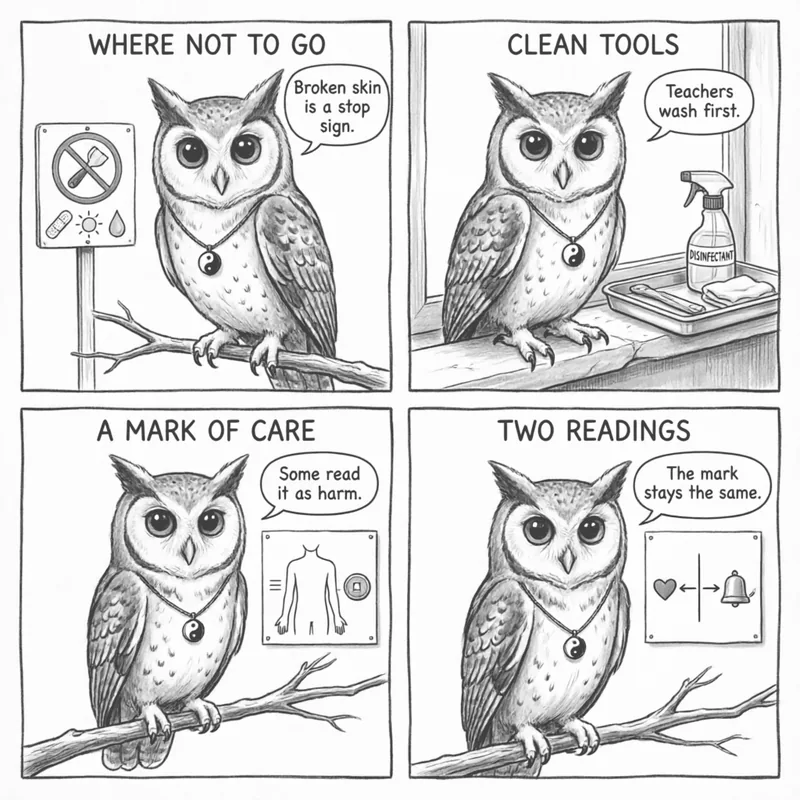
Teaching material for the practice lists situations where the tool stays away: open wounds, active eczema or psoriasis, severe acne cysts, shingles, fresh sunburn, unexplained swelling, prominent veins, areas of reduced sensation, and the front of the neck. Pregnancy appears on the same caution list around the abdomen and lower back. An implanted device is not automatically disqualifying, but pressure over it is generally avoided.
Extra caution belongs to anyone with a bleeding disorder, advanced diabetes with neuropathy, compromised lymphatic drainage, or chemotherapy. Anticoagulants such as warfarin, apixaban, and daily high-dose aspirin appear on the caution lists, because a light capillary release in a healthy person can become an uncontrolled hematoma in someone on blood thinners.
Clean tools matter, since the edge touches skin that can have small breaks. Teachers of the practice wash tools in hot soapy water and disinfect them between people; porous stones are hard to sterilize, which is why clinics lean on stainless steel. Practitioners often put it plainly: pain does not prove the treatment is working, and mild pinkness is enough.
When a Mark of Care Looks Like Harm
A red streak carries whatever meaning the person looking at it brings.
During the late 1970s and 1980s, large numbers of Vietnamese families arrived in the United States and Canada. A related folk practice called cao gio, "scraping for the wind," uses a coin and mentholated oil on the chest, neck, and back. Teachers and nurses saw the resulting broad, symmetric stripes and, unfamiliar with the practice, sometimes suspected abuse and reported the families.
Parents were questioned by police and social workers, and some families delayed emergency care rather than risk being misread. The same pattern appears for kerokan, the Indonesian version; a 2020 paper (Samberkar et al.) describes how examiners separate its orderly marks from non-accidental trauma.
The mark on the skin is identical. Its meaning depends on who is reading it. Unfamiliarity has led to harmful misinterpretations, which is why clinicians are taught to ask what caused a mark before assuming either abuse or harmlessness.
Ollie rotated one ear toward the window and tucked his feet beneath him. "Even I know when to stop preening," he murmured. "A good practitioner knows when to stop scraping, too."
Back to the Kitchen Chair
The oil gets wiped away. A shirt goes back on. The marks darken overnight and fade by the weekend.
The next time you see those streaks on someone at the pool, skip the diagnosis. Ask who taught them, and listen. In most houses, the story starts with a spoon.
Ollie Speaks
Hoo. Let an old owl say something about feathers and skin. I shifted my little jade pendant against my breast and settled my feathers.
Every morning I run my beak along my wing coverts, lining up the edges so I can fly without a sound. It feels wonderful, and it keeps me flying. But I do not mistake preening for becoming an eagle.
Enjoy the cool stone on your jaw. Enjoy the five quiet minutes. A back locked up like a dry pine branch is the work of a trained practitioner. In the tradition, heavy scraping stays with trained hands, and force is not the same thing as benefit.
FAQ
Is gua sha just cupping with a different tool?
They are cousins, not the same motion. Cupping pulls tissue upward with suction, which is why its marks are round and clustered. Scraping presses a smooth edge along lubricated skin, which is why its marks follow the stroke in lines. In the tradition, both are read as moving blood and Qi, and both raise marks on purpose. Cupping covers a broad patch of muscle; scraping runs along one band. Practitioners choose between them by the shape of the problem in front of them.
Why does gua sha leave dark red or purple marks?
The tool stretches tiny vessels in the upper layer of skin until a small amount of blood enters the tissue below. The surface stays intact: no cut, no scab. In the tradition, those marks are read as places where blood and Qi were stuck, and their color is part of the reading: bright red for recent, darker purple for settled. Modern studies show the body responding with more local blood flow and protective enzymes, then clearing the red cells like any light bruise, usually within two to five days.
Can gua sha permanently sculpt my jawline or erase wrinkles?
No. A stone cannot change bone, remove fat, or rebuild deep connective tissue. The slimming people see right after a facial session is mostly fluid moving away from the cheeks and jaw, and it comes back. Relaxing a tight masseter can soften tension lines for an afternoon. Those are real, small, temporary changes, worth enjoying as such. They should not be confused with structural results, and anyone promising permanent sculpting from a stone is selling something the evidence does not support.
Sources
- Huangdi Neijing (Yellow Emperor's Inner Classic), Lingshu, Jiu Zhen Shi Er Yuan (the nine needle forms).
- Wei Yilin, Shi Yi De Xiao Fang (Effective Formulas from Generations of Doctors), 1337.
- Zhang Xiuqin, Holographic Meridian Scraping Therapy (Quanxi Jingluo Guasha Fa), 1990s.
- Nielsen, A., et al. "The effect of Gua Sha treatment on the microcirculation of surface tissue." Explore (NY), 2007.
- Kwong, K. K., et al. "Bioluminescence imaging of heme oxygenase-1 upregulation in the Gua Sha procedure." Journal of Visualized Experiments, 2009.
- Braun, M., et al. "Effectiveness of traditional Chinese 'gua sha' therapy in patients with chronic neck pain." Pain Medicine, 2011.
- Lauche, R., et al. "Pain intensity and pressure pain thresholds after traditional Chinese gua sha." American Journal of Chinese Medicine, 2012.
- Yuan, Q. L., et al. "Traditional Chinese medicine for neck and low back pain: a systematic review." PLoS One, 2015.
- Yuen, J. W. M., et al. "The effects of Gua sha on symptoms and inflammatory biomarkers in chronic low back pain." Complementary Therapies in Medicine, 2017.
- Saha, F. J., et al. "Gua Sha therapy for chronic low back pain: A randomized controlled trial." Complementary Therapies in Clinical Practice, 2019.
- Samberkar, P. N., et al. "Potential forensic implications of kerokan therapy." Medicine, Science and the Law, 2020.
- Hamp, A., et al. "Gua-sha, Jade Roller, and Facial Massage: Are there benefits within dermatology?" Journal of Cosmetic Dermatology, 2023.
- Ahn, S. H., et al. "Comparative Effects of Facial Roller and Gua Sha Massage on Facial Contour and Skin Elasticity." Journal of Cosmetic Dermatology, 2025.
- Wang, B., et al. "Effects of Gua Sha therapy on thoracolumbar fascia thickness in chronic low back pain." Medicine (Baltimore), 2025.