Are You Wood, Fire, Earth, Metal, or Water? Inside a 2,000-Year-Old Body Typology
 Ollie's Take
You sit on the couch, thumbing through a ten-question quiz on your phone. It promises to reveal your personality type from your taste in coffee, your ideal vacation, and how you react when someone cuts you off in traffic. Quick, entertaining, forgotten by dinner.
Long before anyone filled in questionnaires on a screen, observers in ancient China sorted people a different way. They did not ask how you feel about parties. They looked at the width of your shoulders, the shape of your jaw, the way your heels strike the ground, and the seasons that leave you energized or worn down.
The old tradition started with the body. Mind and temperament were never treated as separate from the flesh, bone, and weather that carry them.
Ollie, our resident screech owl, once watched me take one of those quizzes. He blinked twice, then went back to arranging his feathers — which I have chosen to interpret as a review.
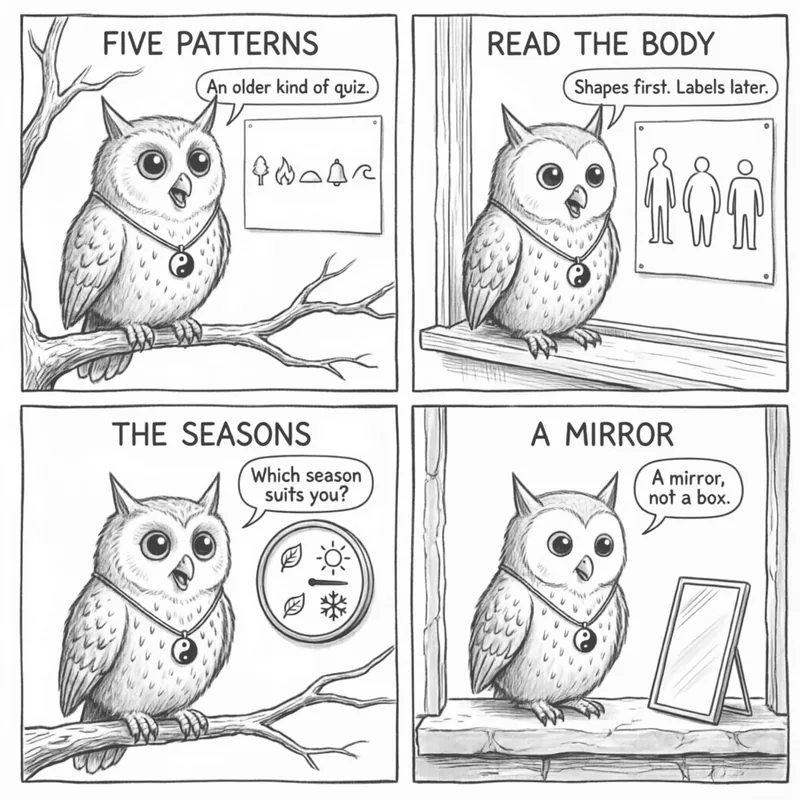
Ollie's take: Feathers first, elements second.
The Text That Started With the Body
The classical source for this framework sits in the Huangdi Neijing (The Yellow Emperor's Inner Classic), in the section known as the Lingshu. Chapter 64 is titled "Yin-Yang Twenty-Five Types of People." Compiled roughly two thousand years ago, it is one of the earliest systematic attempts to sort human beings by physical structure and functional tendencies together.
The text is not a rulebook. What it preserves is a set of recurring patterns — descriptions of how different builds tend to look, act, and weather the seasons. We cannot reconstruct exactly how each observation was gathered, but the model itself is clear: body form, temperament, and seasonal response were read as one system. And it never claims that people are stamped into rigid molds at birth. Two thousand years is a long life for a text, and its staying power comes from close attention to physical detail rather than mystical authority.
Five Shapes, Five Notes, Twenty-Five People
The framework maps the five phases — Wood, Fire, Earth, Metal, and Water — directly onto human bodies. The old text linked each phase to one of the five tones of the classical scale: Jue for Wood, Zhi for Fire, Gong for Earth, Shang for Metal, and Yu for Water.
Then it added a second twist. Each of the five types was split into five sub-variations based on physical nuance and balance, and five times five produced twenty-five. Five boxes, the text admits, were never enough for the people walking past.
Every type also carries a functional network and its channels: the Liver for Wood, the Heart for Fire, the Spleen for Earth, the Lung for Metal, and the Kidney for Water. Each phase was linked to a network of functions, and constitutional tendencies were described through body shape, complexion, movement, and season. These correspondences were never meant to prove an organ disorder from appearance alone.
The observers checked a specific set of markers: the shape of the head and face; the spread of the shoulders and back; the fullness of the belly; the structure of the hands and feet; the ratio of dense bone to soft flesh; the pace and steadiness of the walk; and which seasons brought vitality or trouble.
Ollie, our resident screech owl, likes to perch on the high shelf when the old texts come down. He tilts his head, adjusts his little jade pendant, and watches us try to sort ourselves into tidy categories.
The Five Types
The Lingshu descriptions are vivid, direct, and unapologetically visual. Here is how the classical text sketches the five prototypes.
### The Wood Type (Jue)
Wood presents with a tall, upright posture. The complexion has a pale or slightly greenish cast. The head is relatively small, the face noticeably long, the shoulders and upper back broad against a lean, straight torso, with small, nimble hands and feet.
Mentally, this type runs on intellect. The text notes that these people work with their minds rather than raw strength. They tend to be talented and busy with affairs, and also prone to persistent worry.
Seasonally, Wood does well in spring and summer, when growth is in the air, and struggles in autumn and winter. The tradition ties this build to the Liver network — classically linked with the sinews and the free movement of Qi. That is a functional association inside a larger system, not a claim that a body shape reveals an organ disorder.
### The Fire Type (Zhi)
Fire catches the eye through color and speed. The complexion is ruddy. The head is small and the face tapers toward a pointed chin, like an upward flame. The upper back is broad, the hands and feet compact.
When Fire moves, the shoulders sway with a distinct rhythm. The walk is steady; the thoughts and speech are not. The text describes this type as energetic, perceptive, light with money, and carrying many concerns.
Fire thrives in spring and summer and tends to fade in the inward months of autumn and winter. The tradition connects this build to the Heart network, described in classical functional language as governing the blood vessels and housing the spirit.
### The Earth Type (Gong)
Earth has a centered, sturdy presence. The face is round, the head large, the skin carrying a warm, yellowish undertone. The shoulders and back are thick, the belly naturally full, the legs solid, the flesh generous.
In demeanor, Earth is calm and unhurried. The text says this type dislikes jockeying for power, prefers cooperation, and is good at supporting others. The walk is grounded and deliberate.
Because its nature is stabilizing, Earth handles autumn and winter with ease, while the damp heat of late summer can leave it feeling heavy. This type is tied to the Spleen channel family, associated with digestion and the nourishment of muscle.
### The Metal Type (Shang)
Metal looks clean and structured. The face is square, the features crisply defined, the complexion fair. The head is small, the shoulders and back narrower, the belly flat, the bones light, the hands and feet small and neat.
Mentally, Metal values order and clarity. The text describes these people as upright, composed under pressure, quick inside but disciplined outside — and specifically suited to administrative work.
Metal feels at home in autumn and winter, when the air turns crisp, and tends to drain in the heavy heat of summer. The tradition links this group to the Lung channel family, associated with breath and the body's outer boundary.
### The Water Type (Yu)
Water presents a softer, more fluid silhouette. The complexion tends darker, the head large, the jawline prominent, the features less even. The shoulders are narrow, the lower back long, the belly full. The hands and feet are rarely still, and the walk carries a rolling sway.
The old text pairs this type with strong instincts and few social inhibitions. It also gets blunt here — modern readers will notice character judgments that belong to the text's era rather than to ours. More on that below.
Water does well in the darker, colder months and can feel agitated by the soaring heat of summer. The tradition ties this build to the Kidney channel family, the deep reservoir of the body's reserves.
Ollie ruffles his mottled feathers whenever Water comes up. He knows something about night instincts, dark feathers, and staying alert while the rest of the forest sleeps.
The Blunt Parts and the Year Taboos
Reading ancient medical texts with modern eyes takes some patience. The Lingshu did not sugarcoat. Mixed in with sharp observations about shoulders and seasons are lines that make a modern reader wince.
The text makes blunt character judgments, labeling certain variations as unreliable or unstable. It makes grim remarks about lifespan for specific sub-types. The same chapter also lists "year taboos" — ages 16, 25, 34, 43, and beyond, spaced nine years apart — at which a person of a given type supposedly faced extra danger.
This is the dead end. A modern reader can part ways with the fatalism while keeping the observation. The physicians were people of their era, with its superstitions and its courtly assumptions. You do not need to accept an ancient lifespan prediction to notice that your build, your digestion, and your seasons travel together.
What the Typology Is Good For
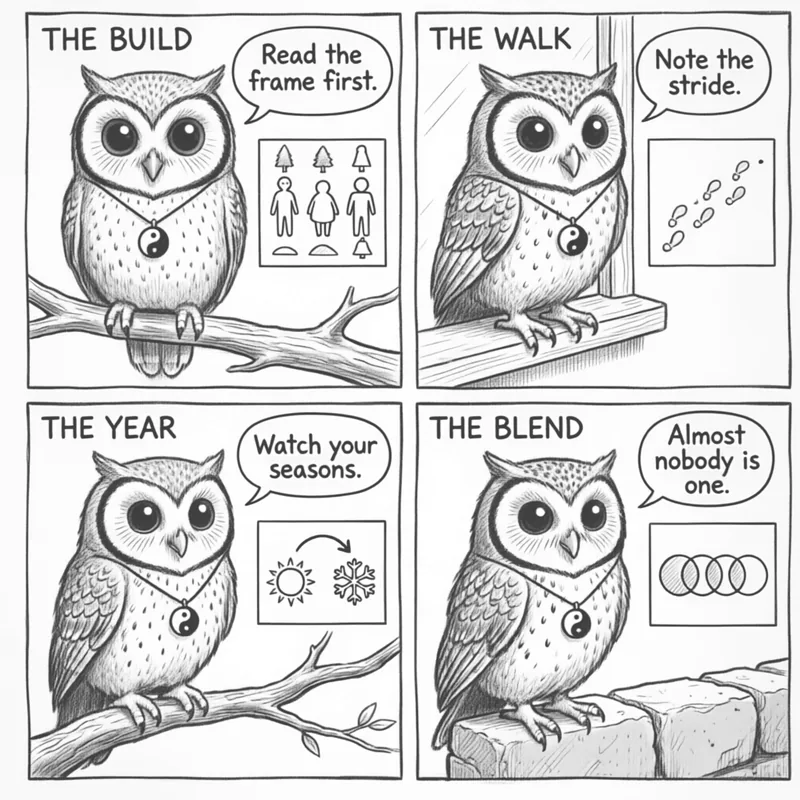
Try to wedge yourself into one of the five boxes and you will hit frustration fast. Almost nobody is pure Wood or unadulterated Earth. The text knew this. Five times five is a confession that five labels cannot hold anyone.
The real use of the framework is observation, not labeling.
One distinction is worth keeping straight. The twenty-five types are not the same thing as reading a current pattern. A person can lean Wood constitutionally and still develop a different pattern through illness, stress, diet, or weather. Feeling heavy in July or tight in the neck does not by itself establish anything about an organ — and persistent or severe symptoms deserve ordinary medical evaluation, not a nice story from a typology.
Notice the seasons. Some people feel grounded every November and flattened every July. The tradition would have you watch your own year turn before deciding anything about yourself.
Notice where tension lives. The tradition reads tension in Wood-leaning people as gathering around the neck and shoulders, the pathways of the Liver and Gallbladder channels, while Earth-leaning people notice it first in the stomach. These are the tradition's readings, not lab findings — but they are specific enough to check against your own experience.
Notice your baseline. Some people run light and fast; others are dense, deliberate, and slow to start. Neither is a defect. The typology is a mirror for noticing, not a file to be sorted into.
The Idea That Did Not Die
The urge to read human variety through constitutional models never left Chinese medicine. It evolved.
In 2009, the China Association of Chinese Medicine published a standardized constitution questionnaire with nine types — Balanced, Qi-Deficient, Yang-Deficient, Phlegm-Dampness, and others. It is an administrative tool built for surveys and health management, swapping the poetic notes of the Lingshu for scoring sheets.
In the West, the typology found a second life through J. R. Worsley, the English practitioner whose classical five-element acupuncture school organized its whole approach around identifying a person's underlying element by voice, color, and manner.
Neither framework is laboratory science, and neither needs to be. They show that the old question — how does this particular body work? — has never stopped being asked. It has only changed its paperwork.
Keeping a Two-Week Notebook
Before deciding anything about your element, step away from the quizzes. Spend two weeks collecting raw observations.
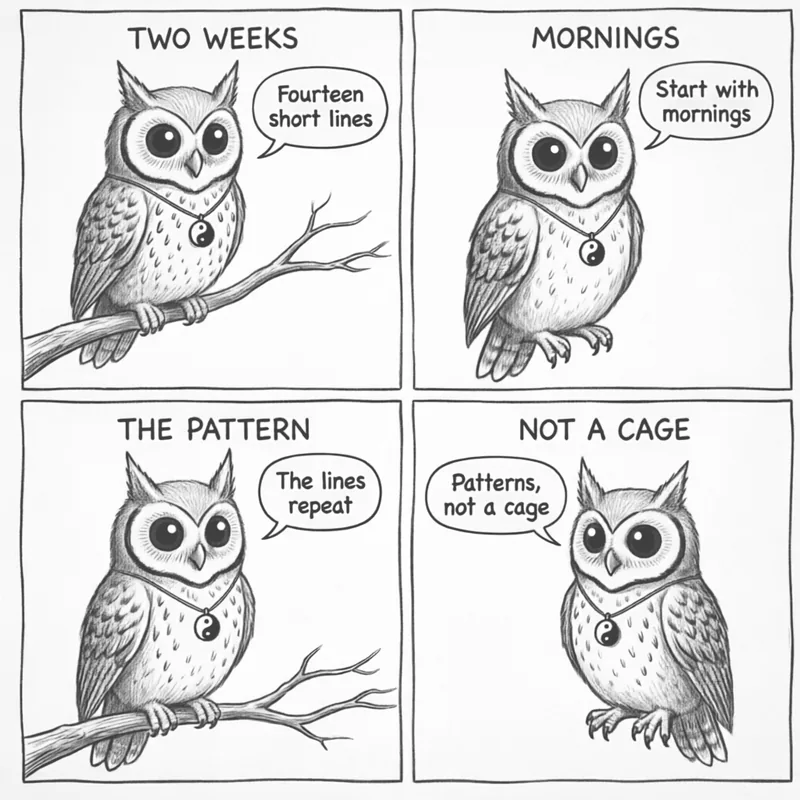
Open a note on your phone. Each morning, write three short lines: how your body woke up; where tension is sitting (jaw, neck, back, belly); and how yesterday's weather landed on your mood and energy.
After fourteen days, read the lines together. Patterns show up faster than identities do. You might find damp mornings slow your appetite, or that windy afternoons sharpen your focus. Nobody can sell you that information; you have to notice it.
If a pattern worries you, take the notes to a qualified professional. A typology is not a diagnosis.
Ollie Speaks
Hoo. Humans do love their boxes.
I have watched visitors try on personalities like winter coats. One month you are an introverted planner; the next, an ambitious visionary. Then an old scroll arrives and suddenly your jawline decides whether you are Water or Metal.
Nobody has ever flown up to my branch to ask whether I am a Wood owl or a Fire owl. I am a bird first. Feathers first, elements second.
My jade pendant swings when the north wind picks up. When winter comes, I do not argue with the frost. I fluff my down, pull my talons close, and let the cold night do what it does.
Look at your own frame with good humor. Notice the width of your back, the way you step off a curb, the months that make you want to sing or sleep. The five phases were written to help you see yourself clearly. Not to build a cage.
FAQ
Can my classical phase type change as I grow older?
The Lingshu treats the basic physical structure — bone, head shape, core proportions — as fairly stable across adult life. What shifts is the expression. The tradition describes a person's balance of Qi and fluids changing with age, stress, and major transitions, so a Wood-leaning build may show more Earth or Water qualities later on. The classical view is a moving balance, not a permanent label handed down at birth.
How is this different from the modern nine-type constitution questionnaire?
The classical Lingshu system reads physical structure: build, bone-to-flesh ratio, facial features, and seasonal tendencies. The 2009 questionnaire from the China Association of Chinese Medicine works differently. It scores current functional patterns — Qi deficiency, dampness, blood stasis, and similar — from a set of standardized questions. One describes structural archetypes; the other tracks how a person is doing now. Both are tradition's instruments, not substitutes for professional assessment.
What if my features seem to fit three different types at once?
That is the normal case, and the text expects it. Five types multiplied into twenty-five because the compilers knew that real bodies rarely fit one prototype. You might carry Wood's long face and active mind alongside Earth's steady digestion and calm. Skip the single label. Use the categories to notice specific things — where tension parks itself, which seasons lift you, how your body runs when it is tired.
Sources
- Huangdi Neijing, Lingshu, chapter 64 (Yin-Yang Twenty-Five Types of People) — the classical five-type typology.
- Huangdi Neijing, Lingshu, chapter 72 (Tongtian: The Five Yin-Yang Types) — the companion passage on temperament types.
- China Association of Chinese Medicine, Classification and Determination of Constitution in TCM (ZYYXH/T157-2009), 2009 — the modern standardized nine-type questionnaire.
- Worsley, J. R. — classical five-element acupuncture, the twentieth-century English school of practice organized around a person's element.