When the Body Reaches Its Last Line — Understanding the Jueyin Stage
When the Body Reaches Its Last Line: Understanding the Jueyin Stage You might feel like your body is fighting itself, burning up and freezing cold at the very same time. Maybe you’re constantly thirsty, gulping down water, but your chest feels hot and you can’t sleep from anxiety.
At the same time, your feet are like blocks of ice, and you’re plagued by urgent, gurgling diarrhea. You feel wired and restless, but also so bone-deep exhausted that you can barely function. It’s a baffling, miserable collection of symptoms that makes absolutely no sense. If this sounds familiar, you’re not going crazy. You’re experiencing a paradox. In the world of Chinese medicine, this deep internal contradiction has a name: the Jueyin (厥阴) stage. It’s the sixth and final level of disease progression described in the classical medical text, the *Shanghan Lun*, and it represents X Ollie, our screech owl, has been following along with these stages — and this one has even him tilting his head in confusion.
 Ollie's Take
The End of the Line
In the Six Stage framework, when an external pathogen invades, it first hits the most superficial level, the Taiyang. If the body’s defenses can’t push it out, it moves deeper, layer by layer, through the Shaoyang, Yangming, Taiyin, and Shaoyin. Each stage has its own unique set of symptoms as the body’s Qi fights the illness in different territories.
Jueyin is what happens when the battle has reached the absolute core of the system. It’s not just one organ or channel that’s affected anymore. At this stage, the body's entire regulatory system—the fundamental connection between Yin and Yang—has broken down.
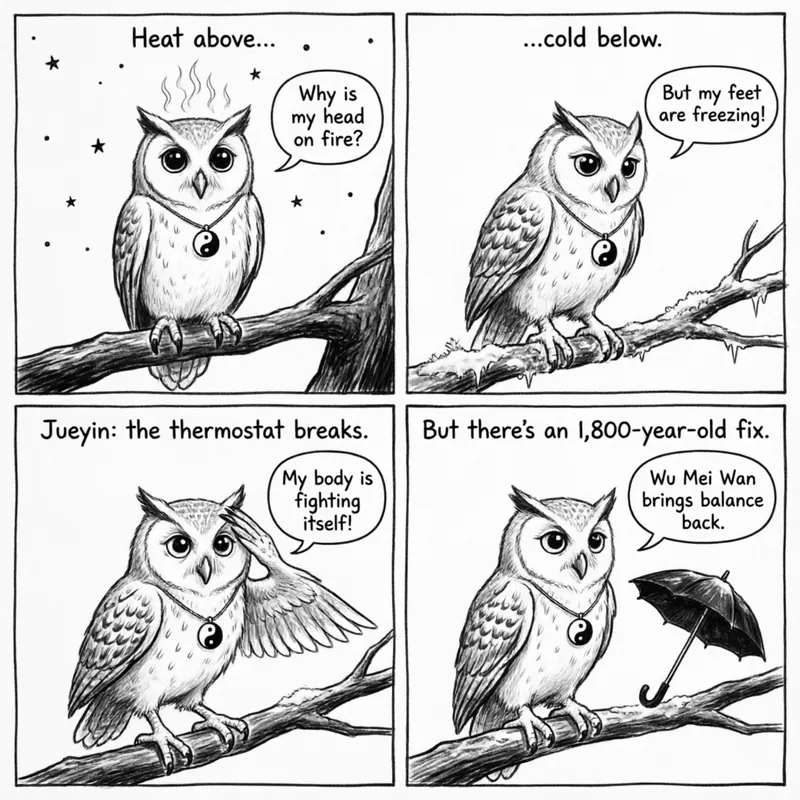
Think of Yin and Yang like a thermostat and furnace that have to constantly communicate. When they work together, your body stays comfortable. But when the thermostat can't talk to the furnace anymore, you get a house that's simultaneously overheating upstairs while the basement pipes freeze. In a healthy person, the cool, calming Yin energy from the lower body rises to cool the active, fiery Yang of the upper body (like the Heart). The warm, active Yang energy descends to warm the cool, quiet organs of the lower body. This constant circulation keeps everything in a state of comfortable equilibrium.
In the Jueyin stage, that circulation stops. Yin and Yang have separated — they are no longer communicating.
The Chinese character 厥 (Jue) literally means "reversal" or "counterflow." The natural flow of Qi hasn't just stopped — it has actually reversed direction. Instead of Yang Qi descending to warm the lower body and Yin Qi ascending to cool the upper body, they flow backwards, creating this chaotic separation. Understanding this "counterflow" helps explain why the symptoms are so contradictory: the body's internal traffic is not just stalled, it's going the wrong way.
A House Divided: Heat Above, Cold Below
The hallmark of the Jueyin pattern is this very separation, which manifests as "upper heat and lower cold."
Imagine your body is a two-story house with a seriously broken thermostat system. The furnace upstairs is stuck on full blast, making the top floor unbearably hot. This is the "heat above." It rises to your chest and head, causing symptoms like extreme thirst, a feeling of heat or pain in the heart region, hunger with no desire to eat, heart palpitations, and intense anxiety or restlessness.
Meanwhile, the air conditioner in the basement is also stuck on full blast, making the ground floor freezing cold. This is the "cold below." All the cold energy sinks to your lower abdomen and limbs. This causes symptoms like icy cold hands and feet, persistent diarrhea (often with undigested food), and a deep lack of energy.
The staircase connecting the two floors is blocked. The heat can’t go down to warm the cold, and the cold can’t go up to cool the heat. They are stuck in their respective zones, creating a state of extreme, contradictory discomfort. This isn’t just a minor imbalance; it’s a full-blown communication breakdown.
Hoo, friends. I have to adjust my little yin-yang pendant just thinking about this one. It feels… all tangled up. My ear tufts are twitching something fierce. It’s like my body is getting two different signals for flight at the same time. One part of my brain is screaming, “It’s dusk! Time to hunt! Go, go, go!” but my talons feel like they’re frozen solid to the branch. How can you possibly soar when your top half and your bottom half aren’t on the same page? It’s all mixed up, like trying to fly north and south at once. It sounds so uncomfortable for you humans, and my little owl heart goes out to anyone feeling so out of sorts.
A Modern Insight: Dr. Ni Haixia and Cancer
This idea of a total system meltdown is what led one of the great modern practitioners of classical Chinese medicine, Dr. Ni Haixia, to a powerful insight. He taught that the internal environment of a Jueyin pattern is the same internal environment that allows for the growth of cancer.
Now, let’s be crystal clear: this does not mean that if you have Jueyin symptoms you have cancer. Not at all.
What Dr. Ni was explaining was the *mechanism*. He argued that when the body's Yin-Yang communication is this broken, the body loses its fundamental organizational blueprint. The Qi that is supposed to manage, repair, and regulate every cell is in a state of chaos. In this chaotic environment, the body can no longer properly identify and destroy abnormal cells. It has lost the "map" that tells it what is "self" and what is "not self," allowing rogue cells to multiply without being checked by the body’s natural surveillance systems.
From this perspective, cancer isn't seen as an invading "thing" so much as a result of a deep collapse in the body's own internal order. This is a very different way of looking at it than we’re used to in the West, focusing on the "terrain" rather than just the "seed." It’s a sobering thought, and it really underscores why maintaining that basic Yin-Yang balance is so critical for long-term health. Our pal Ollie would probably say it's like the forest losing its ability to know which trees belong and which are invasive species.
Is It Jueyin, or Something Else?
Because the symptoms are so dramatic, it’s easy to jump to conclusions. But several other patterns can mimic some aspects of Jueyin, and it’s vital to tell them apart. This is why you should never self-diagnose and always see a qualified practitioner.
Menopause vs. Jueyin: Many women going through menopause experience hot flashes (heat rising) and may have cold feet. This can look like "upper heat, lower cold." However, the mechanism is different. Menopausal hot flashes are typically "empty heat" caused by a decline in Kidney Yin, the body's cooling, moistening fluid. It’s like a car engine overheating because it's low on coolant. The "cold" below is usually not as deep, and it's not typically accompanied by the specific type of chronic diarrhea seen in Jueyin.
Kidney Yang Deficiency vs. Jueyin: A severe deficiency of Kidney Yang (the body's pilot light) can also cause profound cold in the lower body and limbs. Sometimes, because the Yang is so weak it can't anchor itself, a bit of "false heat" can float upward, causing a flushed face or mild night sweats. However, the overwhelming picture is one of cold and exhaustion. The "heat" is flimsy and superficial, not the intense, agitating heat of a true Jueyin pattern.
The key difference is that in these other patterns, the Yin-Yang connection is weak or imbalanced, but it's not completely severed. In Jueyin, the link is broken.
The Path Back: A Formula of Paradox
So, if the system is this broken, how can it possibly be fixed? You can't just use strong cooling herbs, because that would worsen the cold below. And you can't just use strong heating herbs, because that would aggravate the heat above.
The classical solution is as paradoxical as the problem itself.
*(Ollie ruffles his feathers thoughtfully when I explain this to him.)* "So it's like having different owl friends with different hunting skills all work together?" *he hoots.* "The night hunters, the dawn hunters, the ones who catch mice, the ones who catch fish — they all coordinate to feed the whole flock?" Exactly, Ollie. Sometimes the most complex problems need the most collaborative solutions.
The primary formula for the Jueyin stage, described in the *Shanghan Lun*, is called *Wu Mei Wan*, or "Mume Pill." It is a work of absolute genius.
The formula doesn't just blast the problem with one temperature. Instead, it uses a combination of herbs with different flavors and temperatures to coax the body back into communication.
This formula is a perfect example of treating a complex, contradictory pattern with a complex, synergistic solution. The *Huangdi Neijing Suwen* (Chapter 5) states, "When treating cold diseases with hot-natured medicinals, or treating hot diseases with cold-natured medicinals... if the flavor is too uniform, it will result in a rapid and violent effect." *Wu Mei Wan* is the opposite of uniform; it's a carefully balanced team of specialists.
A VERY IMPORTANT WARNING:** *Wu Mei Wan* is an incredibly potent and specific formula. It contains herbs, particularly *Fu Zi*, which are toxic if not processed and dosed correctly by a trained and licensed herbalist. Under no circumstances should you ever attempt to make or take this formula on your own. This information is for educational purposes only, to illustrate the beautiful logic of Chinese herbalism.
The Jueyin stage represents the body at its most chaotic. It’s a stark reminder of how deeply interconnected our systems are. But even at this last line of defense, Chinese medicine offers a path—not of brute force, but of intelligent persuasion, gently reminding the body of the harmony it has forgotten.
***
— Ollie
FAQ
Q: Is the Jueyin stage always the last stage before death?
A: In the classical model, it represents the most severe and final stage of a disease's progression. However, in a clinical setting, being diagnosed with a Jueyin *pattern* is absolutely not a death sentence. It is a diagnostic category that points to a deep breakdown of regulation. With precise and powerful intervention, like *Wu Mei Wan*, the body can be guided back toward balance. The key is that the body has lost its ability to self-regulate, so it needs strong, specific external help from a skilled practitioner.
Q: Can someone have a Jueyin pattern without having a serious illness like cancer?
A: Yes, absolutely. The Jueyin pattern of "upper heat, lower cold" can manifest in a variety of severe, chronic, and difficult-to-treat conditions that are not cancer. It simply describes a specific type of internal chaos. While Dr. Ni Haixia brilliantly linked this internal environment to the *mechanism* that allows cancer to thrive, the pattern itself can be present in other situations. A practitioner's job is to see the pattern and understand it within the full context of the patient's health.
Q: You mentioned the classics associated this pattern with roundworms. Is Jueyin just a parasite infection?
A: That's a great question that gets to the heart of classical medicine. The *Shanghan Lun* was written nearly 2,000 years ago, when parasitic infections were extremely common. Ancient doctors observed that a specific presentation of Jueyin, often involving vomiting after eating and even vomiting of roundworms, responded well to *Wu Mei Wan*. Today, we understand the formula's actions on a much broader physiological level. While the sourness of *Wu Mei* does create an environment inhospitable to parasites, the formula's main power lies in its ability to reconnect Yin and Yang and harmonize the body's temperature regulation. It treats the *pattern* of chaos, whether parasites are a factor or not.
Sources
- Zhang, Zhongjing. *Shanghan Lun* (伤寒论, Discussion of Cold Damage), Jueyin Chapter.
- Huangdi Neijing Suwen* (黄帝内经素問, Yellow Emperor’s Inner Canon Basic Questions).
- Ni, Haixia. Clinical lectures and teachings.
- Bensky, D., Clavey, S., & Stöger, E. (2015). *Chinese Herbal Medicine: Materia Medica* (3rd ed.). Eastland Press.