
The Most Dangerous Quiet — Why "I Just Want to Sleep" Is Not Laziness
Your friends say you look "chill." Your doctor says your labs are "normal." But you know, deep in your bones, that something is deeply wrong. You want to sleep all the time, yet sleep doesn't restore you. You're cold when everyone else is comfortable. You feel… quiet. Dangerously quiet.
Welcome to a pattern Chinese medicine has documented for over 1,800 years. This isn't laziness or a lack of willpower. It's a sign that an illness, or deep exhaustion, has reached the deepest level of your body's defenses. It's called the Shaoyin stage.
In our series on the Six Stages, we've marched from the body's front lines (Taiyang — the surface war), through the half-in-half-out skirmish of Shaoyang, past the raging internal fire of Yangming, and into the digestive collapse of Taiyin. Now, we've arrived at the final defensive line before total system failure: the Shaoyin.
🌙 Can't Sleep? Your Body Knows Why.
Get the free 7-day guide — ancient Chinese wisdom for better rest. Download →
The Body's Quiet Crisis: What Is the Shaoyin Stage?
The Shaoyin stage is where the disease has penetrated all the way to the core, affecting the energetic systems of the Heart and the Kidney. In Chinese medicine, these aren't just the physical organs; they represent a fundamental axis of life itself.
The Heart is considered the Emperor of the body — the seat of consciousness and the ruler of our vital Fire. The Kidney is the foundation, the storehouse of our deepest reserves and the source of our vital Water. Fire and Water must be in balance for life to flourish. The Heart's Fire descends to warm the Kidney's Water, and the Kidney's Water ascends to cool and nourish the Heart's Fire.
When you reach the Shaoyin stage, this vital relationship is broken. Both the Heart and the Kidney are depleted. Their Qi (vital energy) and Yang (warming, activating energy) are so weak that the body's "pilot light" is flickering, about to go out.
This is the quietest and most deceptive of all the stages. The battle is no longer a noisy, dramatic affair. It's a silent, internal struggle for survival.
"I Just Want to Sleep": The Famous Line That Isn't About Rest
The classic text on this subject, the Shang Han Lun (Discussion of Cold Damage), gives a chillingly simple description of this stage. Line 281 states:
"When Shaoyin is diseased, the pulse is faint and thin, and the person only wants to sleep." (少阴之为病,脉微细,但欲寐也)
Let's unpack that, because every word is loaded with meaning.
"The pulse is faint and thin…" This means when a practitioner feels your pulse, it's barely there. It feels weak, thready, and deep. There's simply not enough Yang Qi — the body's activating force — to pump the blood with any vigor. It's like having incredibly weak water pressure in your home; the flow is just a trickle.
"…and the person only wants to sleep." This is the most misunderstood part. This isn't the cozy, restorative desire for sleep after a long day. This is a deep, inescapable lethargy. It's the body's last-ditch effort to conserve every last spark of energy. It's shutting down all non-essential functions, pulling all resources inward, and saying, "I can't anymore."
The person may look peaceful, but they are retreating from life because they lack the basic energy to participate in it. Sleep doesn't refresh them; they wake up just as tired, if not more so. As Ollie would say, it's a state of being perpetually "on fumes."
 Ollie's Take
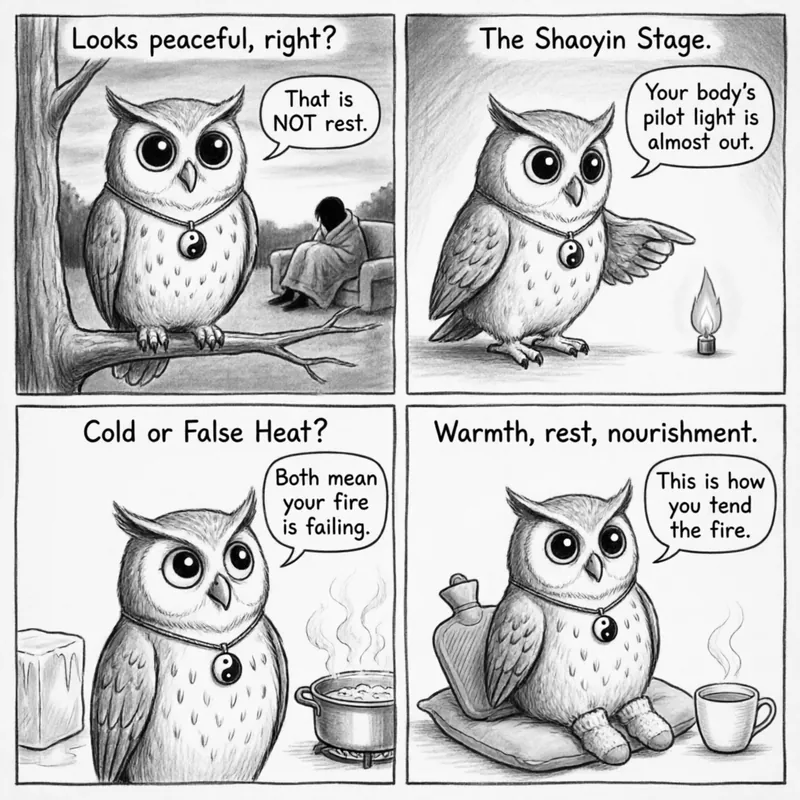
The Flickering Pilot Light: Why Shaoyin Is So Deceptive
Think back to the Yangming stage we discussed. That was a five-alarm fire. Raging fever, drenching sweats, intense thirst — it was impossible to ignore. A person in a Yangming state looks sick, and everyone knows it's an emergency.
A person in a Shaoyin state looks… tired. Maybe a little pale. They're quiet. They don't have the energy to complain much. From the outside, it can be mistaken for calmness or even laziness.
This is what makes it so dangerous. The silence is a sign of depletion, not peace.
The best analogy is the pilot light on an old gas furnace. When it's working, the house is warm. If it flickers and goes out on a freezing night, the house doesn't instantly become an icebox. It just gets quieter. The hum of the furnace stops. Then, slowly but surely, the cold seeps in from every corner until the pipes freeze and burst. The crisis was the moment the light went out, not the moment the pipes burst.
Shaoyin is that flickering light. The vital fire is about to be extinguished, and the body's core temperature — its very vitality — is dropping.
Cold or Hot? The Two Faces of Shaoyin Exhaustion
While the classic Shaoyin pattern is one of profound cold and depletion, it can actually manifest in two different ways. It all depends on what's more depleted: the Yang (Fire) or the Yin (Water).
Shaoyin Cold Transformation
This is the more common and classic presentation. It's a direct result of the Heart and Kidney Yang being completely exhausted. The pilot light is almost out, and the body is turning into a cold, dark house.
Symptoms include:
- An overwhelming desire to sleep, curled up in a ball
- Feeling cold to the bone, especially the hands and feet
- A pale or ashen complexion
- No thirst, or maybe a desire for small sips of warm drinks
- Frequent, clear urination (the Kidneys can't hold water)
- Loose stools or diarrhea with undigested food
This is the picture of someone whose internal fire has dwindled to a few dying embers. They seek warmth and quiet because that's all they can do.
Shaoyin Heat Transformation
This one is more confusing. How can you be so depleted and feel hot? This is what Chinese medicine calls "False Heat" or "Empty Heat."
In this case, the Kidney Yin — the body's cooling, moistening fluid — has been burned away. Without enough water in the pot, the fire (what little is left of the Yang) flares up uncontrollably. It's not a strong, robust fire; it's the frantic, scorching heat of a pot boiling dry.
Symptoms include:
- Severe anxiety and irritability
- Insomnia, or feeling "too tired to sleep"
- A feeling of heat, especially in the chest, palms, and soles of the feet
- A dry mouth and throat, especially at night
- Scanty, dark-colored urine
- A red tongue with little or no coating
This person is exhausted but also agitated. They can't settle down. This paradoxical state is a clear sign that the body's fundamental Yin-Yang balance has been shattered at the deepest level.
Hoo boy. As an owl, I'm a professional sleeper. I KNOW sleep. And let me tell you, this Shaoyin business isn't sleep. My ear tufts are practically vibrating with concern.
Real sleep is when your body plugs into the charger. This is when your phone hits 2% and goes into ultra-power-saving-mode — the screen dims, nothing works right, and it's about to shut down completely. This isn't rest; it's a retreat.
I was perched on a fence post the other night, watching the world go by, and I thought about how easily we mistake quiet for peace. A quiet forest is alive. A quiet body in Shaoyin is… different. It's like the forest after a long freeze — everything is still, but it's not a peaceful stillness. It's the stillness of things barely holding on.
If you recognize yourself in these words — that bone-deep tiredness that sleep never touches, that cold that lives inside you no matter how many blankets you pile on — please don't brush it off as "just being lazy." Your body isn't being dramatic. It's being honest. And honesty, even when it's quiet, deserves to be heard.
— Ollie (adjusts his grandmother's yin-yang pendant, red ear tufts drooping with empathy)
So, What Can You Actually Do? (Besides Just "Resting More")
If you recognize yourself or a loved one in these descriptions, the first and most important step is to seek out a qualified TCM practitioner. The Shaoyin stage is not a DIY situation. It requires a precise diagnosis and often involves potent herbal formulas designed to gently rekindle the body's fire without burning it out.
That said, the guiding principle for supporting a Shaoyin constitution is to conserve and gently warm. Here are some lifestyle shifts that align with that principle.
1. Practice Radical Rest. We're not talking about scrolling through your phone in bed. We mean true sensory deprivation. Lie down in a quiet, dimly lit, warm room. No screens, no podcasts, no stressful conversations. Allow your nervous system to completely power down. Napping is not a luxury; it's a medical necessity.
2. Make Warmth Your Best Friend. Your lower back is the home of the Ming Men (命門), the Gate of Vitality, which is directly related to Kidney Yang. Keep it warm with a heating pad or hot water bottle. Wear socks to bed. Never, ever walk around barefoot on cold floors. Avoid sitting on cold surfaces.
3. Eat Warming, Nourishing Foods. Your digestive system is weak, so it needs food that's easy to process. Think slow-cooked soups and stews. Incorporate gentle warming spices like fresh ginger, cinnamon, and cardamom. Lamb and chicken are excellent warming proteins. Avoid iced drinks, raw salads, and cold smoothies like the plague — they are like throwing ice water on your flickering pilot light.
4. Move Gently, If at All. This is not the time for CrossFit or high-intensity interval training. That kind of exercise spends Qi you simply don't have. If you have any energy at all, a slow, short walk in the sun or some gentle Qigong or Tai Chi is the goal. The aim is to circulate Qi, not exhaust it.
The Shaoyin stage is the body's final, quiet plea for help. It's a sign that the energy that fuels your life, consciousness, and warmth is running critically low. Listening to that quiet and responding with warmth, nourishment, and deep rest is not laziness — it's the wisest thing you can do.
Your takeaway for today: Before you go to bed tonight, fill a hot water bottle and place it against your lower back for 15 minutes. Put on a pair of warm, comfy socks. Notice how that simple act of targeted warmth feels. This is the first step in tending to your inner fire.
FAQ
Can I have Shaoyin symptoms without being sick with a cold or flu?
Absolutely. While the Shang Han Lun describes the progression of an acute illness, the Six Stages are also used to understand chronic conditions. Many people develop a constitutional Shaoyin pattern over time due to chronic stress, overwork, insufficient rest, or aging. It can become their baseline state of being.
Is this the same as adrenal fatigue or chronic fatigue syndrome?
There's a huge overlap in symptoms. From a Western perspective, conditions like adrenal fatigue, chronic fatigue syndrome (ME/CFS), and burnout describe a state of deep exhaustion that modern medicine struggles to define. From a TCM perspective, these conditions almost always involve a Shaoyin pattern of Kidney and Heart depletion. TCM offers a different diagnostic framework and a time-tested approach to treatment that focuses on rebuilding the body's foundational energy.
How can I be exhausted and feel hot at the same time? That doesn't make sense.
This is the concept of "Empty Heat." Think of a car engine. When it has enough coolant (Yin), it runs at a normal temperature. If the coolant leaks out, the engine overheats, not because the fire is stronger, but because there's nothing to control it. In the body, when Kidney Yin (the cooling fluid) is depleted, the body's normal warmth (Yang) can feel like a feverish, agitating heat, even though you are fundamentally exhausted.
Sources
- Zhang, Zhongjing. Discussion of Cold Damage (Shang Han Lun). Eastern Han Dynasty, c. 200 AD. Line 281: "Shaoyin zhi wei bing, mai wei xi, dan yu mei ye." (少阴之为病,脉微细,但欲寐也).
- Mitchell, Craig, Feng Ye, and Nigel Wiseman. Shang Han Lun: On Cold Damage. Paradigm Publications, 1999.
— Ollie
Enjoyed this?
Subscribe via RSS — new articles delivered to your feed reader.
Have a question? Reply by email — good questions become future articles.