
The Fire Inside You Is Going Out (And You Don't Even Know It)
Is this you? You’re wearing a sweater in July. Your feet feel like blocks of ice, even under a pile of blankets.
Your partner calls you the "human ice pack" when you get into bed. Every day by 3 PM, you hit a wall of exhaustion so deep that even the strongest coffee can’t touch it. Maybe you also have a nagging, dull ache in your lower back that never quite goes away. You’ve been to the doctor, run the tests, and heard the frustrating words: "Everything looks normal." But you know, deep down, that something is *not* normal. You feel like a phone that’s perpetually stuck at 15% battery, no matter how long you charge it. In Chinese medicine, we have a name for this. It’s not just in your head; it’s a sign that your body’s essential fire is starting to flicker out.
 Ollie's Take
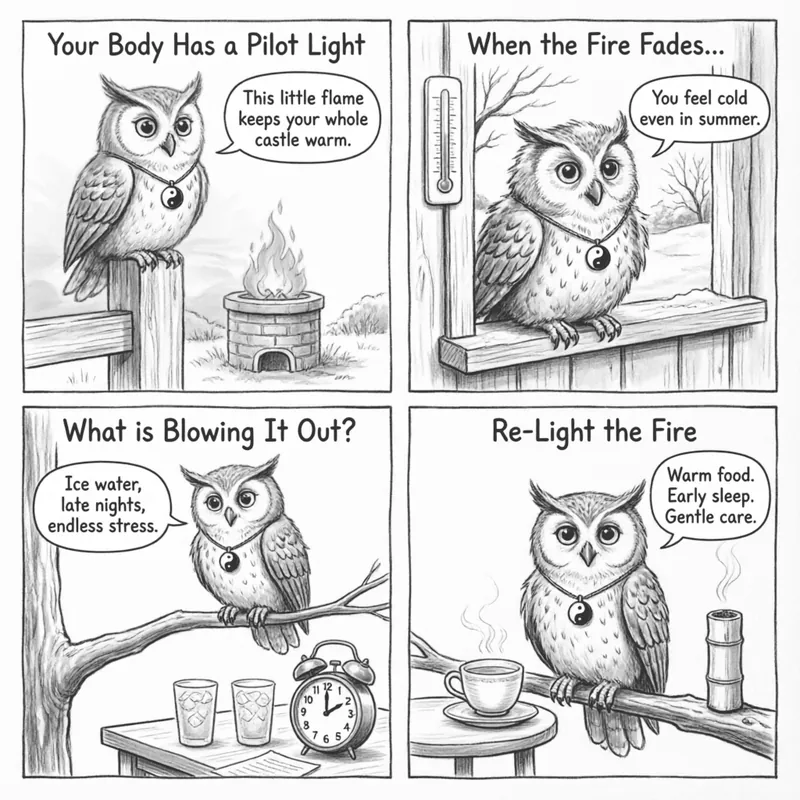
Your Body Has a Pilot Light
Imagine your body is a grand, old castle. To keep it warm and running, there's a massive furnace in the basement. This furnace is your Kidneys, the powerhouse of your body's foundational energy. But for that furnace to work, it needs a small, steady flame—a pilot light.
In Chinese medicine, this pilot light has a beautiful name: *Ming Men* (命门), which translates to the "Life Gate Fire." It's a concept formalized by the brilliant Ming Dynasty physician Zhang Jingyue. He taught that this tiny, vital flame is the source of all the Yang energy—the warmth, activity, and metabolic power—in your entire body.
When the Ming Men fire is burning brightly, your furnace works perfectly. The whole castle is warm, the plumbing flows, the lights are on, and there’s energy for every activity. But when modern life starts to create drafts, that pilot light can shrink. And if it flickers too low, the whole system starts to go cold. As Ollie the screech owl often reminds me, it's like trying to get through a cold winter night with just one tiny candle. It's a struggle.
Five Signs Your Fire Is Fading
When the Life Gate Fire dwindles, the body sends out clear signals. They often creep up so slowly that we mistake them for "just getting older" or "being stressed."
1. You're Always Cold: This isn't just cold hands and feet. It's a deep, internal coldness that a sweater can't fix. The areas closest to the "furnace"—your lower back, abdomen, and knees—will feel especially chilly or weak.
2. Exhaustion That Sleep Can't Fix: This is the hallmark of a depleted fire. It’s not the normal tiredness after a long day; it's a bone-deep weariness that’s there when you wake up and follows you all day long. You might sleep eight hours and still feel like you need a four-hour nap.
3. A Disappearing Libido: The Ming Men fire is the spark for our vitality, creativity, and drive—including our sex drive. When the fire is low, there’s simply not enough energy to spare for passion. It’s one of the first "non-essential" functions the body shuts down to conserve fuel.
4. Frequent, Clear Urination (Especially at Night): The Kidney's Yang energy is responsible for "steaming" and transforming fluids in the body. When the fire is weak, it can't do this job properly. The result? Your body just dumps the fluid out. You might find yourself getting up two, three, or even four times a night to urinate, and the urine is often clear and copious, like plain water.
5. A "Deep and Thin" Pulse: This is something a trained practitioner would notice. When they feel your pulse at the wrist, it won't feel vibrant and right under their fingers. Instead, it will feel weak, hard to find, and thin, like a single guitar string buried deep beneath the skin. It’s a literal, physical sign that the body’s energetic output is weak.
What's Blowing Out the Flame?
So, what’s causing this epidemic of dwindling fire? It’s not a mystery. It's the mismatch between our body's ancient needs and our modern lifestyle. The foundational text of Chinese medicine, the *Huangdi Neijing* (黄帝内经), states: "Yang Qi is like the sun in the sky—lose it, and life withers." We are actively, though unintentionally, blocking our own sun.
Re-Lighting the Fire
The good news is that this fire isn't gone for good. It's just very, very low. You don't need a blowtorch; you need to gently protect the flame and give it the right fuel to grow stronger.
For context: while Ming Men fire and Spleen Yang are related (both are aspects of the body's Yang Qi), they manifest differently. Spleen Yang deficiency primarily affects digestion—bloating, loose stools, feeling cold after eating—though it can also contribute to fatigue. Ming Men fire decline runs deeper, affecting your core thermostat, reproductive vitality, and foundational energy reserves. If you have digestive issues alongside the deep bone-tiredness and cold described above, the Ming Men fire is likely the root.
For extreme cases of Yang collapse—the kind that require immediate professional care—the classical formula *Sini Tang* (四逆汤), or Frigid Extremities Decoction, has been used for nearly 2,000 years. A word of caution: this formula contains Fu Zi (prepared aconite), one of the most potent—and potentially toxic—herbs in the pharmacopeia. The name "four reverse" refers to cold extending past the elbows and knees: a medical emergency, not everyday chilliness. Sini Tang is never for self-prescribing. It is a rescue formula administered under strict clinical supervision.
For the slower, chronic pattern most of us experience, the formula designed by Zhang Jingyue himself is *You Gui Wan* (右归丸), the Restore the Right Kidney Pill. It gently coaxes the Ming Men fire back over months—rebuilding rather than rescuing. (Both formulas require a qualified practitioner's prescription.)
But for most of us, the solution starts with simple, daily habits.
Warm Up Your Diet: Start swapping cold for warm. Instead of a smoothie, try a warm bowl of oatmeal with cinnamon and ginger. Instead of iced tea, have a cup of warm ginger or chai tea. Add warming spices like cinnamon, cloves, fennel, and black pepper to your cooking. Foods like lamb, chicken, squash, and root vegetables are all excellent for stoking the fire.
Honor the Darkness: Make it a non-negotiable priority to be in bed before 11 PM. This is one of the most powerful things you can do for your health. Create a relaxing wind-down routine to signal to your body that it's time to rest and repair. Ollie, who is naturally nocturnal, finds this one particularly hard, but even he admits he feels better after a rare early night.
Bring in the Heat:** A therapy called moxibustion is a cornerstone of rebuilding the Ming Men fire. A practitioner will burn a special herb—*Ai Ye*, or Mugwort—over specific acupuncture points to send deep, penetrating warmth into the body. The primary point is, fittingly, *Ming Men* (GV4), located on the spine directly opposite your navel. Even just placing a hot water bottle on your low back for 15 minutes before bed can feel incredibly nourishing.
There is a gentle self-care version you can try at home: place a small pinch of salt in your navel (the *Shen Que* point, CV8), rest a thin slice of fresh ginger on top, and hold a lit moxa stick about an inch above for 10–15 minutes. The warmth travels directly to the Ming Men area. Shen Que means "Spirit Gate"—it's one of the few points where the Ming Men fire can be reached from the front of the body. Start under a practitioner's guidance the first time.
Stop the Ice Water: This is a simple but powerful change. Switch to room temperature or warm water. It takes so much less energy for your body to process, freeing up that energy for other things.
Move Gently: Swap some of your HIIT classes for activities that build Qi instead of just spending it. Tai Chi, Qigong, and gentle yoga are perfect. They are designed to circulate energy and calm the nervous system, helping to coax the fire back to life instead of blowing it out. Ollie, who watches from his fence post at dawn, has seen far more vitality return to people doing a slow morning Qigong routine than to those punishing themselves at the gym.
Feeling cold and tired isn't a life sentence or a personality trait. It’s a message from your body asking for help. It’s asking for warmth, for rest, and for a chance to let its pilot light shine brightly again. By making these small, consistent changes, you can stop the drafts, add the right fuel, and slowly but surely bring the warmth back to your entire castle.
FAQ
1. Is this the same as having a thyroid problem?
This is a fantastic question. In Western medicine, many of these symptoms—fatigue, feeling cold, low libido—are classic signs of hypothyroidism. From a Chinese medicine perspective, hypothyroidism is often a manifestation of a deeper pattern, most commonly Kidney Yang Deficiency, which is the broader category that includes a weak Ming Men fire. We see the thyroid issue not as the root cause, but as a branch—a symptom of the body's core metabolic fire being too low. So, the two concepts are describing the same reality from different but complementary angles.
2. Can young people have Ming Men fire deficiency?
Absolutely. While we often associate these symptoms with aging, this pattern is becoming increasingly common in people in their 20s and 30s. The cause isn't age; it's lifestyle. A young person juggling a stressful job, late nights studying, a diet of iced lattes and takeout, and intense workouts is a prime candidate for burning out their Life Gate Fire.
3. How long does it take to restore the fire?
This is a marathon, not a sprint. Restoring your core energy is like refilling a deep reservoir one cup at a time. It took a long time to deplete it, and it will take time to build it back. The timeline depends on how depleted you are and how consistently you can apply these warming, nourishing habits. Some people feel a shift in a few weeks, while for others, it may take many months to feel a significant, lasting change. The key is patience and consistency.
***
Sources:
Ollie, your friend at TCM Way
Ollie here. I'm perched on a fence post, and the sun is just starting to peek over the horizon. I was up way too late last night trying to spot a particularly sneaky field mouse. My ear tufts are drooping a little—they always do when I've pushed past my limits. My grandmother's yin-yang pendant feels heavier than usual against my chest feathers—it always seems to know when my energy is low before I do. Right now I can feel my own little owl fire flickering. My usual sharp focus is fuzzy, and even simple things like tracking that mouse felt harder than it should. The pendant reminds me that this isn't permanent—it's just my body asking for some gentle care. So I've learned to be kind to myself when that chill creeps in. (adjusts pendant with one wing, fluffs chest feathers, and settles in to wait for dawn)
— Ollie
— Ollie