
At the Wrist: What TCM Pulse Reading Can and Cannot Tell You
 Ollie's Take
The room goes quiet. A practitioner lays three fingertips along the radial artery at your wrist, just behind the base of the thumb. A clock ticks. For a minute or two, nobody speaks. The fingers rest lightly, press halfway down, then settle closer to tendon and bone. Then the practitioner moves to the other arm. Few TCM rituals are as recognizable, or as widely misunderstood.
Folklore turned that contact into theater. One familiar story has a court physician read a royal pregnancy through a silk thread tied to the person's wrist. When a servant knots the other end around a table leg, the physician supposedly announces that the patient is made of wood. The tale gets one thing right: the pulse has long been treated as a place where the body speaks. It gets the reach wrong. A manual pulse examination can notice rate, rhythm, and qualities felt under the fingers. It cannot identify a modern disease by itself, prove pregnancy, or replace medical testing.
On a low bookshelf, a screech owl named Ollie has one foot tucked into his feathers. The small Yin-Yang pendant against his chest hangs crooked. He is pretending not to listen.
So the question isn't whether the ritual looks impressive. It's what a practitioner can responsibly do with what three fingers notice.
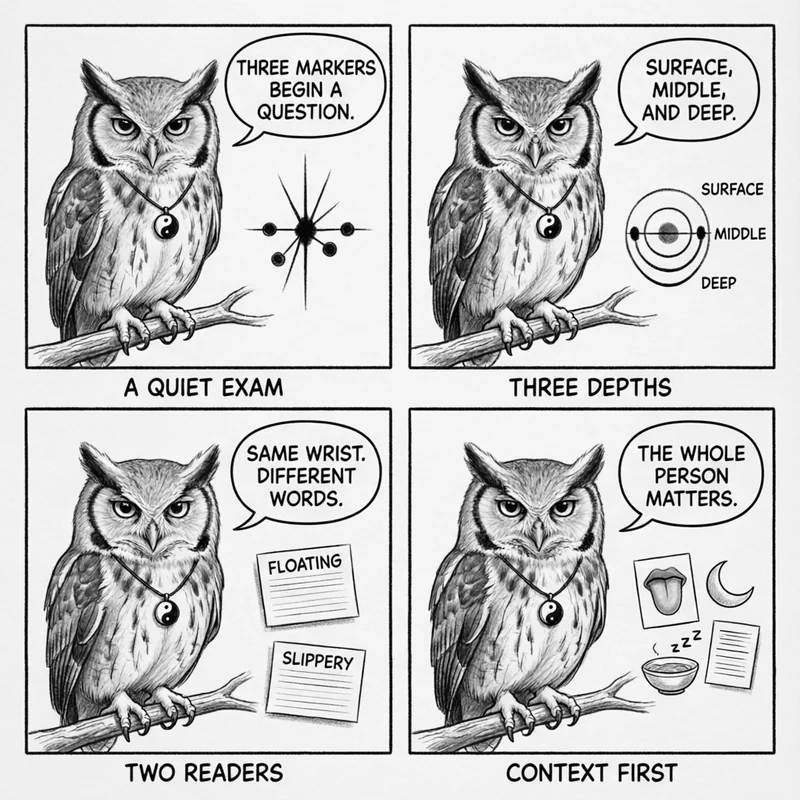
“Same wrist. Different words,” Ollie says. “That is why we keep asking.”
The Mechanics of Three Fingers on an Artery
Three fingers rest in a disciplined row. The index sits nearest the wrist crease, the middle finger beside the radial styloid, and the ring finger farther toward the forearm. Classical texts call these positions cun, guan, and chi. In English, they are the front, middle, and rear positions. The spacing follows the arm: wider on a tall adult, narrower on a child.
The fingers do more than count beats. They vary pressure through superficial, middle, and deep levels, taking care not to lose the pulse altogether. A floating quality is most apparent near the surface; a sinking quality becomes more evident with firmer pressure. These are qualities sensed through changing pressure, not labels for three finger positions.
At each depth, the practitioner notes rate, rhythm, strength, width, and texture. Does the movement feel broad, thin, slippery, rough, taut, or empty? Each term describes a sensation that the practitioner compares with your symptoms, medical history, and other findings.
One commonly taught map pairs the left front, middle, and rear positions with the Heart and Small Intestine, Liver and Gallbladder, and Kidney Yin; the right positions with the Lung and Large Intestine, Spleen and Stomach, and Kidney Yang, sometimes given as Ming Men, the Life Gate. Assignments vary across texts and lineages. Blood in the left radial artery does not take a private route to the Heart while the right serves the Lungs.
A careful examiner also compares the two wrists. The pulse may feel closer to the surface on one side and fuller or weaker on the other. Practitioners read those differences through traditional correspondences, always alongside symptoms and history. Keeping hand position consistent helps comparison, though a practitioner will press harder on a thick wrist than a thin one.
Classical practice also asks three questions beneath every named quality. Does the pulse have Stomach Qi, a relaxed, moderate feel? Does it have Spirit, expressed through orderly rhythm and a supple, harmonious quality rather than rigidity? Does it have Root, a quality and strength maintained under deeper pressure, especially at the rear position? These qualities are weighed together, not named in isolation.
A Wrist in a Wider Tradition
Early Chinese medical texts disagreed about where to listen. The Inner Canon describes pulses from head to foot, while another strand argues that one place can stand for the whole: food enters the Stomach, its essence reaches the Lung, and the Lung meets the hundred vessels. The Nanjing later gives the wrist its strongest classical argument, calling cun kou a great meeting place of the vessels.
The same classics refused to make the wrist a shortcut. They asked for a calm setting, the season, complexion, spirit, and the whole person. Later manuals, including Li Shizhen's Binhu Maixue, organized pulse qualities within the four examinations. This explains the wrist's authority inside the tradition; it does not prove that its positions measure individual organs.
Poetic Names for Everyday Sensations
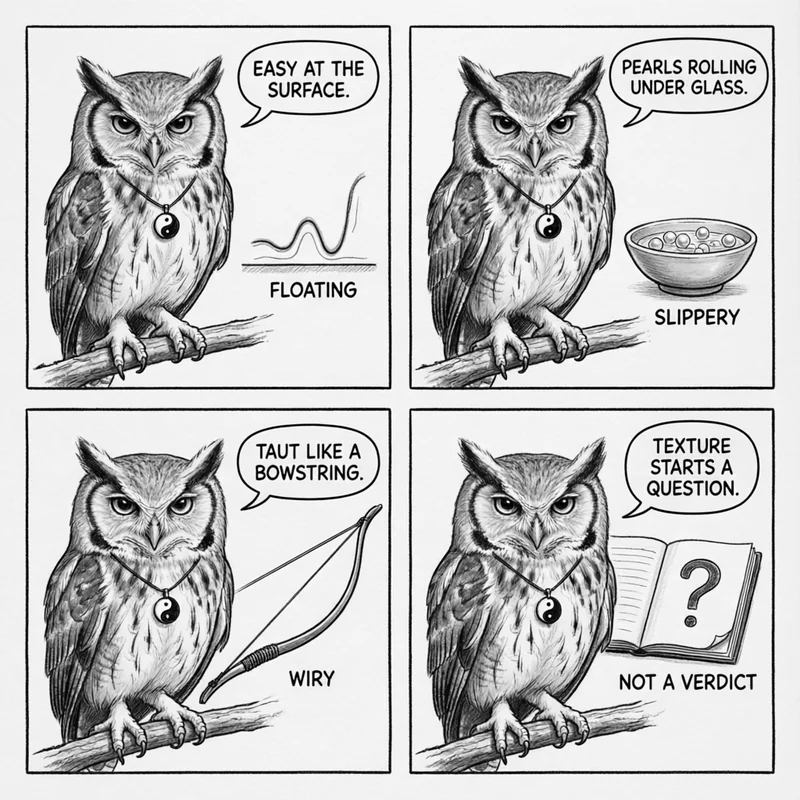
A floating pulse is easy at the surface and weaker with firm pressure. A sinking pulse is faint at the surface and becomes distinct under firmer pressure. Slippery was likened to pearls rolling across a tray: round, smooth, arriving one after another. In traditional pattern language, it may prompt questions about Dampness, Phlegm, food, or pregnancy; it cannot confirm any of them. Wiry feels straight and taut, like a bowstring. A rough or choppy pulse feels hesitant and uneven, like a blade catching as it scrapes bamboo; that texture is not the same as an irregular heartbeat, which is assessed separately. Tight feels tense and forceful, traditionally compared with a twisted rope.
Wiry and tight are easy to confuse. Wiry stays in one taut line; tight pushes back and seems to twist or roll beneath the fingers. In traditional pattern language, wiry more often accompanies constraint, pain, or phlegm-fluid patterns, while tight more often points toward Cold or acute, gripping pain.
The names describe a feeling, not a verdict. A wiry quality may make a practitioner curious about tension, pain, or stagnation. In TCM theory, a rough quality may accompany Blood deficiency, a pattern of insufficient nourishment, or Blood stasis, when movement is obstructed. Signs such as pallor and dizziness pull one way; fixed, stabbing pain pulls another. The pulse texture alone cannot choose between them.
Ollie shuffles sideways along the shelf. “A bowstring tells me how it feels,” he says. “It doesn't tell me why.” He tucks his beak into his chest feathers.
What the Wrist Adds
The pulse's job is to shape the next question. A taut middle pulse might prompt questions about tension, sleep, or recent stress; a weak, deep one might prompt questions about appetite, fatigue, and recovery after exertion.
Pulse reading creates a deliberate pause. In a hurried appointment, ninety seconds of silence with someone's wrist in hand is a lot of attention. The practitioner can notice breathing, posture, temperature, and the person's account of their life. Some of what registers during that pause has nothing to do with the artery.
Ollie has stopped preening. One ear tuft flicks up. “Ninety seconds of attention,” he murmurs, shifting his weight to the other foot. “I hunt that way. Sit still long enough and the field tells you where the mouse is. Nobody ever found one by walking fast.”
Suppose someone arrives after a week of broken sleep and three strong coffees a day. The pulse feels rapid. The practitioner can ask when the racing sensation began, whether it occurs at rest, and whether fever, breathlessness, night sweats, or unusual thirst have appeared. If the symptom is mild and settles with rest and less coffee, the practitioner might note that context and avoid forcing it into a pattern. If it persists, especially at rest, that is a question for a physician, not a pulse. If the rapid quality keeps returning alongside dryness and a scant tongue coating, Yin deficiency becomes a possible traditional reading.
In the traditional model, no single quality is enough. A thin, rapid pulse with dryness, night sweats, and a red tongue with scant coating may fit Yin deficiency with deficiency Heat. A full, forceful, rapid pulse with pronounced thirst, a red tongue, and a yellow coating may fit excess Heat. Neither combination establishes a pattern alone, and neither is a diagnostic checklist. A floating pulse with sudden chills, fever, and body aches may fit an exterior pattern; floating without those symptoms needs another explanation.
That is why the rest of the examination matters. Answers from the Ten Questions, the tongue, medical history, medicines, sleep, and digestion help interpret the pulse in context. Across visits, changes can be compared with symptoms using the same cross-checking logic as tongue reading, but pulse changes alone do not show that a treatment worked.
What the Research Shows
Picture one volunteer before three practitioners on the same afternoon. Would all three choose the same word under their fingers? Researchers have run versions of that experiment.
A 2019 systematic review led by Jacobson and colleagues examined twenty-one studies of inter-examiner agreement in East Asian medicine, not exclusively pulse reading. Across nine studies, mean pairwise agreement was 57%, with results ranging from 19% to 96%. Across seven studies, mean Cohen's kappa was 0.34. The authors called agreement low to moderate.
Put plainly: two trained practitioners often notice something, but they do not always describe it the same way. Kappa adjusts observed agreement for the agreement expected by chance. A mean of 0.34 suggests limited agreement beyond chance, although the result depends on study design and the categories being assessed.
Ollie tilts his head at the sentence. “Three owls, one rustle,” he mutters. “They might call it three different things. Different names don't prove there is a mouse.”
Bilton and Zaslawski's 2016 review of twelve pulse-diagnosis studies found something practical in the noise. When researchers defined what “wiry” meant before the study began, examiners agreed more often. Methods and results still varied widely.
Whole-pattern assessment faces the same problem. In Schnyer's 2019 randomized trial, practitioners assessing menstrual pain reached a median kappa of 0.26, and structured training did not significantly improve it. That year, Popplewell and colleagues found 23% pattern agreement and 19% weighted agreement in an open clinic population.
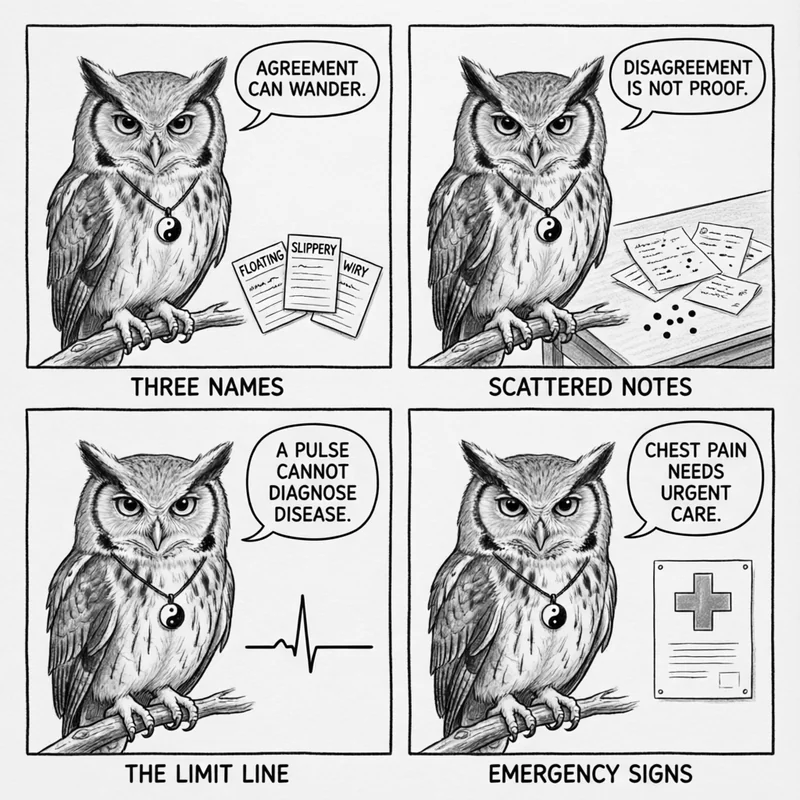
These studies examine different tasks: some assess pulse descriptions, while others assess broader TCM patterns. Their agreement scores are not interchangeable. Low agreement alone cannot tell us whether terminology, technique, changing physiology, or interpretation caused the disagreement. Agreement is not validity: two examiners can agree and both be wrong.
Taken together, the research shows variable agreement about pulse descriptions and broader TCM patterns. It does not show that a named pulse quality can independently identify a disease. Manual pulse examination can still add attention, continuity, and useful questions.
Where the Line Is
A pulse examination cannot establish a modern disease, identify an infection, locate a tumor, screen for diabetes, or assess a lipid panel. It cannot replace blood pressure measurement, laboratory work, electrocardiography, or imaging. Nor can it determine whether an herb or supplement is safe.
Do not wait for a pulse reading during an emergency. Chest pain, fainting, sudden one-sided weakness or trouble speaking, severe breathlessness, and sudden vision loss all call for urgent medical help. Palpitations that arrive with any of these signs belong in the same urgent category. New or persistent palpitations without them still warrant a prompt check-up.
Ollie Speaks
My toes lock around the shelf edge, two forward and two back. From here I can hear the clock, the cloth, and the practitioner's slow breath. I am listening for what changes. A knock can mean a visitor or a branch against the window. A pulse can mean one thing today and something else tomorrow. That is why I wait before naming the sound. My pendant is only painted wood. I will be here, pretending I am not asleep.
If You Are Having Your Pulse Taken
- Sit for a few minutes first. A reading taken immediately after rushing upstairs says more about the stairs than the rest of your week.
- Mention coffee, decongestants, heart medicine, thyroid medicine, a cold, or a poor night's sleep without waiting to be asked.
- Ask what the practitioner noticed and how it fits with your symptoms and history. “Your left middle position felt taut today; does that line up with the jaw tension you mentioned?” is a useful answer. “Your Liver is blocked” is not.
- Do not change prescribed medicine because of a pulse reading. New, persistent, or worrying heart symptoms belong in a doctor's office.
FAQ
Does a faster pulse always mean Heat?
No. A rapid pulse can appear with fever, anxiety, pain, dehydration, anemia, thyroid problems, medicines, caffeine, exertion, or poor sleep. In traditional pattern language, it may accompany Heat, but Heat is not the only possibility, and a rapid quality alone cannot establish it. The practitioner also considers thirst, temperature preference, sweating, tongue color, tongue coating, sleep, digestion, and the person's medical context. If the rate stays high while you are resting, get it checked. The traditional label may be interesting; it is not a substitute for finding the cause.
Why did two practitioners read my pulse differently?
Some disagreement is expected. Studies find variable agreement among examiners, especially when terms are poorly defined. Ask each practitioner which symptoms, tongue findings, history, and medicines shaped the interpretation. A different label does not automatically mean your condition changed, and a confident description is not proof of a diagnosis. If two readings disagree about something urgent, such as a very fast or irregular heartbeat, do not settle it through pulse language; get medical assessment. Use the comparison to ask better questions, not to choose a winner.
Can a smartwatch replace TCM pulse reading?
No. A smartwatch may estimate heart rate and sometimes rhythm, which can be useful for detecting patterns that need medical attention. It does not measure the traditional qualities described as floating, sinking, wiry, slippery, or rough. It also cannot place those qualities into a TCM pattern. A wearable may provide a useful record to discuss with a qualified clinician, especially if it repeatedly flags an irregular rhythm. If a device warns you, treat that alert as a reason to seek medical advice, not as a TCM reading or permission to choose herbs.
Sources
- Jacobson E, et al. Experimental Studies of Inter-Rater Agreement in Traditional Chinese Medicine: A Systematic Review. J Altern Complement Med. 2019;25(11):1085-1096. doi:10.1089/acm.2019.0197.
- Bilton K, Zaslawski C. Reliability of Manual Pulse Diagnosis Methods in Traditional East Asian Medicine: A Systematic Narrative Literature Review. J Altern Complement Med. 2016;22(8):599-609. doi:10.1089/acm.2016.0056.
- Schnyer RN, et al. Can Reliability of the Chinese Medicine Diagnostic Process Be Improved? Results of a Prospective Randomized Controlled Trial. J Altern Complement Med. 2019;25(11):1103-1108. doi:10.1089/acm.2019.0260.
- Popplewell M, Reizes J, Zaslawski C. Consensus in Traditional Chinese Medical Diagnosis in Open Populations. J Altern Complement Med. 2019;25(11):1109-1114. doi:10.1089/acm.2017.0148.
- Huangdi Neijing, Suwen. Chapters 11, 17, 18, 20, and 21.
- Nanjing. Difficulty 1.
- Li Shizhen. Binhu Maixue. Preface and pulse-quality sections.