Minor Snow: The Old Calendar's Quiet Turn Toward Winter
 Ollie's Take
A thin layer of frost covers the metal handrail before sunrise. The grass has stiffened into pale gray bristles, and the morning air smells of chimney smoke, dry asphalt, and damp earth. On the cedar branch beside the kitchen window, Ollie shakes the frost from his feathers and grips the bark again, ear tufts flattened against the cold. "Cold enough that the world stopped moving," he says.
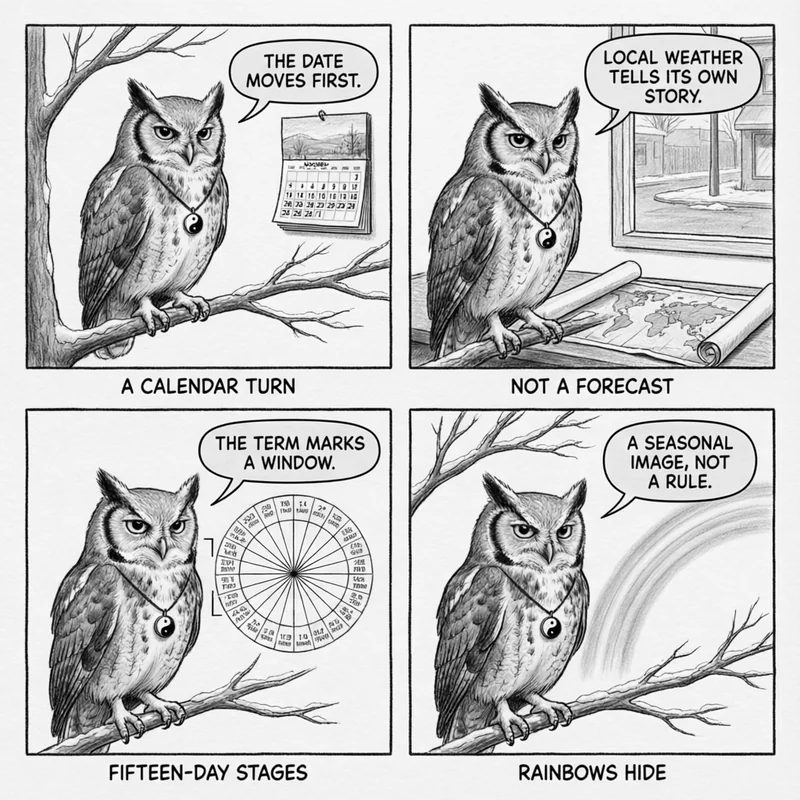
Nothing is falling from the sky. The street is dry. Yet the traditional calendar says Minor Snow has begun. The name is not a forecast for the morning outside your window. It marks the point when the year's work turns from harvest toward storage.
“Cold enough that the world stopped moving,” Ollie says.
A date, not a weather report
Minor Snow begins when the sun reaches 240 degrees of ecliptic longitude. The term lasts fifteen days. In 2026, it begins on November 22. It is the twentieth of the twenty-four solar terms, a system that organized the agricultural year in China and still marks the seasons for many people. UNESCO added the system to its Representative List of the Intangible Cultural Heritage of Humanity in 2016.
The longitude figure describes the sun's apparent path across the year. Each solar term begins at another fifteen-degree mark. That gives the season a shared date even when the weather refuses to cooperate. Someone in Guangzhou may still need only a sweater. In Harbin or northern Minnesota, snow may have arrived two weeks earlier. The calendar tracks the year's position, not the conditions on every street.
The traditional Chinese calendar is lunisolar. Its months follow lunar cycles, while the twenty-four solar terms track the sun's apparent annual motion within the same system. Lunar dates shaped many festivals; the solar terms gave farming households a seasonal clock for harvest, repairs, and storage. Minor Snow is therefore a solar marker, not a forecast of local snowfall. Snow might arrive tomorrow or not until December, but the term turns attention toward what must be kept before winter hardens.
Three pictures of the season
Classical observers divided each solar term into three five-day stages called pentads. They used images from the natural world rather than exact temperature records. For Minor Snow, the sequence was: rainbows hide from sight, heaven Qi rises while earth Qi descends, and closure creates winter.
The first image says that rainbows disappear. In the older seasonal picture, a rainbow belonged to the meeting of warmth, moisture, and sunlight associated with brighter months. Its absence marked a turn toward colder, drier weather, even if the sky was merely gray.
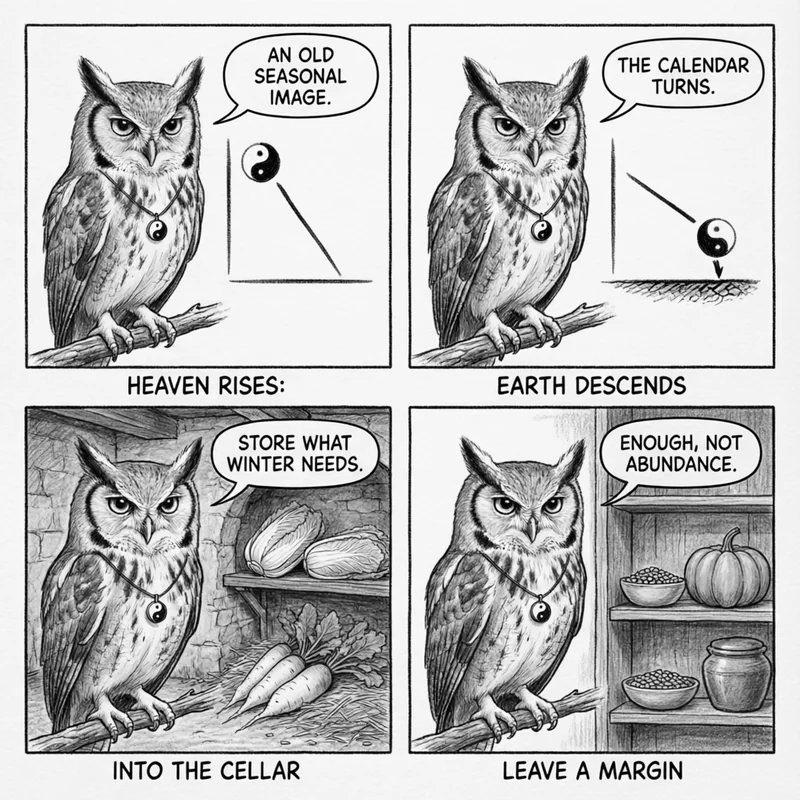
The second says that heaven Qi rises while earth Qi descends. Spring and summer were described as a time when those influences met and supported growth. By late November, that exchange was said to cease. The image gives the quiet of early winter a shape: sky and ground drawing apart.
The third says that closure creates winter. Fields receive less attention. Tools are put away. Householders seal drafts and move provisions under cover. Ollie tucks his chin against his chest and settles lower on the branch. "I'm all for closure," he mutters. "It means I can stop pretending to be busy."
What went into the cellar
In parts of northern China, a late-November farmyard might show napa cabbages spread root-up in the last thin sun. The outer leaves lose some surface moisture before the vegetables go underground. Historical accounts describe households packing cabbage, sturdy radishes, and scallions into earthen trenches or stone-lined cellars before the ground froze hard. They covered the produce with straw or dry soil, adjusting the layer to insulate it without trapping enough moisture to cause rot.
A cellar was not a refrigerator. It buffered vegetables from sharp temperature swings. Too warm, and dampness and decay could spread. Too cold, and the crop could freeze. A warm spell might leave condensation under the straw. A hard freeze could push the cold deeper than expected. Households checked the covering, opened ventilation when damp air gathered, and added protection when the ground hardened. The work did not end when the vegetables disappeared underground.
Methods varied with climate and food. Roots could be buried in cool sand. Leafy greens needed air and protection from freezing. Coastal households might dry fish in a cold wind, while rice-growing families pounded sticky rice into cakes that could be dried and steamed later. These were local solutions, not one national tradition.
The point was margin. A household needed familiar food to last past the weeks when fresh greens disappeared. It also needed enough judgment to use the crops most likely to spoil before the family ran short. The calendar began the season. Daily checking carried the household through it.
Historical practice is not a modern recipe. Anyone preserving food today should use tested guidance from the National Center for Home Food Preservation rather than copying a cellar method from an old account. The storage story matters because it shows what the solar term asked of a household: look ahead, notice the weak point, and leave some room to absorb a bad week.
Why TCM used the image of storage
The Huangdi Neijing applies a similar image to the body. In Suwen Chapter 2, the three winter months are called a season of closing and storing. The text describes an earlier bedtime, a later rising, warmth, and protection from exposure to cold. These were instructions for seasonal conduct. They did not promise that winter would make someone ill or that a cold morning could reveal a hidden deficiency.
The term Ming Men, or Life Gate, appears in early Chinese medical literature, but later physicians developed its meaning in different ways. Zhang Jingyue, a Ming-dynasty physician, gave it a particularly central role and described its fire as a root of Yuan Qi and a source of warmth that helps the body use food and fluids. Within this model, the Kidney network is associated with winter and with Jing, or Essence. Jing includes constitutional and acquired aspects and is linked to growth, development, reproduction, maturation, and aging. The storage metaphor in this article is a useful shorthand, not a complete definition or a measurable biomedical substance.
The wider medical metaphor treated the body as a household with resources to gather, store, spend, and protect. That explains why the winter passage in the Neijing concerns conduct: sleep, warmth, and exposure matter within the model because they change how the household is run. The text does not offer a weather rule that applies identically to every person. It asks the reader to adjust ordinary behavior to the season rather than ignore it.
The seasonal logic is not hard to follow once the vocabulary is set aside. A household stores food because the growing season has ended. The classical medical model recommends conservation because winter is described as a time of greater demand on warmth and reserve. The analogy is cultural and historical. It is not evidence that cold weather causes kidney disease, nor does feeling cold establish a TCM pattern.
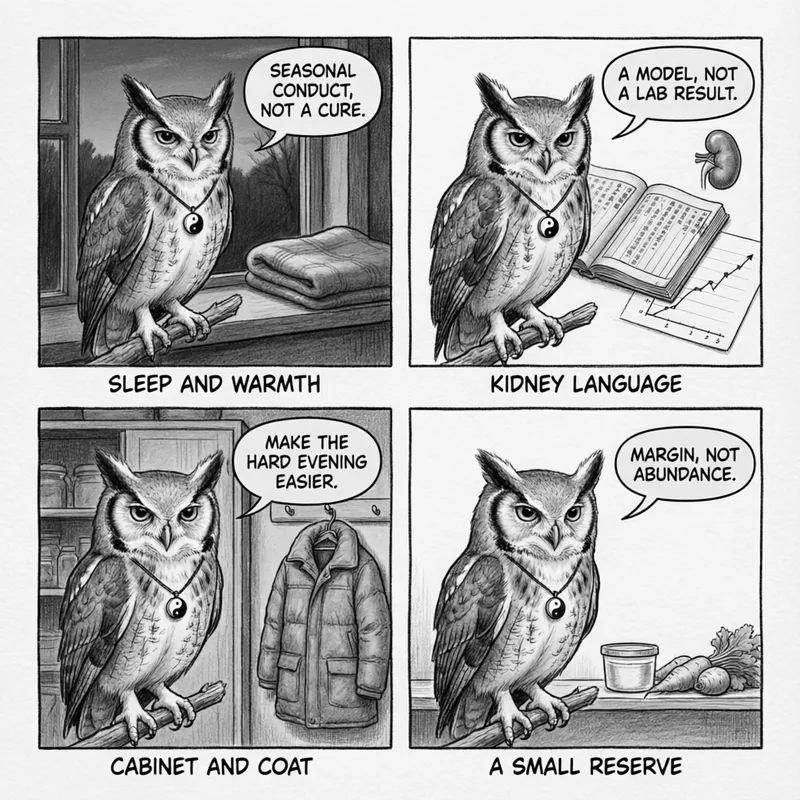
That boundary matters. A traditional model may help someone notice the shape of a season. It cannot diagnose the cause of persistent fatigue, pain, breathlessness, or cold intolerance. Those symptoms can have many medical explanations and deserve qualified care. The useful part of the old image is narrower: winter invites attention to what supports you and what should not be spent carelessly.
What a modern household might keep
Few readers have a cabbage trench. The modern version of storage is margin. It may be a shelf of food you actually eat, a few meals in the freezer, the cold-weather layer left in the car, or a prescription refill collected before the last dose. It can also be time: one evening left open in a crowded week, or a task moved earlier when daylight and patience are easier to find.
The reserve should fit your actual needs. Stockpiling without a plan only moves the problem into a cupboard. The old household did not keep everything. It kept what would carry it through the period when fresh supplies were scarce. A modern reader can ask a smaller version of the same question: what usually runs short in the next few weeks, and what would make that shortage less disruptive?
The modern test is a difficult evening, not a perfectly organized cupboard. You come home after dark, the shops are closed, and everything has taken longer than expected. A can of beans, an onion, and something from the freezer can keep the evening from turning into another errand. That small reserve is the cellar's descendant: not abundance, just one less avoidable crisis. Preparation is useful when it removes a decision, not when it creates a new system to maintain.
For seasonal eating, the answer depends on where you live. The old food clock is a cultural model, not a rule that root vegetables become medicine in November. What winter makes visible is the change in supply, light, and routine. Those changes are concrete. A pantry can hold dried beans and squash. A coat hook can hold the warm layer that was forgotten in October. A calendar can leave one evening unclaimed.
An hour spent on a bright afternoon can protect an evening two weeks later. A warm layer by the door can save a cold wait at a bus stop. This is not prediction. It is noticing where an ordinary week is fragile and placing something useful within reach.
Outside, Ollie tilts his head toward the condensation on the lower pane and fluffs his chest feathers once. Then he returns his gaze to the dry street. The window has fogged while the weather has not changed. Inside, a pot of beans and squash sits on the counter. None of this is a cure or a ritual. It is preparation small enough to finish.
By late afternoon, the lower edge of the window is clouded with moisture. No flake has fallen. The year has turned anyway. Minor Snow has done what a calendar can do: it has made that turn visible, and given a household one more reason to look ahead.
FAQ
Why is it called Minor Snow, not First Snow?
The name came from a seasonal picture in ancient central China. Around this point in the year, colder air and longer nights made light snow possible, but did not guarantee that snow would fall or settle. "Minor" points to the early stage of that seasonal turn, not to a measured snowfall. The term describes a calendar boundary, while the first snow is a local weather event shaped by elevation, humidity, and moving air. Those two events can be weeks apart.
Why does the date shift from year to year?
A solar year lasts about 365.24 days, while the civil calendar uses 365 whole days. That fraction accumulates until a leap day corrects the total, and the wall date of a solar term moves by small amounts on ordinary calendars in the meantime. The term still begins at the precise moment when the sun reaches 240 degrees of ecliptic longitude. The variation comes from the way people count whole days, not from a change in the underlying seasons themselves.
I've heard winter is hard on the Kidneys. Should I worry?
Winter is associated with the Kidney network in classical Chinese medicine, but that association is not a diagnosis. Even within TCM, feeling cold alone does not establish Kidney Yang deficiency. Exposure to cold may produce a different pattern, while fatigue or low energy can also reflect sleep loss, illness, medication effects, or another health condition. A practitioner must assess the whole person rather than infer a pattern from one symptom or from the season. Persistent or worrying symptoms deserve evaluation by a qualified medical professional.
Sources
- Hong Kong Observatory, The 24 Solar Terms
- Hong Kong Observatory, 2026 Gregorian-Lunar Calendar Conversion Table
- UNESCO, The Twenty-Four Solar Terms
- National Center for Home Food Preservation, Resources
- Chinese Text Project, Huangdi Neijing, Suwen 2
- Zhang Jingyue. Jingyue Quanshu (Complete Works of Jingyue), Ming dynasty.