
Taiyang and Wei Qi: What Chinese Medicine Means by the Body's Surface
The classical idea of an exterior pattern is a way to organize observations, not a hidden layer, a modern diagnosis, or an instruction to sweat out an illness.
 Ollie's Take
Short answer: Taiyang (Greater Yang) is a classical pattern family in Chinese medicine associated with the body's exterior response, not a literal anatomical layer or a modern disease diagnosis. Wei Qi (defensive Qi) is a traditional concept describing protective, warming, surface-regulating function, not a direct synonym for the immune system. This historical framework organizes observations such as shivering, sweating, and aversion to wind. It is not a tool for self-diagnosis, an instruction to induce sweating, or a replacement for modern medical care.
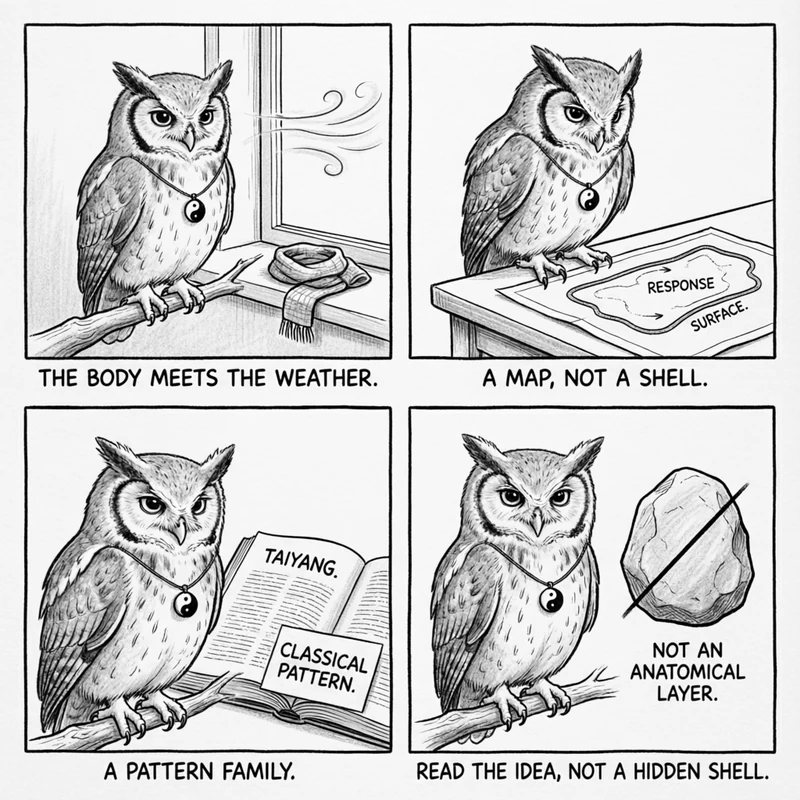
A morning when the surface becomes visible
Step out into a brisk autumn morning before sunrise. A cold draft catches the exposed back of your neck. Your shoulders rise, your skin prickles, and a sharp shudder runs down your spine.
In that moment, you feel the boundary where your body meets the environment. The skin is not merely a container. It responds to temperature, drafts, moisture, and season.
Classical Chinese doctors watched this boundary closely. They grouped what they saw—shivering in a breeze, a stiff neck on a cold morning—into a framework they called the exterior.
Ollie, our resident screech owl editor, tilts his head. “When you say surface,” he asks, “do you mean skin, a channel, or a shield?” None of those quite fits. Here, the surface is a map of how the body responds at its outer boundary.
What Taiyang names
The classical account begins with the Shang Han Lun (Discussion of Cold Damage), a foundational text traditionally associated with the late Han dynasty physician Zhang Zhongjing. What we read today comes through centuries of commentary and Song-dynasty editing—Zhang Zhongjing's original manuscript did not survive intact.
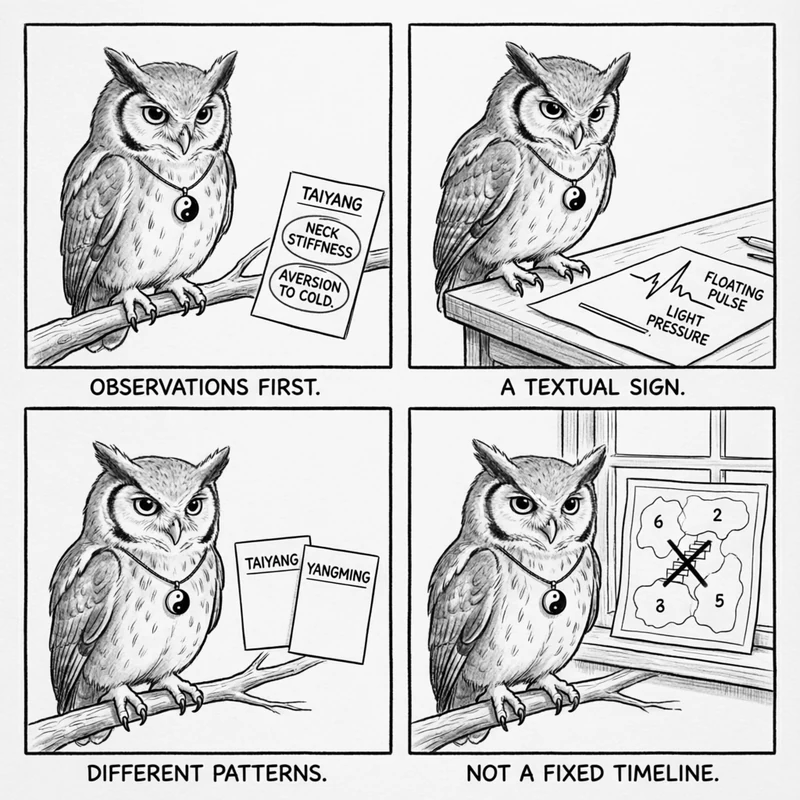
The text groups presentations into six pattern families, often called the Six Channels or Six Conformations. As discussed in our guide to why the Six Channels are not a disease timeline, these are structural categories for observed symptoms, not a clock counting down an illness.
Taiyang, usually translated as Greater Yang or Supreme Yang, comes first in the text's ordering. It organizes signs traditionally associated with the exterior response to wind and cold. That placement does not imply that every illness begins there or follows the conformations in sequence.
The opening Taiyang clauses show what this meant in practice. Their early signs include a floating pulse, headache, neck stiffness, and aversion to cold. One presentation, “wind strike” (zhong feng), adds fever, sweating, aversion to wind, and a moderate or relaxed pulse. Another, “cold damage” (shang han), has aversion to cold whether or not fever has appeared, along with generalized pain, dry retching, and tight pulses.
These clauses describe what the patient feels and what the practitioner detects, not an organism or organ pathology. A floating pulse often supports an exterior interpretation, but it is not exclusive to exterior disorders, so practitioners read it with the full pattern. Here, it is one sign in the Taiyang presentation—not evidence that Qi is physically concentrated near the skin. Our article on what TCM pulse reading actually measures walks through that distinction.
Taiyang is broader than one surface snapshot. An opening Taiyang presentation typically centers on aversion to cold or wind, neck or body aching, and a floating pulse. Other patterns can also involve chills, so the full combination of signs matters more than any single sensation. These are orientation points, not a self-diagnosis chart.
Wei Qi without turning it into immunology
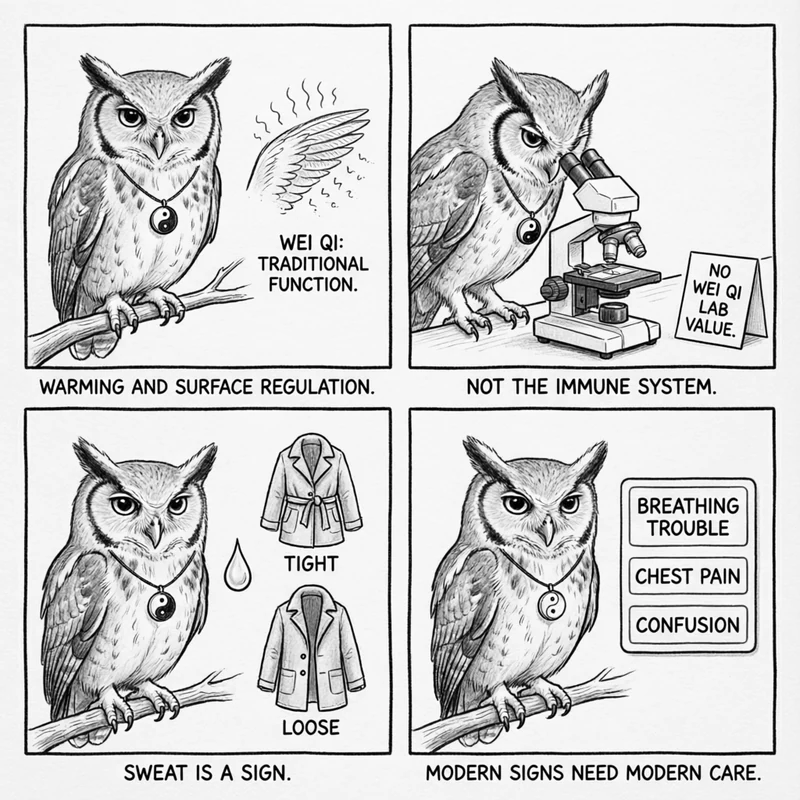
Taiyang and Wei Qi both concern the exterior, but they belong to different classical frameworks. Taiyang names a Six-Conformation pattern category; Wei Qi is a broader physiological concept describing warming, protection, and regulation of the surface.
Many later teaching models describe Wei Qi as arising from food essence transformed through the functions of the Spleen and Stomach, with the Lung helping disperse it toward the exterior. The Inner Classic treats Wei Qi across more than one passage; this summary follows a common later synthesis rather than a single fixed quotation.
Classical physicians used sweating and the state of the interstices—a functional term for the small openings at the body's surface, not a measured anatomical structure—as signs of how the exterior was being regulated. They often explained this regulation through Wei Qi and the relationship between Ying and Wei. Sweat itself was not considered Wei Qi.
Ollie's throat feathers puff slightly. “‘Protection’ is where the comparison ends,” he says. “Wei Qi organizes warmth, sweat, and reactions to a breeze. Immunology measures cells, antibodies, and other physical processes. Different tools, different jobs.”
Modern immunology concerns physical entities and biochemical processes, including neutrophils, T cells, B cells, immunoglobulins, cytokines, mucosal membranes, and lymph nodes. Traditional theory uses Wei Qi to describe a familiar cluster of surface changes: feeling warm or chilled, sweating, and sensing cold air against the skin. It explains those observations through warming and pore regulation, not by locating a measurable substance.
You can picture the difference by stepping into an air-conditioned room on a hot day. Your skin tightens, fine hairs rise, and you reach for a layer. A modern physiologist describes reflexes and blood-flow changes; a classical practitioner might organize the same moment through Wei Qi. No blood test returns a Wei Qi value.
The Huangdi Neijing frequently pairs Wei Qi with Ying Qi (nutritive Qi), while also discussing Wei Qi on its own. In this traditional model, Wei is relatively Yang, mobile and warming; Ying is relatively Yin and nourishing. Ying is said to circulate within the mai—a classical term for vessels, not a one-to-one synonym for modern blood vessels—while Wei circulates outside them to warm and regulate the exterior. This pairing helps explain why chills, sweating, and sensitivity to wind may change together.
Later commentators often used the relationship between Ying and Wei to explain differences in sweating and aversion to wind among Taiyang presentations. This was a way of relating visible surface changes within the traditional model. It did not make sweat decisive: the full pattern, not sweating alone, determined the distinction.
Why sweat appears in the old text
The Shang Han Lun gives sweating considerable weight because it is visible at the boundary between inside and outside. Early physicians did not have laboratory tests, but they could observe whether perspiration appeared, ask when it began, and compare what changed with it. In Taiyang patterns, the presence or absence of sweat helped separate presentations, but it was never a verdict by itself:
- Absence of sweat: In the canonical Ma Huang Tang-type Taiyang cold-damage presentation, later clauses make the absence of sweating an important differentiating sign. The exterior is traditionally described as constrained, with the interstices failing to open normally. The person may feel markedly chilled, tight, and achy.
- Spontaneous sweat: In the opening wind-strike presentation, spontaneous sweating contrasts with that absence. Later commentators commonly explained it, along with aversion to wind, as a failure of harmony between Ying and Wei: the exterior was not regulating the interstices and securing normal sweating. This is a functional pattern in classical theory, not a claim about anatomically open pores.
Picture two people in the same chilly room: one is dry, tight, and miserable; the other is clammy, loose-skinned, and still shivering. Classical doctors saw that difference as meaningful—not merely a difference in intensity, but a difference in the pattern before them.
Ollie ruffles his feathers and blinks slowly. “Sweat is something you can see and ask about,” he says. “Then you compare what else changes with it.”
In some Taiyang treatment passages, a gentle sweat is regarded as a favorable response only when it is followed by relief of aversion to cold, pain, and other relevant signs. This response is pattern- and treatment-specific; sweating alone does not prove that the condition has resolved. Classical authors warned that excessive sweating could damage bodily fluids and exhaust Yang Qi.
Classical formula names also circulate online. Guizhi Tang and Ma Huang Tang belong to specific, differentiated presentations, not generic cold remedies. Ma Huang Tang contains ephedra, which carries serious cardiovascular and legal risks. Neither is a self-care option. As discussed in what Chinese medicine means by escorting out an illness, these historical strategies belong within qualified clinical assessment, not a one-size-fits-all regimen.
Where Taiyang ends
Classical surface models have firm limits. A framework developed before the discovery of microbes and cellular pathology cannot replace modern clinical evaluation. Taiyang is not another name for the common cold, influenza, COVID-19, or any specific viral or bacterial infection. A person with cold-like symptoms may match a Taiyang presentation, another Chinese medicine pattern, or a condition requiring immediate medical care.
The boundary between the classical map and modern care becomes clearest at a few familiar public-health red flags:
- Difficulty breathing, shortness of breath, or persistent chest pain or pressure.
- New confusion, severe dizziness, fainting, or difficulty waking up.
- Signs of severe dehydration, such as inability to keep fluids down, dark urine, or extreme dry mouth.
- A fever that is worsening, fails to settle with standard care, or lasts more than a few days.
- Rapid physical deterioration or symptoms that suddenly worsen after initial improvement.
Public-health guidance generally recommends earlier evaluation for infants and young children, pregnant people, older adults, and anyone who is immunocompromised or has a chronic health condition. For these higher-risk groups, waiting to see whether a supposed Taiyang pattern resolves on its own may be dangerous.
How to use the surface map safely
When someone says that “wind-cold has entered Taiyang,” read the phrase as traditional clinical shorthand, not as literal anatomy. It may refer to a cluster of observations such as sudden chills, neck stiffness, aversion to wind, and a floating pulse. In Chinese medicine, wind and cold may describe traditional external pathogenic influences as well as qualities within a diagnosed pattern; they are not microbes or physical objects traveling through a channel.
The safe use of this map is to ask clearer questions, not to reach a diagnosis. What appeared first? Is sweating present or absent? Are the symptoms improving, persisting, or worsening? These observations can help someone describe what is happening without deciding the cause or choosing a treatment.
General comfort guidance commonly includes resting, wearing a comfortable layer, and avoiding cold drafts. It does not include forcing sweating, self-prescribing herbal formulas, or delaying medical care. Severe, persistent, or worsening symptoms—and any of the warning signs above—call for medical evaluation. The classical map may sharpen the description, but modern care determines when escalation is needed.
Questions the map leaves open
Does Taiyang being listed first mean it must come first?
Not necessarily. Taiyang comes first in the received text, but the Six Conformations are pattern families, not chapters in a fixed disease clock. A presentation can begin elsewhere, several patterns can combine, and one pattern may change before another appears. The ordering helps readers navigate the classical text; it does not establish a required first stage or predict what must happen next in the body. That is why the text's sequence should not be read as a modern prognosis, even though Taiyang occupies the opening position.
Are the interstices supposed to be literal pores?
No. “Interstices” is a classical functional term for the small openings at the body's surface, not a structure shown to be operated by Wei Qi. “Regulating” them describes how the exterior was understood to open, close, warm, and retain moisture. Classical physicians worked from visible signs such as sweating or its absence, chill, tightness, and sensitivity to wind. Modern physiology instead describes skin blood flow, sweating, and neural reflexes. The vocabularies may organize the same moment, but they are not synonyms, and the classical term should not be mistaken for a measured anatomical mechanism.
Can one symptom separate Taiyang from Shaoyang or Yangming?
No. In the classical text, Taiyang is oriented toward the exterior, with opening signs that can include aversion to cold or wind, neck or body aching, and a floating pulse. Shaoyang discussions may involve alternating chills and fever, bitter taste, or rib-side fullness; Yangming passages may emphasize pronounced fever, thirst, and sweating. Persistent cold limbs and fatigue without an acute onset may be considered through a deficiency pattern instead. These are textual contrasts, not instructions for sorting yourself into a category. Practitioners compare the whole presentation because no single sign, including sweat or chills, assigns a pattern.
Sources
- Zhang Zhongjing. Shang Han Lun (Discussion of Cold Damage). Translated by Craig Mitchell, Feng Ye, and Nigel Wiseman. Paradigm Publications, 1999.
- Unschuld, Paul U., trans. Huang Di Nei Jing Ling Shu: The Ancient Classic on Needle Therapy. University of California Press, 2016. Chapters 18 and 76.
- Unschuld, Paul U., and Hermann Tessenow, trans. Huang Di Nei Jing Su Wen: An Annotated Translation of Huang Di's Inner Classic—Basic Questions. 2 vols. University of California Press, 2011. Chapter 43.
- Hanson, Marta. Speaking of Epidemics in Chinese Medicine: Disease and the Geographic Imagination in Late Imperial China. Routledge, 2011.
- Hsu, Elisabeth. The Transmission of Chinese Medicine. Cambridge University Press, 1999.
- Scheid, Volker. Chinese Medicine in Contemporary China: Plurality and Synthesis. Duke University Press, 2002.
- National Health Service (NHS). “Common cold.” https://www.nhs.uk/conditions/common-cold/.
- Centers for Disease Control and Prevention (CDC). “Signs and Symptoms of Flu.” https://www.cdc.gov/flu/signs-symptoms/index.html.