The Six Channels Are Not a Disease Timeline
How to read the six channels of the Shang Han Lun without turning a traditional pattern map into a modern diagnosis, forecast, or cancer warning.
 Ollie's Take
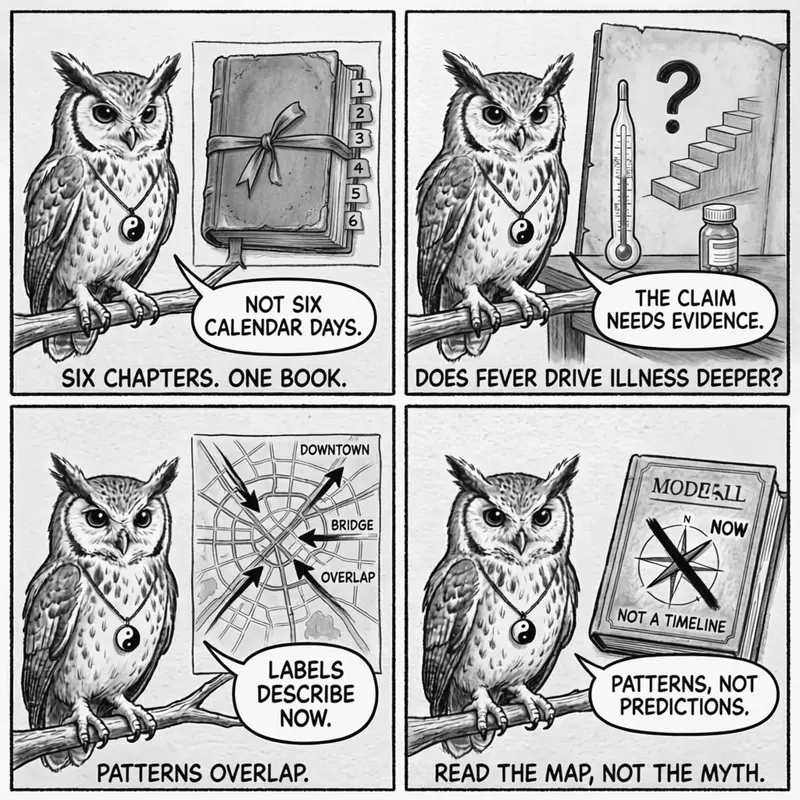
Take medicine for a fever, an online warning sometimes says, and you may drive a cold deeper into the body, stage by stage, until it becomes a chronic disease or cancer. The warning borrows the authority of the Shang Han Lun (Discussion of Cold Damage), a medical text traditionally associated with Zhang Zhongjing in the late second or early third century CE. But its six channels (liu jing) are not a universal disease timeline.
The story has obvious emotional force. It supplies a simple cause for a frightening outcome and a rule that seems to promise control. It is also a misreading of both the historical text and modern biomedical evidence.
The work did not survive as an untouched authorial manuscript. According to the traditional transmission account, the physician Wang Shuhe collected and arranged material attributed to Zhang Zhongjing. Song-dynasty editors later standardized and published the received text. What we read today is therefore the result of successive editorial hands, not a finished manuscript from a single author.
“The chapter order is not the body’s order,” Ollie says.
What Are the Six Channels?
The Chinese term liu jing has been translated into English as six channels, six meridians, or six conformations. In modern speech, “channel” may suggest a fixed anatomical tube, like a blood vessel, or a route on a map. In six-channel diagnosis, the term does not denote six literal tubes. It groups recurring constellations of signs according to factors such as exterior or interior location, cold or heat, strength or weakness, and the body’s response. Medical lineages differ on how these patterns relate to the channels and organ systems.
Ollie, our resident screech owl, perches on the desk lamp and taps his beak beside three different English translations of liu jing. His ear tufts lift. Three translations for one term? Then we should not assume “channel” means a tube you could find in an anatomy book.
In outlining the six channel categories, the text organizes dynamic pattern families. These categories describe recurring patterns of signs, including where a disorder appears to be located, whether cold or heat predominates, and how Qi (pronounced “chee”) and functional activity are responding:
- Taiyang (Greater Yang): Exterior-oriented patterns commonly marked by aversion to cold, neck stiffness, headache, and a floating pulse. Taiyang may appear early, coexist with another pattern, or be absent. It is not a required first stage.
- Yangming (Yang Brightness): Interior heat or fullness patterns. Classical symptoms include high fever, severe thirst, heavy sweating, or abdominal distension.
- Shaoyang (Lesser Yang): Half-exterior, half-interior patterns. Classical signs include alternating chills and fever, a bitter taste in the mouth, a dry throat, or discomfort and fullness along the side of the ribs.
- Taiyin (Greater Yin): Interior cold patterns rooted in digestive weakness. Classical descriptions include abdominal fullness, cold sensations, loss of appetite, and loose stools.
- Shaoyin (Lesser Yin): Patterns centered on diminished systemic resilience, classically associated with a weak pulse and a desire to sleep. Cold or heat transformations may appear. These are traditional distinctions, not a substitute for modern assessment of severe lethargy or collapse.
- Jueyin (Reverting Yin): Complex presentations with seemingly contradictory signs, often involving both cold and heat. Classical descriptions include heat or discomfort rising toward the chest alongside cold extremities. This is a traditional pattern label, not modern proof of organ failure.
Later commentary makes another distinction that matters here. A Yangming channel pattern centers on fever, sweating, and thirst. A Yangming bowel (fu) pattern involves heat binding with stool. Constipation may appear in the second, but it is not required in every Yangming presentation. Treating that one symptom as proof of deep progression confuses a pattern distinction with a biological timeline.
Pattern Families, Not Calendar Days
A common misconception is that a sick person starts in Taiyang on Monday, moves to Shaoyang by Wednesday, enters Taiyin by Friday, and reaches Jueyin the following week. The received text and later clinical literature do not support such a mechanical reading.
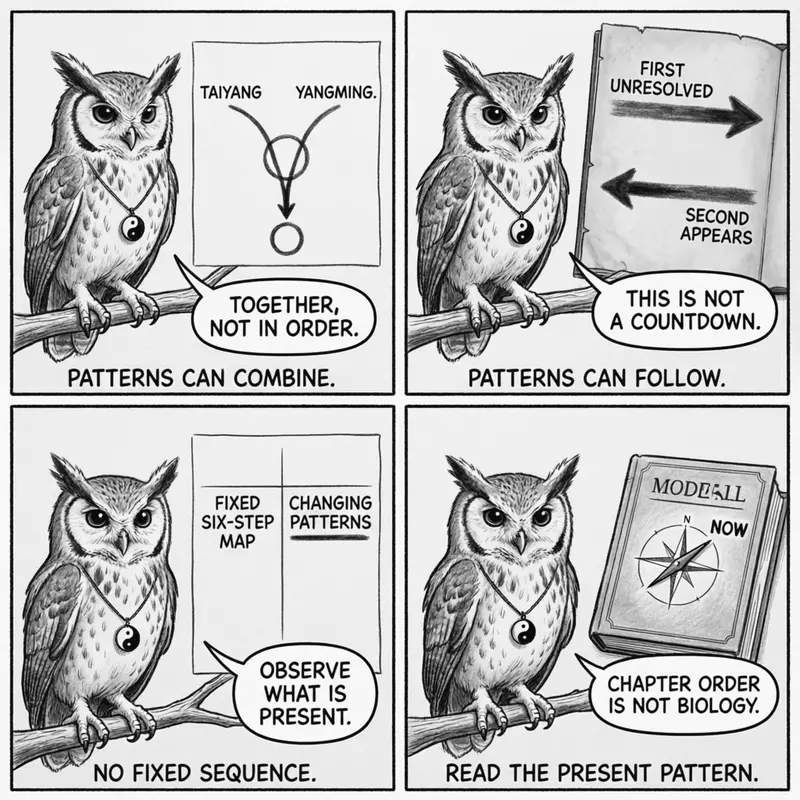
The text describes combination disease (he bing), in which channel patterns occur together, and concurrent disease (bing bing), in which another channel pattern develops before the first has fully resolved. Someone might show a Taiyang exterior headache alongside a Yangming interior fever on the first day of feeling unwell. In later six-channel interpretation, a person may instead present initially with signs classified as Taiyin or Shaoyin rather than display a progression through each Yang channel.
Ollie hops from the desk lamp onto a pile of medical glossaries and taps a claw against the chapter headings. So the chapter order may help organize the material, but it does not prove that every illness must follow that same sequence? He blinks at the page. That distinction changes how you read the book.
Consider a traffic-monitoring system in a large city. A control room uses labels such as “downtown congestion,” “highway slowdown,” or “bridge bottleneck.” Each describes where traffic problems are concentrated at that moment, based on incoming sensor data. A highway slowdown might clear, shift toward downtown, or coincide with a bottleneck on the bridge. The labels do not mean that every car entering the highway must drive to the bridge and break down.
The analogy has limits. A city’s roads are static concrete structures with fixed geographic boundaries. The human body is an interconnected biological system in which metabolic, immune, and inflammatory processes overlap continuously. Traditional patterns shift because living organisms respond fluidly to infection, rest, nutrition, and environment.
Pattern Maps vs. Modern Prognostics
Reading traditional medical texts responsibly requires us to distinguish three layers of knowledge: what the classical tradition says in its own vocabulary, what medical historians can establish about the text’s transmission, and what modern biomedical and clinical evidence can assess about human disease.
The six channels form a historical framework for pattern identification. The text also discusses transmission, transformation, combined patterns, treatment principles, and favorable or unfavorable developments. The framework therefore addressed several practical questions: What pattern is present now? What principle of care fits that pattern? What changes might signal resolution, combination, or transformation?
What it cannot do is function as a modern prognostic system. It cannot identify microscopic pathogens, sequence viral genomes, detect cellular mutations, measure inflammatory cytokines, or screen for malignancy. A historical category such as Shaoyin or Jueyin describes a broad pattern of bodily exhaustion or thermal imbalance. It is not a modern diagnosis of septic shock, end-stage renal disease, or localized tumor growth.
Using an ancient pattern map as a substitute for modern diagnostics turns a flexible historical tool into a rigid and dangerous prediction machine.
Why the “Cold to Cancer” Myth Persists
If the historical texts do not support a six-step pipeline from a common cold to severe chronic disease, why does this narrative remain popular in modern wellness circles?
Illness is unpredictable, and frightening diagnoses demand explanations. Faced with something like cancer or an autoimmune condition, most people reach instinctively for a single cause, something they did or did not do that set it in motion. A story that says, “You suppressed a fever with over-the-counter medicine five years ago, which pushed the cold into your sixth channel and caused your current illness,” supplies a complete narrative arc. It turns a complex, multifactorial biological process into a single cause-and-effect mistake.
That narrative order gives frightened readers an illusion of control. It suggests that following a neat set of rules and avoiding symptom suppression can guarantee protection against serious disease. But the story outruns both the classical sources and modern scientific evidence.
Ollie tilts his head, ear tufts flattened, and shifts his weight from foot to foot on the lamp’s edge. A neat story is easier to hold onto than uncertainty. That does not make it true.
The specific claim also depends on a hidden leap. A fever is one part of the body’s immune response, but lowering it does not send an infection into another channel or prevent the immune system from recognizing a pathogen. Nor does the timing of a fever establish a later cancer risk. The six labels describe patterns at a moment of assessment; they do not supply a mechanism by which one symptom causes a distant disease years later.
The received Shang Han Lun does not teach that reducing a fever drives an acute infection through six fixed stages into cancer, and modern oncology provides no evidence for such a mechanism. Cancer develops through complex interactions among genetic changes, environmental exposures, cellular damage, immune evasion, and other biological processes. There is no evidence that taking medicine to relieve fever or other symptoms of a respiratory infection causes cancer.
Where the Historical Map Ends
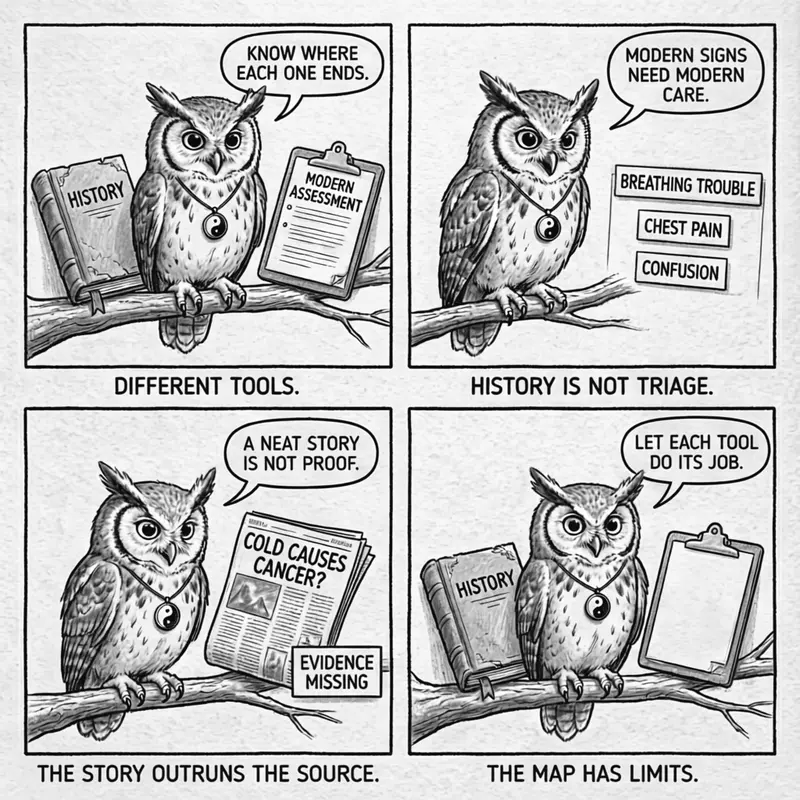
Traditional pattern models were created centuries before modern emergency medicine, antibiotics, fluid resuscitation, and advanced diagnostics. The history lesson stops where modern clinical assessment begins. This article is cultural and historical education, not a triage guide or a source of medical decision-making.
General health information identifies warning signs such as the following. These examples belong to modern clinical assessment, not to the six-channel vocabulary:
- High fever that will not settle or is accompanied by confusion, severe lethargy, or a stiff neck
- Shortness of breath, rapid breathing, or difficulty breathing
- Chest pain, pressure, or a sudden rapid heartbeat
- Fainting, dizziness, or inability to stay awake
- Signs of severe dehydration or persistent vomiting that prevents fluid intake
- Blood in the stool, dark tarry stools, or blood in vomit
- Sudden physical weakness, numbness, or loss of motor control
- Rapidly worsening illness in infants, older adults, or immunocompromised people
The six channels do not determine whether any of these developments is dangerous, and they cannot replace independent medical assessment for infections, heart disease, or cancer. Traditional pattern vocabulary is one way to read historical medical texts. It is not a tool for emergency triage or modern medical decision-making.
Reading History with Clarity
Once modern internet myths and rigid interpretations are cleared away, the Shang Han Lun becomes more interesting. The received text preserves an influential early tradition of clinical observation and pattern-based care, although that tradition reaches us through compilation, transmission, and later editorial work.
The six channels were not intended as a terrifying, inescapable pipeline to chronic illness. They were open, overlapping pattern families used to track changing relationships among exterior and interior, cold and heat, deficiency and excess, and the body’s functional responses. Respecting that history means allowing the text to be what it is: a landmark in the history of medicine, not a modern crystal ball.
When you encounter a six-channel claim, check three things: Does it describe the signs present now or predict an inevitable future? Does it acknowledge combined and changing patterns? Does it discount appropriate medical assessment? A claim that fails those checks is using the framework as a fear-based forecast rather than a pattern map.
FAQ
What are the six channels in Chinese medicine?
The six channels (liu jing) are pattern families described in the classical text Shang Han Lun to group symptoms of illness. Rather than literal anatomical tubes or rigid disease stages, they are clinical categories: Taiyang, Yangming, Shaoyang, Taiyin, Shaoyin, and Jueyin. The labels describe how the body expresses interior or exterior heat, cold, fullness, or exhaustion at a particular time. Historically, they helped practitioners analyze bodily patterns, but they are not modern anatomical routes or diagnostic tests for specific bacterial or viral infections. They also appear in later debates over how those patterns should be interpreted and used in practice.
Does every cold move through all six channels?
No. The received Shang Han Lun includes combined disease (he bing), concurrent disease (bing bing), and patterns that transform or appear without passing through every preceding category. A mild cold or viral infection does not automatically pass through every category from Taiyang to Jueyin. Symptoms may remain in one category, resolve completely, move directly to an interior pattern, or show signs of several channels at once. The six-channel model is a flexible observational map, not a calendar or an inevitable progression that every sick person must experience. A pattern label can also change as new clinical signs appear over time.
Can the six channels predict cancer or another modern disease?
No. The six channels cannot predict, diagnose, or trace the development of cancer, autoimmune disorders, or modern organ failure. Claims that suppressing a cold pushes illness deeper through six stages and causes chronic disease are modern internet myths. They lack support in both classical Chinese medical literature and modern scientific research. Complex modern diseases develop through cellular, genetic, and environmental factors that cannot be forecast or explained by classical six-channel pattern categories. The categories can help readers understand a historical vocabulary, but they cannot assess a symptom that requires clinical evaluation today. The key error is treating a chapter sequence in an edited book as a biological law that every body must follow.
Sources
- Zhang Zhongjing. Shang Han Lun: On Cold Damage. Translated by Craig Mitchell, Feng Ye, and Nigel Wiseman. Paradigm Publications, 1999.
- Marta Hanson. Speaking of Epidemics in Chinese Medicine: Disease and the Geographic Imagination in Late Imperial China. Routledge, 2011.
- Elisabeth Hsu. The Transmission of Chinese Medicine. Cambridge University Press, 1999.
- Volker Scheid. Chinese Medicine in Contemporary China: Plurality and Synthesis. Duke University Press, 2002.
- National Cancer Institute. “Risk Factors for Cancer.”
- MedlinePlus. “Fever.” U.S. National Library of Medicine.